
Al Rouf LED

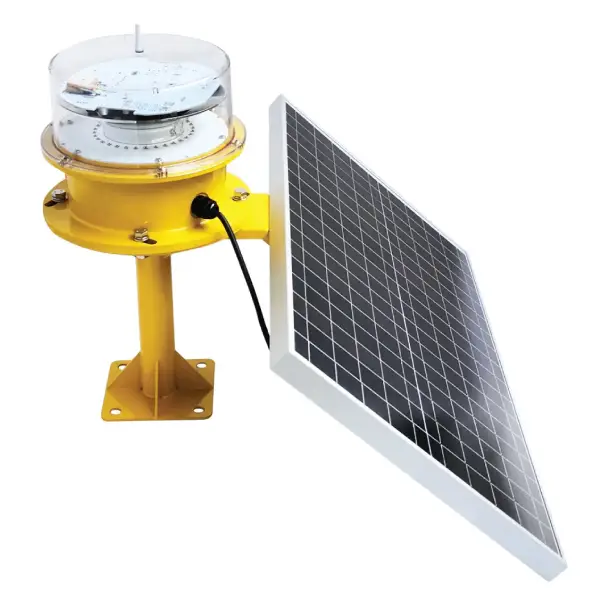
ART-MBS-02 SINGLE Medium-Intensity Type B Solar Aviation Obstruction Light


Warning Sign
Click the relevant product code in the table above to access the Flood Light (IES file) files and the installation instructions for your luminaire.

What Is ART-MBS-02 SINGLE?

ART-MBS-02 SINGLE  is a medium-intensity Type B solar aviation obstruction light designed to mark elevated obstacles and structures that require clear flashing warning signals in accordance with international aviation regulations.
The system combines a high-power SMT LED light source with a four-panel solar power system and a robust cast aviation aluminum housing, enabling stable long-term outdoor operation without external power supply.

Product Overview

ART-MBS-02 SINGLE provides reliable flashing aviation warning signals for elevated obstacles in infrastructure and industrial projects.
It operates independently on solar power and integrates an advanced optical system, high-efficiency LED source, and integrated protection mechanisms to ensure stable performance under harsh environmental conditions.

Why Is ART-MBS-02 SINGLE Used?

  • Enhances aviation safety by clearly marking elevated obstacles with medium-intensity flashing warning lighting.
  • Fully compliant with Type B aviation obstruction lighting requirements.
  • Independent solar-powered operation without the need for external electrical infrastructure.
  • Designed for stable performance in harsh outdoor and industrial environments.
  • Suitable for long-term installation in high-altitude and remote locations.

Key Technical Features

  • High-strength cast aviation aluminum housing for durability and environmental resistance.
  • High-power SMT LED light source delivering high brightness and long service life.
  • Effective night luminous intensity of 2000 cd.
  • Advanced reflective optical system for precise and uniform light distribution.
  • Flashing operating mode at 20–60 flashes per minute.
  • Four-panel solar power system rated at 4 × 14 W with high charging efficiency.
  • High-efficiency monocrystalline silicon solar cells with a service life exceeding 20 years.
  • Independent battery charge and discharge management module for improved stability and reduced maintenance.
  • Integrated surge and over-voltage protection system rated at 3KA.
  • Resistant to impact, rain, snow, strong wind, sunlight, and severe weather conditions.
  • Optional customization features including:
    • GPS / Beidou wireless synchronization
    • LORA wireless synchronization up to 10 km
    • Remote control and telemetry

When Should This Product Be Used?

  • When medium-intensity Type B aviation obstruction lighting is required.
  • For marking elevated obstacles and structures near flight paths.
  • When solar-powered autonomous operation with long-term stability is preferred.
  • In outdoor or industrial environments exposed to harsh weather conditions.
Check out the instructions in which we explain what can be read from these graphs.
Manual

Applications

  • Airports
  • Towers and elevated structures
  • Communication towers
  • High-rise buildings
  • Bridges
  • Industrial chimneys
  • High-pole lighting structures

Technical Specifications

Specification Details
Light Type Medium-intensity aviation obstruction light – Type B
Operating Mode Flashing (20–60 times/min)
Effective Night Intensity 2000 cd
Light Color Red
Light Source LED
Solar Power System 4 solar panels × 14 W
Average Power Consumption ≤ 2.5 W
Battery System Integrated battery management system
Protection Rating IP65
Horizontal Coverage 360°
Vertical Divergence 3°
Operating Temperature -40°C to +55°C
Wind Resistance Up to 240 km/h
Operating Altitude ≥ 2500 m
Approximate Weight ≈ 20 kg
Photocell Stage 50 / 100 Lux

Standards & Aviation Compliance

  • ICAO Annex 14 – Volume I (8th Edition)
  • GACA MH/T 6012-2015 and AC-137-CA-2017
  • FAA Advisory Circular 150/5345-43J

Frequently Asked Questions

When is medium-intensity Type B the appropriate choice?
Medium-intensity Type B lighting is used for elevated obstacles and structures that require specific luminous intensity and flashing patterns according to aviation regulations and site design.

What is the benefit of the four-panel solar system design?
It provides higher charging efficiency and improved operational stability in environments with variable solar irradiance.

Does low power consumption affect light intensity?
No. High-power SMT LEDs combined with an advanced optical system achieve the required luminous intensity while maintaining low power consumption.

Can multiple units operate synchronously?
Yes. Wireless synchronization via GPS / Beidou or LORA allows synchronized operation across large-scale installations.

For technical specifications, datasheets, or quotation requests, please contact Alrouf Lighting’s technical team.


crossmenu linkedin facebook pinterest youtube rss twitter instagram facebook-blank rss-blank linkedin-blank pinterest youtube twitter instagram