
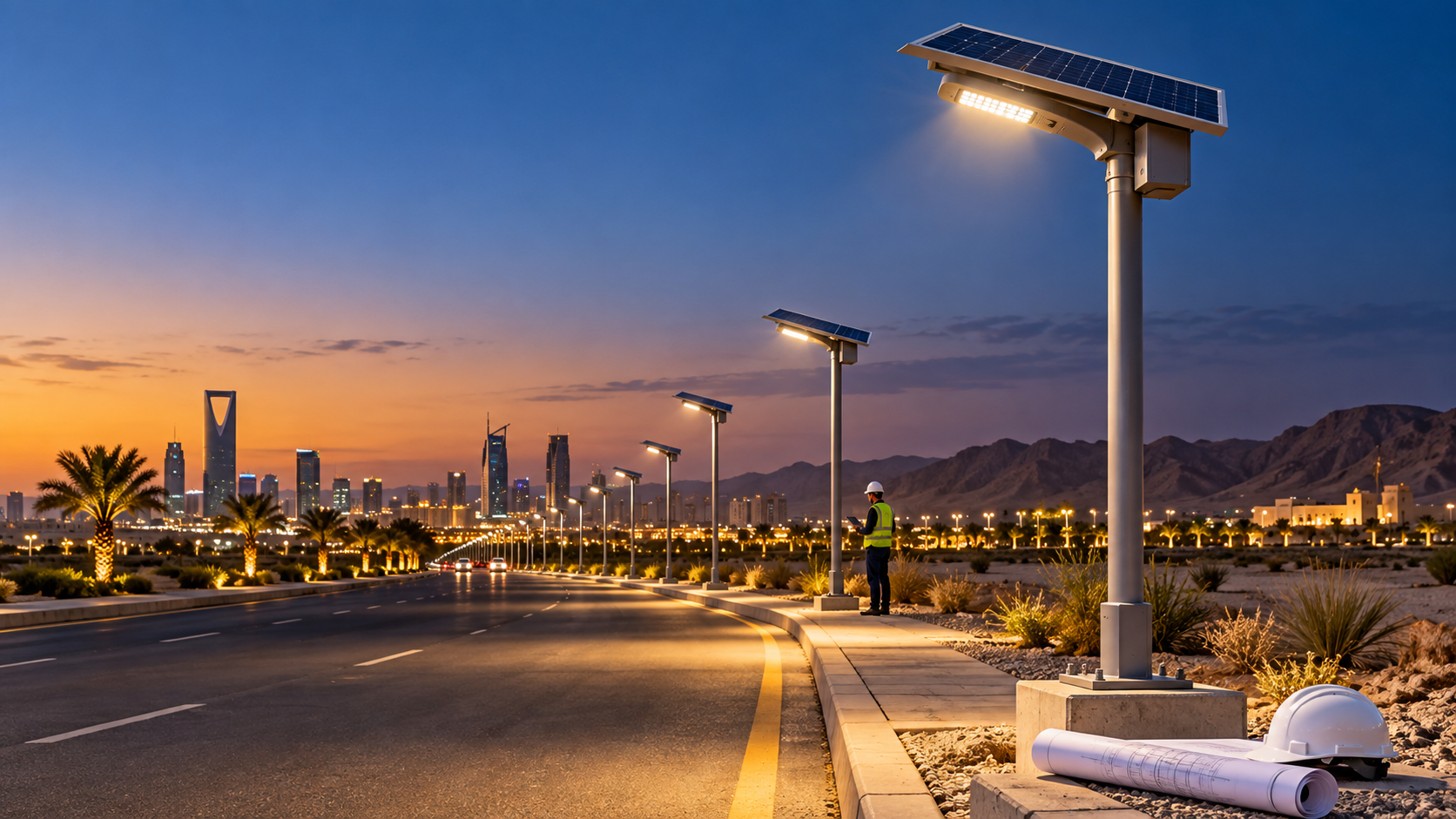
The price of a solar street light in Saudi Arabia depends on the complete system and the installation site, not its wattage alone. The LED output, solar panel, battery, lighting controls and outdoor protection all affect the product specification. Poles, foundations, installation and the number of lights affect the total project cost.
For that reason, a price for one luminaire should not be treated as the cost of illuminating an entire road or outdoor area. This guide explains what to include when comparing quotations and what information a supplier needs to recommend a suitable system.
An integrated solar street light brings its main lighting and energy components together in one unit. A typical off-grid system includes:
Products with the same stated wattage can have different panel sizes, battery capacities, light outputs, optics and control settings. Compare the complete specifications before comparing prices.
Alrouf offers integrated options including the Triton Series and QH Series. Triton covers 30W–150W, while QH covers 60W–250W. Their different model ranges give projects options for different lighting requirements.
The light must provide suitable illumination across the intended road, pathway or outdoor area. That choice affects the luminaire model, optical distribution, pole layout and potentially the number of units required.
Wattage is an electrical specification; it does not tell you on its own whether a road will be lit adequately. A lower-priced unit may require a different pole arrangement or fail to meet the required lighting result.
For selection guidance, read How to Choose a Solar Street Light for Roads in Saudi Arabia.
The panel must generate enough energy for the planned lighting schedule, and the battery must store enough to operate the light after sunset. Required nightly hours, brightness settings and operation during low-sunlight periods all influence sizing.
A quotation for a larger battery or solar panel may cost more upfront, but comparing that price with an undersized system would not be a fair comparison. Ask suppliers to state the panel rating, battery specification and assumed operating schedule for each proposal.
Timer settings, staged dimming and motion sensors can change how much energy the light uses overnight. The available modes depend on the controller and the configuration supplied.
When comparing quotations, request the actual lighting profile: how long the light operates, at what brightness, and what happens when movement is detected. This makes it easier to assess whether two offers meet the same requirement.
The luminaire price may exclude the pole, foundation, mounting work and installation. These costs depend on the site, ground conditions, pole design and access for equipment and workers.
For an off-grid installation, grid connection and electrical trenching may be unnecessary. The project still needs suitable poles and structural installation. Ask for an itemised quote so you can see which work is included.
The quantity of lights, delivery location and site conditions influence the total quotation. A road project with an established pole plan differs from a remote site that needs new foundations and difficult access.
Outdoor conditions also matter. Heat, dust, shading and seasonal sunlight should be considered when selecting the panel, battery and maintenance approach for a Saudi installation.
Compare what the quoted warranty covers and how the system can be serviced. Solar panels may need periodic cleaning, while batteries, mounting hardware, sensors and housings should be inspected according to site conditions.
A quotation should make clear whether installation, commissioning, maintenance or replacement parts are included. Product price alone will not show these longer-term responsibilities.
Use the same scope for every supplier quotation:
| Cost item | What to confirm |
|---|---|
| Solar street light units | Model, quantity, output, panel, battery, controller and warranty |
| Poles and mounting | Pole specification, brackets and required height |
| Foundations and installation | Civil work, assembly, access equipment and commissioning |
| Design | Lighting calculations and solar-energy assessment, if required |
| Delivery | Transport to the project location |
| Maintenance | Cleaning, inspections and any contracted service |
The installed project cost is the sum of the applicable items above. To compare alternatives over time, also consider expected maintenance, component replacement and any electricity or electrical-infrastructure costs associated with a grid-connected option.
A solar installation can avoid some grid-connection work, particularly where the electrical network is distant. Whether it costs less overall depends on the actual site and the alternatives being compared. The U.S. Department of Energy’s solar street and area lighting guidance likewise recommends evaluating technical and cost suitability for the specific installation.
A lower-wattage unit may have a lower product price, but it is not necessarily the lower-cost project solution. The road may need more poles or luminaires to achieve the required coverage, or the selected product may not meet the lighting specification.
Start with the area’s required illumination and layout. Then compare models that can meet those requirements, including their panel and battery configurations. A project-specific lighting calculation helps establish the appropriate quantity and arrangement.
The two series serve overlapping but different requirements:
Neither range has one price for every configuration. The battery, panel and other specifications vary by model. Read the Triton vs QH comparison to shortlist the relevant series before requesting a quotation.
A useful request for quotation includes:
If some details are unknown, send the information you have. A lighting assessment can help determine the model and quantity before the commercial quotation is finalised.
There is no reliable single price based on “100W” alone. The solar panel, battery, controls, protection, warranty and quotation scope must also be specified. Request a model-specific price and check whether the pole and installation are included.
A fully off-grid solar street light uses energy generated by its panel and stored in its battery, so it does not draw electricity from the grid during normal operation. It still has purchase, installation and maintenance costs. Confirm the configuration being quoted.
That depends on the supplier’s quotation. Ask for separate line items for the luminaire system, pole, foundation, mounting, delivery and installation.
Compare complete installed costs and ongoing responsibilities. Include any grid connection and cabling work required for the conventional option, as well as electricity, maintenance and expected component replacements for each option. Use the same project period and lighting requirements for both.
The most useful solar street light price is one tied to a system that can meet your project’s lighting and operating requirements. Share your site details so the luminaire, panel, battery, pole arrangement and installation scope can be evaluated together.
Contact Alrouf to request a project-specific solar street lighting quotation.
