
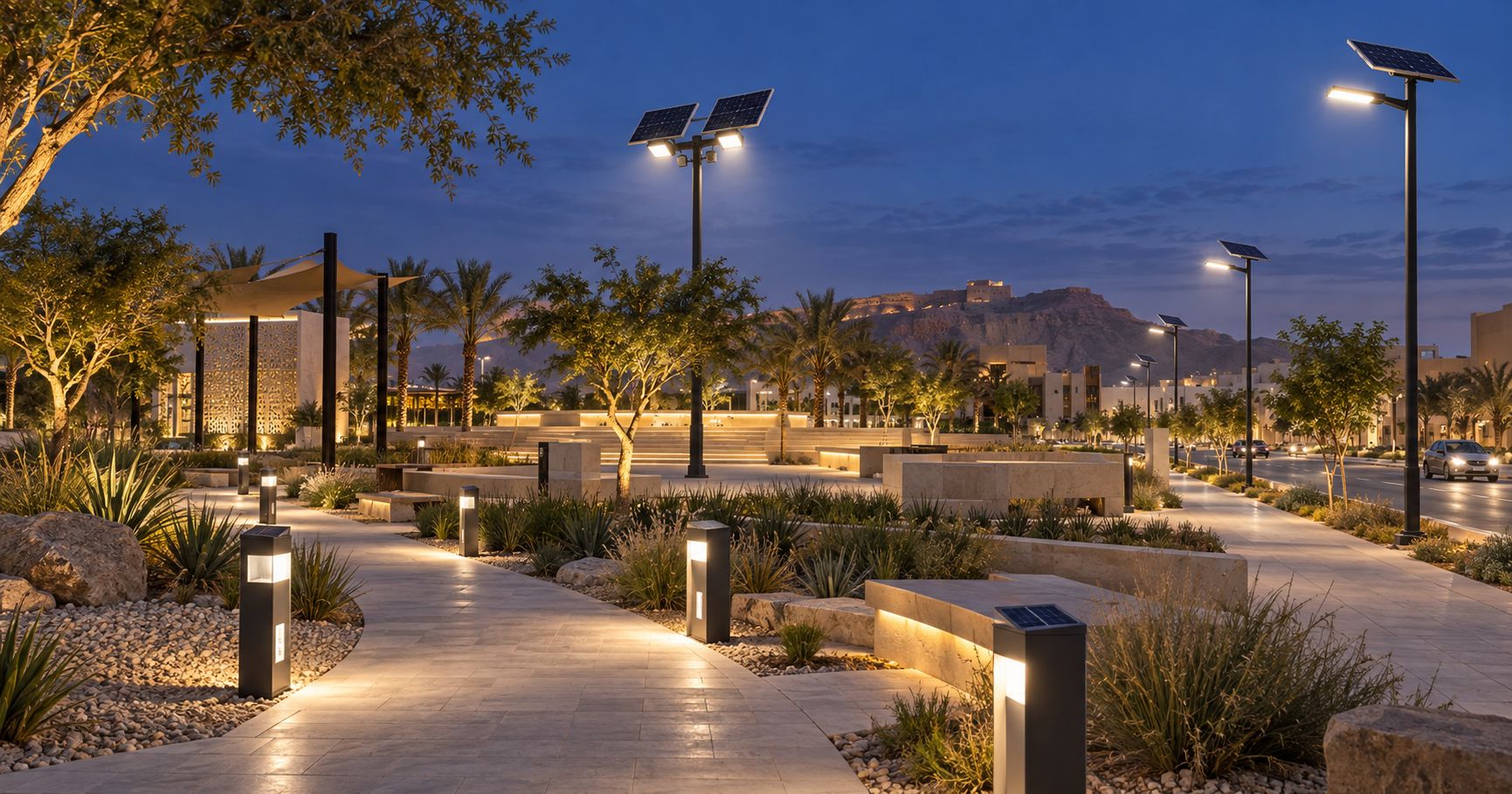
A road, pedestrian path, landscaped area, and open yard do not need the same type of light or layout. This guide helps project owners, consultants, and contractors identify the lighting approach for each outdoor area before selecting a product model.
Outdoor solar lighting can be considered for:
The first decision is what the light needs to illuminate. Road lighting must provide suitable coverage along a route. Pathway lighting helps people follow pedestrian routes. An open yard may need a wider distribution of light. These different purposes affect fixture selection, positioning, and the final lighting design.
The table below describes common lighting approaches. It is a site-planning guide, not a list of products confirmed as available from Alrouf.
| Outdoor area | Lighting approach to consider | What to check before selection |
|---|---|---|
| Roads and vehicle routes | Solar street lights | Road width, pole positions, spacing, required illumination, and optical distribution |
| Wider pedestrian routes | Solar street lights or suitable pathway lighting | Path width, surrounding activity, glare, and continuity of coverage |
| Landscaped paths and steps | Lower-level pathway lights or bollards | Walking direction, level changes, planting, and possible obstructions |
| Open yards and perimeters | Solar flood lighting | Area dimensions, mounting positions, aiming, glare, and spill light |
| Sites with difficult panel positioning | A configuration that allows suitable panel placement | Shade, panel orientation, available space, and maintenance access |
A large project may need more than one lighting approach. Final product availability and suitability should be confirmed against the project requirements.
Solar street lights can be considered for municipal streets, internal compound roads, industrial access routes, service roads, development entrances, and remote roads.
For these applications, the lighting layout should follow the route and account for intersections, pedestrian crossings, entrances, landscaping, and signs. Fixture wattage alone cannot confirm that a road will receive suitable illumination; pole height, spacing, light output, and optical distribution also matter.
The Alrouf Triton Series Integrated Solar Street Light is an off-grid product range with models from 30W to 150W for road and other outdoor lighting applications. Its self-contained design combines the LED luminaire, solar panel, battery, and controller.
For a closer look at the specifications needed for a roadway project, read How to Choose a Solar Street Light for Roads in Saudi Arabia.
A park usually has several activity zones: main paths, seating areas, entrances, play areas, open gathering spaces, and service routes. Using one fixture type across all these spaces may leave some areas poorly served.
Start by identifying how people move through the park after dark. Main circulation routes may call for a different lighting layout from seating areas or landscape edges. The design should also consider nearby homes, vegetation, signs, and future changes to the site.
For larger public projects, product selection is only one part of delivery. Alrouf’s public solar lighting project guide covers procurement, installation checks, commissioning, and handover.
Pathway lighting helps people identify the direction and boundaries of a walking route. Potential locations include park paths, residential compounds, hotel landscapes, courtyards, building approaches, and connections between facilities.
When planning these routes, check:
The lighting should support movement without obstructing the path or creating unnecessary glare. Product selection should follow the required lighting result and the available site conditions.
Industrial and remote sites may need lighting for access roads, pedestrian routes, entrances, storage areas, and perimeters. Solar lighting can be considered where electrical infrastructure is unavailable or would require extensive cabling and civil work.
Before selecting fixtures, map vehicle movements, pedestrian access, security boundaries, loading areas, existing shade, and future expansion. An access road and a wide storage yard may require different lighting approaches, even though they are part of the same facility.
The site team should also establish who will inspect the system and how the solar panel, battery, controller, and fixture can be accessed after installation.
New developments often open in phases. Access roads, entrances, pathways, and public spaces may become operational before electrical infrastructure is complete across the whole site.
Solar lighting can be considered for these areas, but the team should distinguish between temporary and permanent needs. A temporary installation may prioritize deployment and possible relocation. Permanent lighting must be coordinated with the final road, landscape, architectural, and maintenance plans.
Review future buildings and planting before approving fixture locations. A location with good sunlight today may be shaded when later construction phases are complete.
Mark roads, pathways, entrances, open spaces, landscapes, parking connections, and perimeters on the site plan. Record the purpose of each zone and who uses it after dark.
Identify the required operating hours, expected activity, mounting options, and the lighting result needed for each area. A professional lighting calculation should be used where the project requires defined illumination and uniformity.
Solar panels need suitable exposure to charge the battery. Assess shade from buildings, trees, walls, signs, equipment, and planned future structures. In dusty locations, include panel inspection and cleaning in the maintenance plan.
Check proposed positions against roads, pavements, underground services, landscaping, drainage, security equipment, and access routes. This can prevent conflicts during installation and reduce later relocation.
Solar lighting still requires inspection. The maintenance plan should cover panels, batteries, controllers, fixtures, mounting components, and nearby vegetation. Safe access to these components should be considered during the layout stage.
Once the application and layout are defined, assess the required light output, optics, mounting height, spacing, operating profile, and solar system configuration. Confirm the proposed product against the project specification before ordering.
Choosing by wattage alone. A wattage figure does not show how light will be distributed across a road or area.
Using one fixture type everywhere. Roads, walking routes, and open yards have different lighting requirements.
Ignoring future shade. Trees and later construction may reduce the sunlight available to a panel.
Treating solar lighting as maintenance-free. Panels and electrical components still need appropriate inspection and upkeep.
Making unsupported savings assumptions. Installation and operating costs depend on the site, equipment, civil work, operating schedule, and maintenance requirements. Cost claims should be based on the specific project.
A successful outdoor solar lighting plan starts with the site, not a model number. Define what each area needs, check its sunlight and layout, and then select a lighting system that meets the project requirements.
Explore Alrouf’s solar lighting product range. For road and access-route projects, review the Triton integrated solar street light.
Contact Alrouf with your project location, site plan or dimensions, areas to be lit, estimated number of lighting points, and required operating hours to discuss the suitable options.
They can be considered for roads, parks, pathways, compounds, industrial facilities, entrances, perimeters, and remote locations. Suitability depends on the site layout, sunlight exposure, and lighting requirements.
The answer depends on the path width, expected use, required lighting level, and surrounding features. Wider routes may need a different fixture and layout from narrow landscaped paths.
Yes, it can be considered for access roads, pedestrian routes, entrances, and other suitable areas. Each zone should be assessed according to its activity, dimensions, and maintenance requirements.
Yes. Solar panels, batteries, fixtures, controllers, poles, and mounting components need periodic inspection. The required frequency depends on the equipment and site conditions.
Check the area’s purpose, nighttime activity, sunlight and shade, road or pedestrian routes, mounting position, nearby obstructions, future construction, and maintenance access.
Start with road width, pole height and spacing, required illumination, optical distribution, operating hours, and local solar conditions. Then review the product specifications and complete the necessary lighting assessment. Our road solar street light selection guide explains these factors in more detail.

