
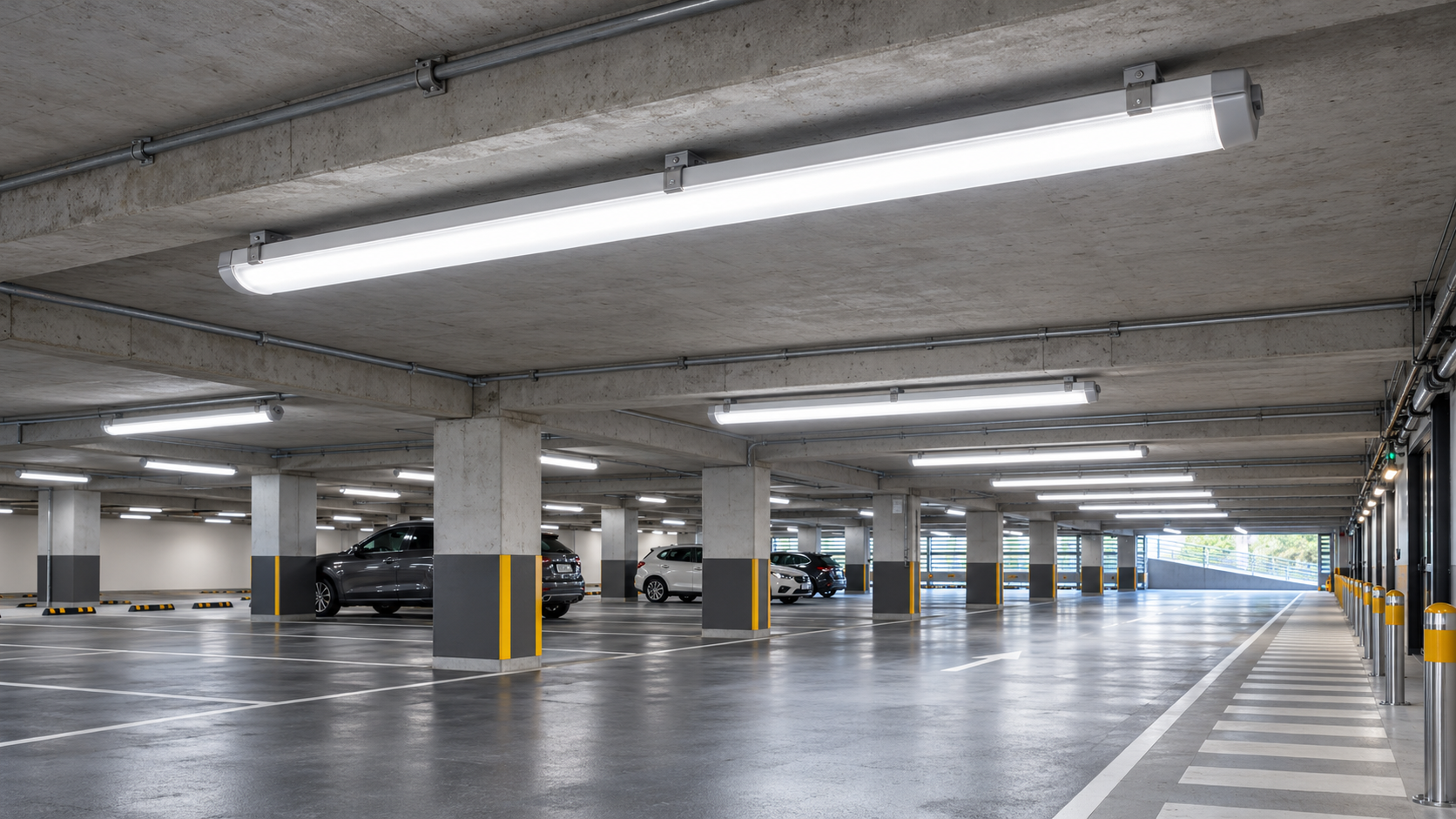
Choose tri-proof LED lighting by matching the exact fixture to the site’s dust and water exposure, cleaning methods, impact risks, lighting requirements and installation conditions. Then verify its optical performance, electrical compatibility and available controls.
Warehouses and parking facilities can both benefit from sealed linear lighting, but their requirements are not identical. A storage aisle needs suitable visibility around racks and goods, while a parking area needs lighting coordinated with vehicle routes, pedestrian movement and structural obstructions.
This guide explains what to check before selecting equipment for a project in Saudi Arabia.
Tri-proof LED lighting is a commercial description commonly used for luminaires designed to withstand several environmental challenges, such as dust, water exposure and mechanical impact.
The term does not establish one universal level of protection.
Check the selected product’s declared IP rating, impact rating where specified, materials and operating limits. Do not assume that every fixture described as tri-proof has identical performance.
Also, tri-proof lighting is not automatically explosion-protected. Where a site has a classified explosive atmosphere, equipment must be assessed separately against the hazardous-area requirements.
Start with the conditions at the proposed installation position.
A covered parking area may experience windblown dust, humidity or occasional water exposure. A warehouse may have dry storage areas alongside loading entrances or zones subject to cleaning.
Record:
Select equipment for these conditions rather than choosing the highest protection rating available without checking what the application needs.
An IP rating describes specified enclosure protection against ingress. An IK rating describes resistance to mechanical impact under defined test conditions.
These ratings address different properties.
Neither independently establishes chemical resistance, corrosion resistance, explosion protection or suitability for every cleaning procedure.
| Selection factor | What to confirm |
|---|---|
| Dust exposure | The required ingress protection and maintenance arrangements |
| Water exposure | Whether the rating covers the expected conditions |
| Cleaning | Permitted pressure, temperature, distance and cleaning agents |
| Mechanical exposure | Declared impact resistance and mounting suitability |
| Chemical exposure | Compatibility of housing, seals and hardware |
| Temperature | Operating limits for the complete fixture and control equipment |
A fixture intended for ordinary moisture exposure should not be assumed suitable for high-pressure cleaning.
Even where a high-pressure washdown rating is declared, follow the manufacturer’s cleaning instructions.
Warehouse lighting should support the work performed in each zone.
Storage, picking, packing, inspection and loading can require different assessments. Consider the surfaces where workers need to see goods, labels, equipment and movement.
Tall shelving can block light and create shadows.
Assess the rack faces and working positions as well as the floor. An arrangement that performs well in an empty warehouse may behave differently once it is fully stocked.
For a more detailed planning process, read our warehouse aisle lighting guide.
A linear tri-proof luminaire is not automatically the right option for every high-ceiling warehouse.
Compare candidate fixtures using their photometric data and calculated performance. Some zones may suit linear luminaires, while others may require a different distribution or luminaire type.
The Alfanar Warehouse project provides an example of Alrouf’s published tri-proof lighting supply work in a warehouse application. Its project configuration should not be treated as a universal design for other facilities.
In parking facilities, review how the proposed lighting serves vehicle lanes, parking bays, pedestrian routes and entrances.
Include structural elements such as:
Fixture positions should account for these obstructions rather than following a spacing pattern without checking the result.
Review glare from the normal viewing positions of drivers and pedestrians. A high-output fixture can still be unsuitable if its placement produces uncomfortable brightness or leaves important areas in shadow.
Emergency lighting and exit signage should be addressed as separate design requirements. A standard tri-proof fixture should not be assumed to provide an emergency function unless the supplied configuration explicitly supports it.
Wattage describes electrical power consumption. It does not establish whether a fixture delivers sufficient illumination to the required surfaces.
Compare:
Use the exact model’s IES or equivalent photometric file to evaluate the proposed layout.
A beam-angle description can help compare options, but it does not replace a lighting calculation.
There is no single distance between tri-proof lights that suits every warehouse or parking area.
Develop the arrangement around the selected fixture, mounting height, site geometry and lighting criteria. Check darker areas between fixtures and behind obstructions, not only the average result.
The Alrouf Linear Light Tri-Proof range includes different configurations.
The published catalogue lists IP65 for the specified T552 models, while the E-POWER T56 section lists IP69K and IK10. It also identifies dimming and sensor options within the range.
These specifications should be checked against the exact model being quoted. Do not combine the highest output, protection rating and control options from different configurations into one assumed specification.
Before ordering, request:
Controls can reduce unnecessary operating hours or adjust output where the application permits.
For parking and storage areas, assess whether occupancy detection, scheduled operation or dimming would support the intended use.
Confirm:
A sensor that performs well in an open room may behave differently in a stocked aisle or behind structural beams.
Test the proposed sequence under realistic conditions before accepting the installation.
A lower-wattage fixture is not always the lowest-energy solution if more units are needed to meet the lighting requirements.
Compare arrangements that deliver equivalent performance.
For constant-power operation:
Energy consumption (kWh) = Total fixture input power (W) ÷ 1,000 × Operating hours
For multiple identical fixtures, multiply by the fixture quantity.
If the system dims, use actual power consumption for each operating stage rather than assuming that a brightness percentage equals the same percentage of electrical power.
For broader considerations, read our guide to energy-efficient industrial lighting.
Check how the fixture will be mounted, wired, cleaned and serviced.
Review:
Do not assume that every linear model supports through-wiring or continuous linking. Verify any electrical limits and installation conditions.
For demanding industrial settings, the SWCC project page provides another published example of Alrouf’s tri-proof lighting work. Use the project as an application reference while assessing your own site independently.
| Item | Information to prepare |
|---|---|
| Application | Warehouse, parking area, corridor or production zone |
| Geometry | Dimensions, mounting positions and obstructions |
| Tasks | Storage, picking, vehicle movement or inspection |
| Lighting targets | Required maintained illumination, uniformity and glare criteria |
| Environment | Dust, water, temperature, corrosion and cleaning exposure |
| Equipment | Exact model, output, distribution and protection ratings |
| Controls | Dimming method, sensors and operating sequence |
| Installation | Mounting, cable entries and any linking arrangement |
| Maintenance | Cleaning access, service procedures and component availability |
It is a commercial description for luminaires designed to withstand several environmental challenges. Check the exact protection ratings and operating limits instead of relying on the term alone.
No. Suitability depends on the selected model’s declared rating and cleaning instructions. Confirm permitted washing conditions before specifying the fixture.
Yes, where its light distribution, output, mounting arrangement and environmental performance meet the warehouse’s requirements. Assess racks and task surfaces as part of the layout.
They can be suitable when selected for the actual environment and lighting design. Review water exposure, mounting clearance, structural obstructions, glare and control requirements.
No. Ingress protection and lighting performance describe different properties. Evaluate output and distribution separately.
Not automatically. A classified hazardous area requires equipment with the appropriate protection concept, marking and supporting documentation.
Do not assume so. Confirm the exact driver, sensor and control configuration with the supplier.
Establish the required lighting performance and mounting arrangement, then compare candidate fixtures using photometric calculations. Wattage alone is insufficient.
Prepare your site layout, mounting heights, operating hours, environmental conditions and lighting requirements before requesting a quotation.
Review the Alrouf Linear Light Tri-Proof range and confirm the configuration appropriate to your application.
For warehouse, parking or industrial projects in Saudi Arabia, contact Alrouf to request current product information and a project-specific quotation.
