Explosion-proof and intrinsically safe lighting are two approaches to protecting electrical equipment used in potentially explosive atmospheres. Although both terms are associated with hazardous-area safety, they describe different protection concepts.
Explosion-proof equipment uses an enclosure designed to contain an internal explosion and prevent flame propagation into the surrounding atmosphere. Intrinsically safe equipment limits electrical and thermal energy so that ignition cannot occur under the conditions covered by its protection level.
Neither approach is automatically suitable for every hazardous location. Equipment selection must follow the approved area classification, applicable standards and the exact product certification.
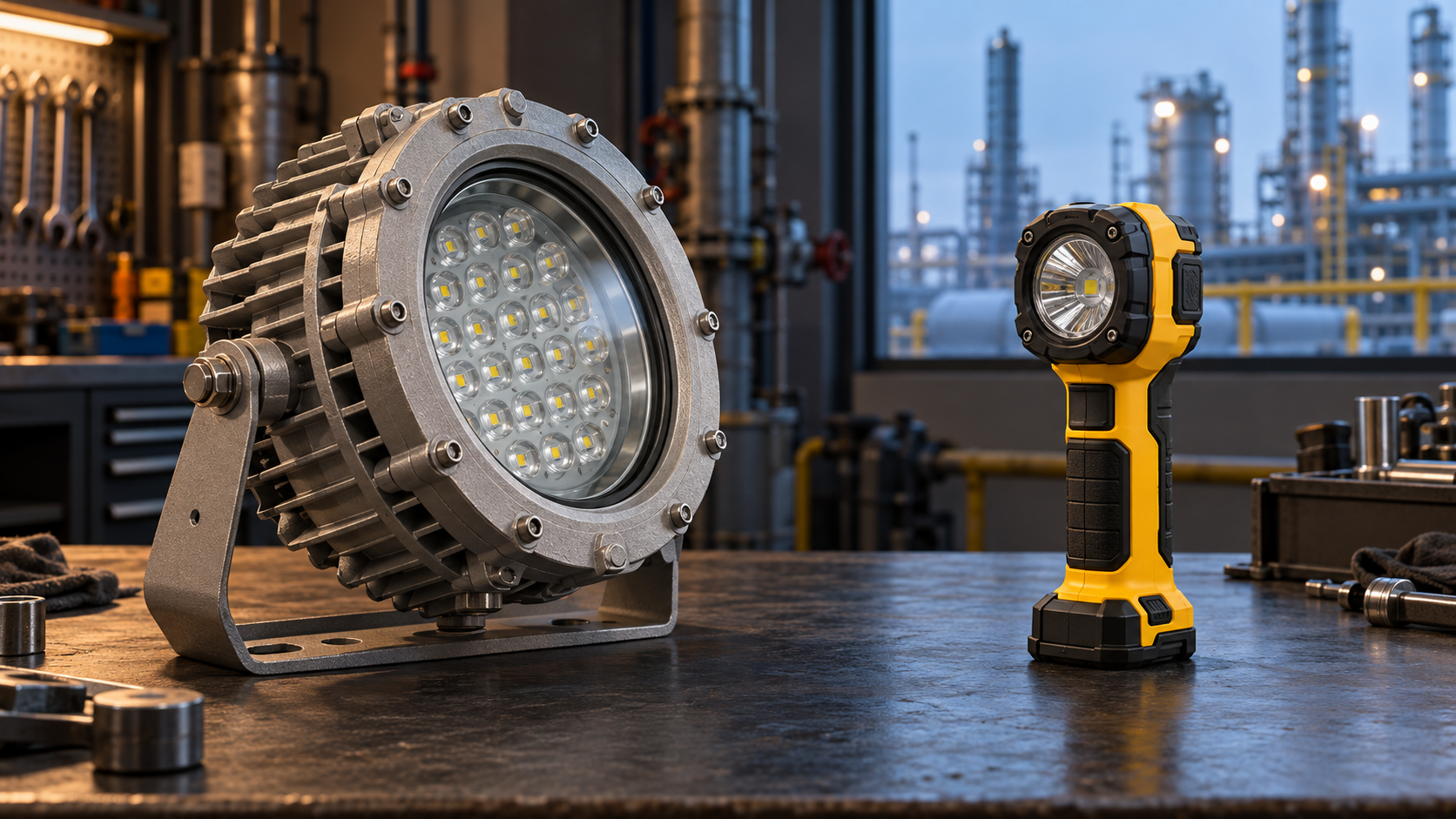
Explosion-proof lighting commonly refers to industrial luminaires designed for hazardous environments where flammable gases or vapours may be present.
In the strict flameproof-enclosure sense, protection type Ex d uses an enclosure capable of withstanding an internal explosion and preventing its transmission to the surrounding explosive atmosphere.
However, hazardous-area luminaires may use several protection techniques, including flameproof enclosures, increased safety, encapsulation and dust ignition protection.
The applicable protection techniques must be identified from the product's actual Ex marking.
Intrinsically safe lighting uses an energy-limitation approach to reduce ignition risk.
Under IEC 60079-11, intrinsic safety (Ex i) limits electrical and thermal energy within the equipment and associated circuits under specified operating and fault conditions.
This approach is commonly used for suitable low-power equipment, including certain portable lights and instrumentation.
An ordinary LED light is not intrinsically safe simply because it uses low-voltage LEDs. The complete equipment or system must meet the applicable requirements.
| Feature | Explosion-Proof / Flameproof (Ex d) | Intrinsically Safe (Ex i) |
|---|---|---|
| Protection principle | Contains an internal explosion and prevents flame transmission | Limits electrical and thermal energy capable of causing ignition |
| Typical construction | Flameproof enclosure and certified flamepaths | Energy-limited circuits and suitable components |
| Common applications | Industrial luminaires and other electrical equipment | Portable equipment, instruments and suitable low-power devices |
| Power considerations | Can accommodate higher-power equipment designs | Energy limits constrain circuit and equipment design |
| Installation requirements | Certified enclosure, cable entries and installation practices | Certified equipment and, where applicable, associated apparatus and circuit parameters |
| Hazardous-area suitability | Depends on Ex marking and protection level | Depends on Ex marking and protection level |
Selection should begin with the site's approved hazardous-area classification.
For gas atmospheres, Zones 0, 1 and 2 describe different probabilities and durations of explosive atmospheres. For combustible dust, the corresponding classifications are Zones 20, 21 and 22.
A suitable luminaire must have the required equipment protection level, gas or dust group, temperature classification and ambient temperature rating.
Do not select lighting based on the terms "explosion-proof" or "intrinsically safe" alone. Check the complete model-specific certification and installation instructions.
Before requesting a quotation for hazardous-area lighting, prepare the following information:
For industrial luminaires, explore Alrouf Hazardous Area Lights and review the relevant product configurations.
Alrouf's product range includes the A-Series Explosion Proof Flood Light and H-Series Explosion Proof Linear Light.
These are examples of products to evaluate, not evidence that a specific model is suitable for every hazardous zone.
No. Flameproof protection contains an internal explosion and prevents its transmission to the surrounding atmosphere, while intrinsic safety limits the energy available to cause ignition. Both require suitable equipment design and certification.
Some intrinsically safe lighting equipment can be suitable for Zone 1, provided its certified protection level and other markings meet the installation requirements. Suitability cannot be assumed from the product description alone.
No. LED technology alone does not establish hazardous-area suitability. The complete luminaire must use appropriate explosion-protection techniques and have supporting documentation for the intended installation.
Neither is universally better. The correct choice depends on lighting performance, electrical power requirements, hazardous-area classification and available certified equipment.
Request the exact model datasheet, applicable certification, Ex marking, installation instructions, electrical specifications and photometric information where needed. Confirm that the documents cover the proposed configuration.
Planning an industrial lighting installation in Saudi Arabia?
Contact Alrouf Lighting Technology with your hazardous-area classification, project specifications and lighting requirements to discuss suitable product configurations and request supporting technical documentation.
