
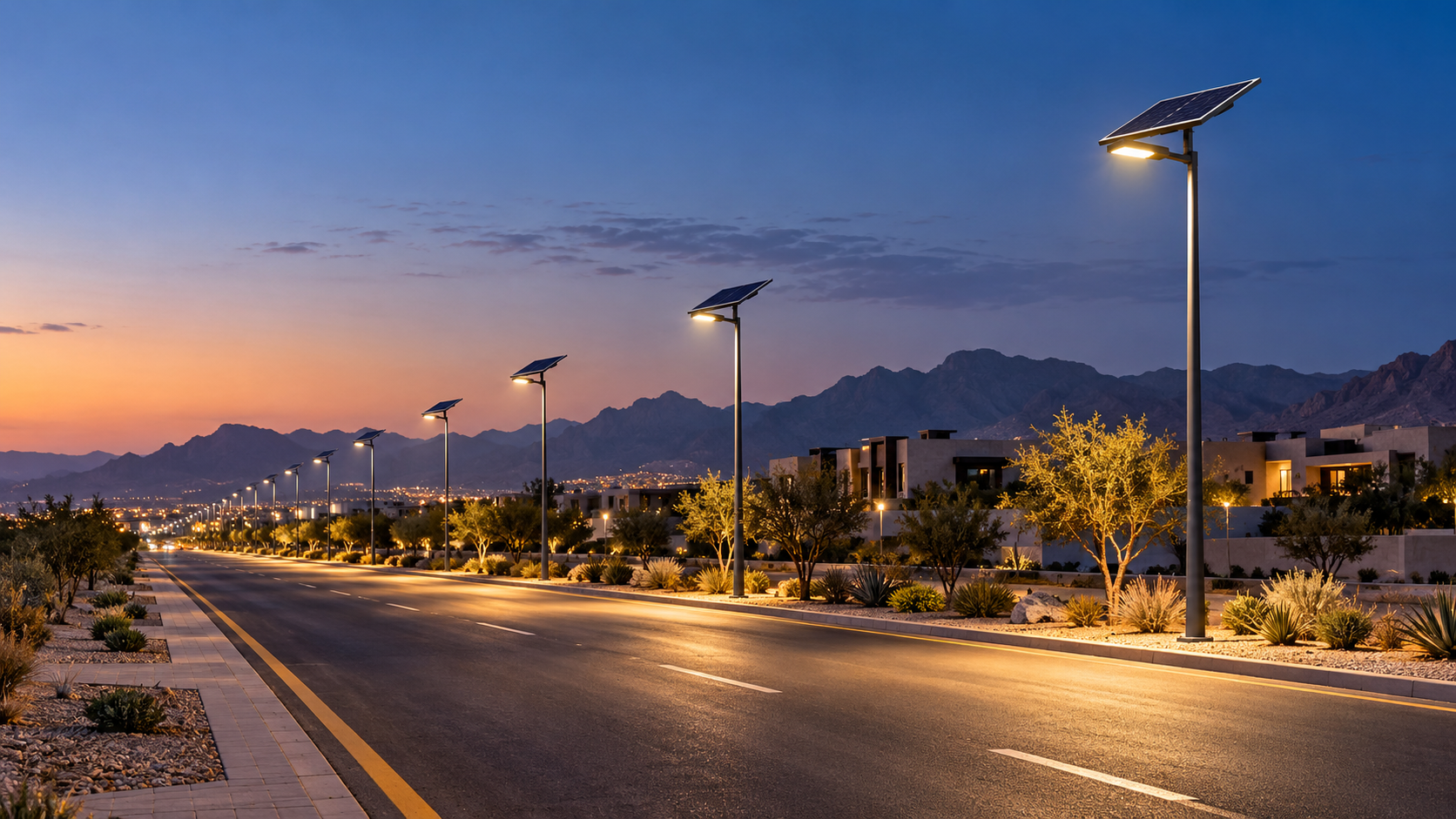
Solar street lights are changing how project teams consider lighting for roads, pathways, parks, and locations far from the electricity grid. By generating and storing energy at each lighting point, an off-grid system can provide illumination without extending electrical cables to every fixture.
The future of solar street lights depends on more than installing additional panels. Reliable projects require efficient LED luminaires, appropriately sized batteries, suitable lighting controls, and a plan for installation and maintenance. In Saudi Arabia, site conditions and the required nighttime operating schedule should guide every decision.
Connecting a new road or remote site to the grid may involve trenching, cabling, and coordination with other infrastructure. An off-grid solar streetlight offers another approach: its panel collects energy during the day, its battery stores that energy, and its controller operates the LED luminaire at night.
This can make solar lighting worth evaluating for private roads, parks, campuses, industrial access routes, and remote areas. Its suitability still depends on the required illumination, sunlight exposure, mounting conditions, and hours of operation. A solar light should be selected because it meets the project’s requirements, rather than because the site receives abundant sunshine in general.
For a practical assessment of road width, pole spacing, output, and optics, read How to Choose a Solar Street Light for Roads in Saudi Arabia.
A solar streetlight has a limited amount of energy available each night. The LED luminaire, solar panel, battery, and controller must therefore be considered as one system.
Luminous efficacy describes how much light a luminaire produces for each watt it uses. Optical distribution matters just as much: light needs to reach the road or pathway where it is required. A fixture with high output but unsuitable optics may still leave unevenly lit areas.
The Alrouf Triton Series Integrated Solar Street Light is an example of an off-grid product range. It is available in 30W to 150W models, with a stated efficacy of 195 lm/W and several optical distribution options. The appropriate model and optic should be confirmed through a project-specific lighting assessment.
Solar streetlights can use local controls to manage when and how brightly they operate. Depending on the supplied controller configuration, these may include automatic dusk-to-dawn switching, motion-sensor dimming, or programmed brightness stages.
A road with activity throughout the night may need a different operating profile from a quiet pathway. Control settings should support the approved lighting design while managing the energy stored in the battery.
Some larger projects may also need connected monitoring so operators can review asset status or manage schedules remotely. That requires compatible equipment and a communication system; it should not be assumed to be a standard feature of every solar streetlight. Our smart solar streetlights guide explains the difference between local controls and connected networks.
Solar street lighting removes the need for a grid connection at an off-grid lighting point, but it does not remove maintenance.
Panels may need cleaning, particularly where dust affects sunlight exposure. Batteries, controllers, fixtures, poles, and mounting components require inspection according to the product and site conditions. New buildings or trees can also create shade after the original installation.
For a network of public lighting points, the project owner should keep a record of models, locations, operating settings, test results, warranties, and maintenance work. These records make future inspection, replacement, and expansion easier to manage.
A reliable solar lighting project begins with the location. The team should identify the areas to be illuminated, nighttime activity, required lighting levels, available sunlight, possible shading, pole positions, and maintenance access.
It should then assess the complete system: luminaire output and optics, panel capacity, battery storage, controller settings, mounting arrangement, and the required operating schedule. The final design should be checked against the project’s technical requirements.
Public projects also need clear procurement, commissioning, and handover responsibilities. See Public Solar Lighting in Saudi Arabia: From Procurement to Handover for the delivery process beyond product selection.
The future of solar street lights is a move toward better planned lighting systems: efficient fixtures, energy storage sized for the required schedule, controls that suit the location, and maintenance teams with the information they need.
For projects where an off-grid solution is suitable, Alrouf’s Triton integrated solar street light provides a range of model options to assess. Contact Alrouf with your project location, application, quantity, site dimensions, and required operating hours to discuss the appropriate configuration.
Future projects are likely to focus on complete system design: efficient LED output, appropriate solar and battery capacity, suitable controls, and documented maintenance. Connected monitoring may be useful where a project has many distributed assets, if compatible equipment is specified.
Not automatically. Required illumination, road dimensions, pole positions, sunlight exposure, battery autonomy, and the operating schedule should be assessed before selecting a solar lighting system.
Yes. Panels, batteries, controllers, fixtures, and mounting components need appropriate inspection. Maintenance requirements depend on the product and site conditions.
No. Local automatic switching and dimming can operate without an IoT network. Remote monitoring requires a compatible product configuration, communications, and a management platform.
