
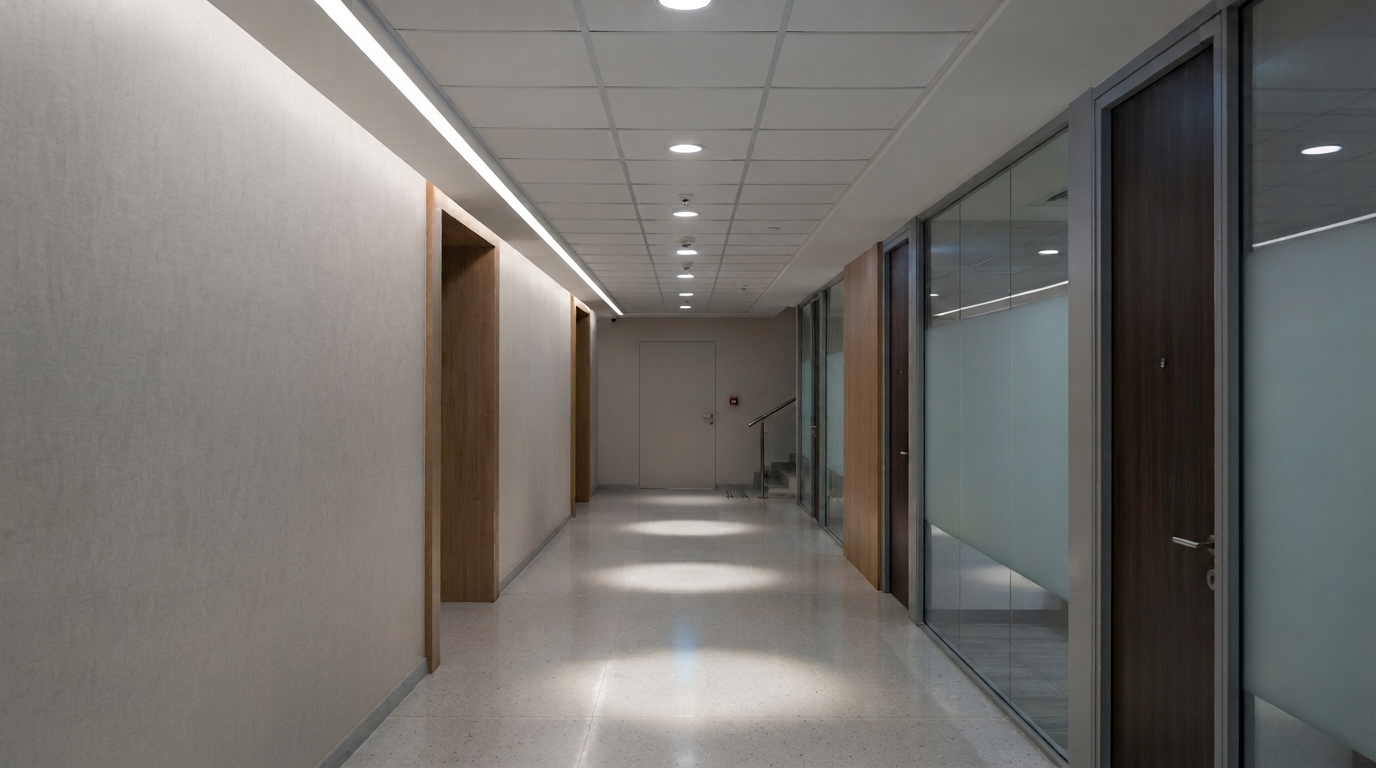
Emergency lighting plays an important role in maintaining visibility when normal power is interrupted. Choosing the right emergency ceiling lighting solution requires more than looking at the fixture itself. The installation environment, mounting method, emergency duration, light output, battery technology, and operating mode should all be considered.
This guide explains the main factors to consider when selecting emergency ceiling lighting for commercial, public, and industrial buildings.
Emergency ceiling lighting refers to emergency luminaires installed on or within a ceiling to provide backup illumination when the normal power supply fails.
These systems can be used in areas such as corridors, staircases, offices, hospitals, hotels, shopping malls, and parking facilities where visibility may be required during a power interruption.
The specific performance of an emergency lighting system depends on the selected luminaire and its technical configuration.
Emergency ceiling lighting normally operates from the building's electrical supply while its internal battery remains charged.
When normal power is interrupted, the emergency lighting system switches to its backup power source and provides illumination for its specified emergency duration.
Emergency ceiling lighting can use different operating modes:
The appropriate mode depends on the emergency lighting design and project requirements.
Emergency ceiling lighting can be installed using different mounting configurations. The right option depends on the ceiling construction, architectural requirements, and installation environment.
Surface-mounted emergency lighting is installed directly onto the ceiling surface.
This can be useful where there is limited space within the ceiling or where a straightforward installation is preferred.
Recessed emergency lighting is installed within the ceiling structure.
This configuration can provide a more integrated appearance and can be suitable for architectural ceilings where the luminaire needs to sit within the ceiling.
Semi-recessed installation provides an alternative between fully recessed and surface-mounted configurations.
The suitability of this mounting method depends on the ceiling design and the selected emergency lighting product.
Some emergency lighting installations may require a hanging or suspended configuration, particularly where ceiling height or building design makes direct mounting unsuitable.
The available mounting configuration should always be checked for the selected product.
One of the common decisions when planning emergency ceiling lighting is whether to use recessed or surface-mounted installation.
Recessed emergency lighting can be considered when the ceiling provides sufficient space for the fixture and an integrated appearance is required.
Surface-mounted emergency lighting can be more practical where there is insufficient ceiling depth or where direct installation is preferred.
The choice should be based on:
There is no single mounting configuration that is suitable for every project.
Several technical factors should be evaluated before selecting an emergency lighting solution.
Emergency duration determines how long the luminaire can provide illumination after normal power fails.
For example, the Al Rouf LED emergency ceiling light range provides approximately 3 hours of emergency duration, depending on the selected model.
The required duration should be determined according to the project's emergency lighting requirements.
Light output is another important consideration.
Different emergency lighting models can provide different normal and emergency lumen outputs. The required output depends on factors such as:
The emergency output should be considered rather than relying only on the normal operating lumen rating.
The battery provides backup power when the normal electrical supply is unavailable.
Different emergency lighting products may use different battery technologies and capacities.
For example, Al Rouf LED's emergency ceiling light family uses LiFePO₄ 1500mAh batteries, with different voltage configurations depending on the model.
Battery capacity, emergency duration, and recharge time should be reviewed together when selecting a product.
Determine whether the project requires maintained or non-maintained emergency lighting.
Maintained systems can remain illuminated during normal operation, while non-maintained systems are designed to provide emergency illumination when the normal power supply fails.
The required mode should follow the emergency lighting design and consultant specifications.
The installation environment should also influence the selected protection rating.
For example, the Al Rouf LED emergency ceiling light range includes IP54 and IP65 models.
The required IP rating depends on environmental exposure and the location where the emergency luminaire will be installed.
The ceiling structure should be assessed before selecting the emergency light.
Possible configurations can include:
Selecting the correct configuration helps ensure that the luminaire is compatible with the intended installation.
Different buildings can have different emergency lighting requirements.
Emergency ceiling lighting can support visibility in office areas, corridors, staircases, and shared spaces during power interruptions.
Healthcare facilities may require emergency illumination throughout circulation areas and other locations where safe movement is important.
Emergency ceiling lighting can be used in corridors, staircases, and other indoor areas of hotels.
Large commercial spaces can require emergency illumination across public circulation areas and access routes.
Parking facilities can require emergency lighting when normal lighting is unavailable. The selected IP rating should correspond to the conditions of the installation area.
Industrial facilities can use emergency ceiling lighting in offices, corridors, workshops, storage areas, and other indoor spaces where backup illumination is required.
A self-contained emergency lighting system contains its own battery within the emergency luminaire.
When normal power fails, the internal battery supplies the required emergency power to the light.
This differs from centralized emergency lighting systems, where emergency power can be supplied from a separate central battery system.
For self-contained emergency lighting, the battery capacity, recharge time, emergency duration, and maintenance requirements should be considered when selecting the appropriate solution.
Understanding the difference between maintained and non-maintained operation is important when selecting emergency lighting.
A maintained emergency light can remain illuminated during normal operation and continue providing emergency illumination when the main power supply fails.
This configuration may be appropriate where continuous illumination is required as part of the emergency lighting design.
A non-maintained emergency light is designed to operate as emergency lighting when the normal power supply fails.
This can be suitable where emergency illumination is only required during a power interruption.
The appropriate configuration depends on the project design.
Emergency duration depends on the selected product and its battery configuration.
The Al Rouf LED emergency ceiling light family provides approximately 3 hours of emergency operation.
However, emergency duration should always be checked against the technical specifications of the specific model and the requirements of the project.
A practical selection process can follow these steps:
Determine where the emergency lighting will be installed, such as an office, corridor, hospital, hotel, shopping mall, parking garage, or industrial building.
Determine whether the ceiling is suitable for surface-mounted, recessed, semi-recessed, or suspended installation.
Check the project's emergency lighting requirements and select a product with an appropriate emergency operating time.
Consider the size of the area, ceiling height, mounting position, and required emergency illumination.
Determine whether maintained or non-maintained operation is required.
Evaluate the installation environment and select the appropriate IP protection level.
Before final selection, verify:
Emergency lighting requirements can vary between projects depending on the building type, layout, ceiling design, and consultant specifications.
For projects in Saudi Arabia and the GCC, the selected emergency lighting solution should be evaluated against the project's technical requirements and intended application.
A product family with different lumen outputs, battery configurations, operating modes, and protection levels can provide greater flexibility when selecting emergency lighting for different areas within a project.
Al Rouf LED offers a range of LED Emergency Ceiling Lights for commercial, public, and industrial applications.
The product family includes:
Depending on the model, the range provides 500–1650 lm normal lumen output, 100–330 lm emergency lumen output, approximately 3 hours emergency duration, LiFePO₄ battery technology, and IP54 or IP65 protection.
If you are looking for a specific emergency ceiling lighting solution, explore the LED Emergency Ceiling Lights product range for model-specific technical specifications.
You can also explore the complete Emergency Lighting Solutions from Al Rouf LED.
Consider the installation area, ceiling structure, required emergency duration, lumen output, battery technology, operation mode, IP rating, and project specifications before selecting an emergency lighting solution.
Recessed emergency lighting is installed within the ceiling, while surface-mounted emergency lighting is installed directly onto the ceiling surface. The appropriate option depends on the ceiling structure and project requirements.
Emergency duration depends on the selected model and battery configuration. Some emergency ceiling lighting products, including models in the Al Rouf LED range, provide approximately 3 hours of emergency operation.
Self-contained emergency lighting has its own internal battery. The battery supplies emergency power when the normal electrical supply fails.
Maintained emergency lighting can remain illuminated during normal operation, while non-maintained emergency lighting is designed to operate when the normal power supply fails.
The required IP rating depends on the installation environment. The Al Rouf LED emergency ceiling light range includes IP54 and IP65 options.
Yes, recessed emergency lighting is available for applications where the ceiling structure and product configuration support recessed installation.
Emergency ceiling lighting can be used in offices, hospitals, clinics, hotels, shopping malls, airports, corridors, staircases, parking garages, and industrial buildings.
Choosing emergency ceiling lighting requires a balance between installation requirements, emergency performance, battery backup, light output, operating mode, mounting configuration, and environmental protection.
Rather than selecting a single emergency light for every application, evaluate the specific requirements of each area and choose a configuration that matches the building layout and project specifications.
For model-specific information, explore the LED Emergency Ceiling Lights from Al Rouf LED.
