
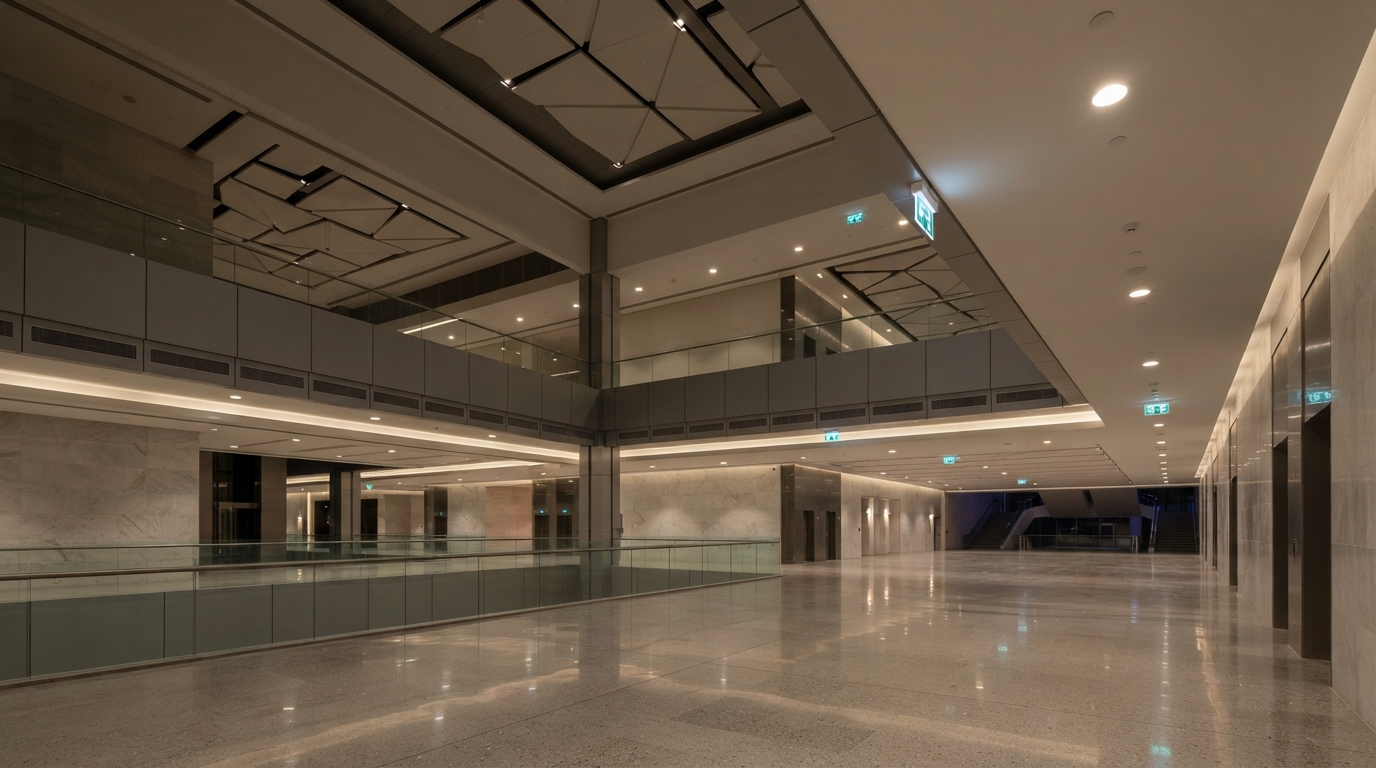
Commercial buildings require dependable emergency lighting to maintain visibility when normal power is interrupted. Offices, hospitals, hotels, shopping malls, parking facilities, and industrial buildings can all have different emergency lighting requirements based on their layout, operating conditions, and project specifications.
LED emergency ceiling lights can provide a practical solution for commercial projects where reliable backup illumination, flexible installation, and model-specific performance are required.
This guide explains how LED emergency lighting can support different commercial applications and what makes a product range suitable for project-based requirements.
Commercial emergency lighting is not a one-size-fits-all application.
A small office corridor may have different requirements from a hospital, hotel, parking garage, or industrial facility. Factors such as ceiling configuration, area size, required illumination, environmental conditions, and emergency operating duration can influence the selected solution.
For project applications, it is therefore useful to have emergency lighting products available with different:
This flexibility allows consultants, contractors, and project teams to select a suitable configuration for different areas within the same development.
Offices typically require emergency illumination across circulation areas, corridors, staircases, and other shared spaces.
For these applications, LED emergency lighting can provide backup illumination while maintaining a compact and practical installation.
Depending on the project design, requirements may include:
The selected emergency lighting configuration should correspond to the building's electrical and safety design.
Hospitals and clinics require reliable visibility across circulation spaces where staff, patients, and visitors may need to move during a power interruption.
Emergency lighting can be used in:
For healthcare projects, product selection should take into account the required emergency duration, installation method, light output, and environmental conditions.
Hotels can require emergency illumination across guest and service areas.
Applications may include:
The selected emergency lighting solution should integrate with the building's overall emergency lighting design while providing the required backup illumination during a power failure.
Shopping malls and large retail facilities contain extensive public circulation areas.
Emergency lighting can support visibility in:
Large commercial developments can benefit from having multiple emergency lighting configurations available to accommodate different ceiling structures and area requirements.
Parking garages can present different environmental conditions from standard indoor commercial spaces.
When selecting emergency lighting for parking applications, the protection rating and installation environment should be considered alongside emergency performance.
For example, the Al Rouf LED range includes models with IP54 and IP65 protection, allowing project teams to select a configuration according to the intended installation environment.
The required protection level should always be verified against the actual project conditions.
Industrial facilities can contain warehouses, workshops, production areas, storage spaces, and service corridors.
Emergency lighting in these environments may need to support visibility across larger spaces and different ceiling heights.
Project teams can evaluate:
The correct configuration depends on the specific area and project design.
For large commercial and industrial developments, having multiple product configurations can simplify product selection across different areas.
A project-oriented emergency lighting range should provide flexibility in areas such as:
Different spaces may require different levels of illumination.
The Al Rouf LED emergency ceiling light range provides normal lumen outputs from 500 to 1650 lm, while emergency lumen output ranges from 100 to 330 lm, depending on the model.
This allows project teams to evaluate different output levels according to the intended application.
Battery performance directly affects emergency operation.
The Al Rouf LED range uses LiFePO₄ 1500mAh batteries, with different voltage configurations depending on the model.
The battery configuration should be evaluated together with the required emergency duration and project specifications.
Commercial projects can require different emergency operating configurations.
Available models can support maintained or non-maintained operation, depending on the selected model.
This provides flexibility when integrating emergency lighting into different building safety designs.
Environmental conditions can vary significantly between commercial applications.
The range includes IP54 and IP65 options, allowing the appropriate model to be considered based on the installation environment.
Project requirements can also differ according to the ceiling construction.
Available configurations include:
The appropriate configuration depends on the selected product and project installation requirements.
The Al Rouf LED range includes several models designed for different project requirements:
A compact emergency lighting configuration within the range, with model-specific power and lumen specifications.
An emergency lighting model providing a different output configuration for commercial applications.
Designed as part of the same emergency lighting family with its own power and performance configuration.
A higher-power configuration within the range, suitable for applications requiring a different light output.
The exact technical characteristics vary between models, so project teams should review the model-specific specifications before selection.
Commercial and industrial projects in Saudi Arabia can involve detailed consultant and contractor specifications.
Emergency lighting selection may therefore need to consider:
Al Rouf LED provides emergency lighting solutions designed for commercial and industrial applications, with different configurations that can be evaluated according to project requirements.
LED emergency lighting can provide several practical advantages for project applications.
Emergency luminaires provide illumination when normal electrical power is unavailable, supporting visibility during power interruptions.
Different models allow project teams to select products according to application-specific requirements rather than using the same configuration throughout an entire development.
Surface, recessed, semi-recessed, and suspended configurations can accommodate different ceiling designs.
Available IP54 and IP65 configurations provide options for different installation environments.
Integrated battery configurations provide emergency power without requiring every luminaire to depend on a separate external emergency power source.
For commercial projects, product selection should begin with the application rather than the product name.
Consider the following:
Application:
Identify whether the product will be used in an office, hotel, hospital, mall, parking facility, or industrial building.
Installation:
Confirm the required ceiling configuration and available mounting method.
Emergency performance:
Review emergency duration and emergency lumen output.
Environment:
Determine the required IP protection according to the installation conditions.
Operation:
Confirm whether maintained or non-maintained operation is required.
Technical compliance:
Verify the complete technical specifications and required certifications against the project specification.
Selecting emergency lighting for a commercial development often requires evaluating several models against the project's technical requirements.
Al Rouf LED offers a range of emergency lighting solutions for commercial, public, and industrial applications, including models with different lumen outputs, battery configurations, operating modes, and protection levels.
Explore the LED Emergency Ceiling Lights range to review the available models and technical specifications.
For larger developments or projects requiring technical recommendations, you can also contact Al Rouf LED for product selection and project support.
The appropriate emergency lighting depends on the building type, area layout, required emergency performance, mounting configuration, and project specifications. Commercial applications can include offices, hospitals, hotels, shopping malls, and parking facilities.
Yes. LED emergency lighting can be used in industrial buildings, warehouses, workshops, and service areas. The selected model should match the application's light output, protection, mounting, and emergency performance requirements.
Project teams can evaluate different configurations based on lumen output, emergency duration, battery technology, operation mode, IP protection, and mounting method.
The range uses LiFePO₄ 1500mAh batteries, with different voltage configurations depending on the selected model.
The Al Rouf LED emergency ceiling light range includes IP54 and IP65 models. The appropriate option depends on the installation environment.
Yes. Different areas can have different requirements. A project may use different emergency lighting models or configurations according to ceiling type, area size, environmental conditions, and required performance.
Yes. The range includes models supporting maintained or non-maintained operation, depending on the selected model.
You can review the available LED Emergency Ceiling Lights and contact Al Rouf LED for technical support, product recommendations, or project quotations.
Commercial projects require emergency lighting solutions that can adapt to different applications, ceiling configurations, environmental conditions, and technical specifications.
A flexible LED emergency lighting range allows consultants, contractors, and project owners to evaluate different light outputs, battery configurations, operating modes, protection levels, and mounting options for each application.
For commercial and industrial developments in Saudi Arabia, explore the Al Rouf LED Emergency Ceiling Lights range or contact the team for project-specific support.
