
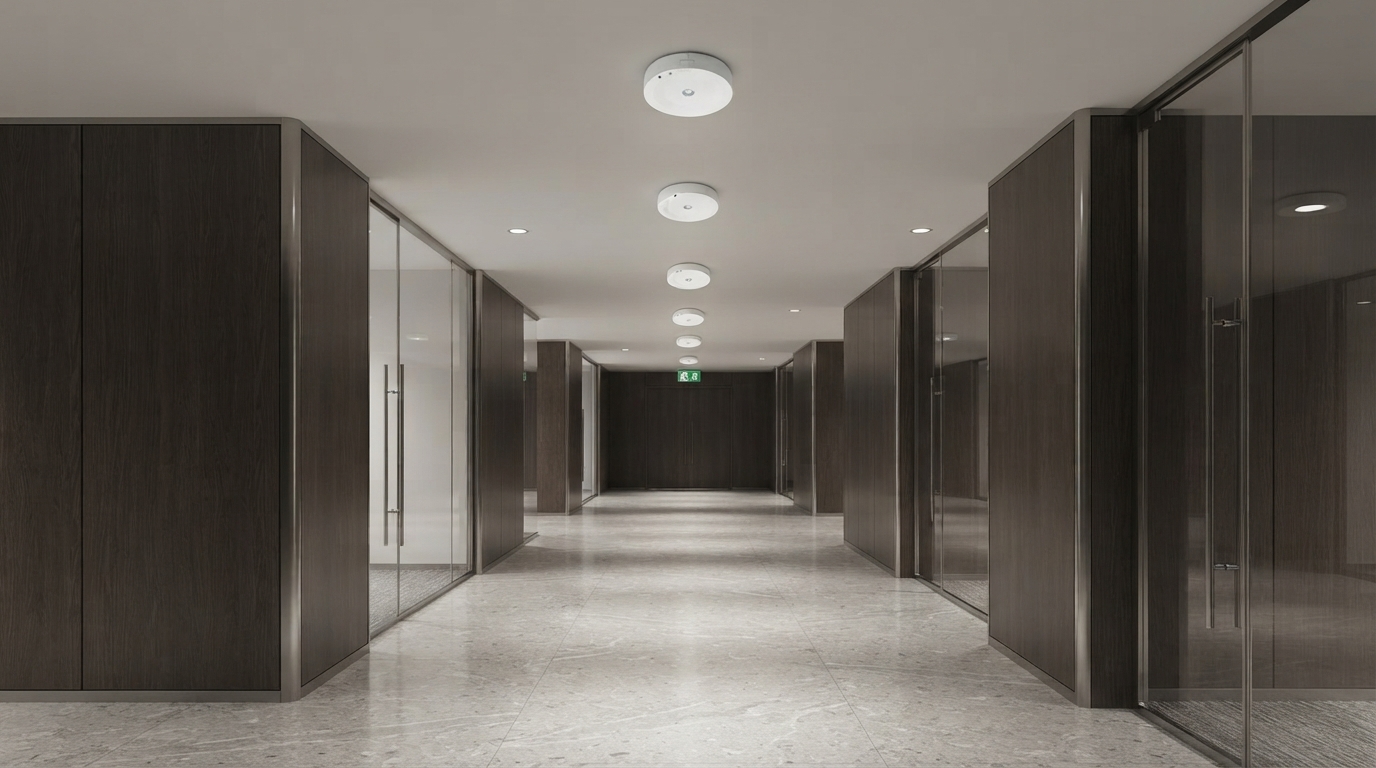
Choosing the right emergency downlight for a commercial project involves more than selecting a light output. The required lumen level, emergency duration, battery technology, IP rating, operation mode, and ceiling installation all need to match the project requirements.
For projects using recessed emergency lighting, LED Emergency Down Lights provide a practical way to integrate emergency illumination into the ceiling while maintaining a clean appearance. Al Rouf LED offers multiple models with 150LM, 200LM, 250LM, and 300LM configurations, as well as different battery and protection options.
An emergency down light is a recessed emergency luminaire designed to provide illumination when normal power is unavailable. Unlike emergency exit signs, which primarily identify escape routes, downlights provide emergency illumination within the surrounding area.
The Al Rouf range includes several emergency downlight model groups, with different lumen outputs and protection levels designed for different project requirements.
Use the emergency-mode lumen output and rated operating duration of the exact model when comparing emergency downlights.
The supplied Alrouf catalogue’s specification tables list 150 lm, 250 lm and 300 lm options across the model groups shown below. Some headline graphics show different figures, so the current model-specific datasheet should be confirmed before ordering.
Higher lumen output does not automatically mean longer emergency operation. For example, the BY-T1006E1 is listed with 300 lm output and 150 minutes of emergency duration, while several 150 lm and 250 lm models are listed with 180 minutes.
Select the combination that meets the project’s emergency lighting design. Fixture quantity and spacing should be assessed using suitable emergency photometric data, mounting positions and the actual layout.
Emergency duration is another important specification.
The documented BY-T1003E model provides 180 minutes of emergency operation, with a 24-hour recharge time.
When comparing models, check the technical specification of the selected emergency downlight to confirm that its emergency duration meets the project's requirements.
Battery technology varies according to the model.
The BY-T1003E, for example, uses a Lithium 3.7V 1500mAh battery. The model is specified with 180 minutes of emergency duration and a 24-hour recharge time.
This means battery capacity and technology should be considered together with the required emergency operating time when selecting a model.
The emergency downlight range includes both IP20 and IP54 models.
Several models in the range are IP20, while the BY-T1403S and BY-T1405S models are specified with IP54 protection.
The IP rating should be selected according to the installation environment and the project's technical requirements.
Auto-Test functionality is available on selected models.
The BY-T1003E includes an Auto-Test function, along with overcharge and over-discharge protection.
If automatic testing is part of the project's emergency lighting requirements, the selected model should be checked for this functionality.
Emergency downlights are designed for recessed ceiling installation, making them suitable for projects where the emergency luminaire needs to be integrated into the ceiling.
Before specification, confirm that the selected downlight is compatible with the ceiling construction and available installation space.
The Al Rouf range includes several model groups rather than a single emergency downlight configuration.
Examples include:
This range allows project teams to compare output and protection requirements before selecting the appropriate model.
Emergency downlights and emergency exit signs perform different functions within an emergency lighting system.
An emergency downlight provides illumination from the ceiling, while an emergency exit sign provides visual directional information toward an exit.
For a complete emergency lighting design, the selected products should therefore be specified according to their intended function rather than treating them as interchangeable products.
You can also read our LED Emergency Exit Signs Guide to learn more about viewing distance, mounting configurations, and emergency exit signage.
Emergency downlights can be considered for recessed emergency lighting applications in commercial and public buildings, including:
The final model should be selected according to the project's lighting design and technical specifications.
Before specifying an emergency downlight, confirm:
Using these criteria makes it easier to narrow down the appropriate model instead of selecting an emergency luminaire based only on its appearance or wattage.
Al Rouf LED provides a range of LED Emergency Down Lights with different lumen outputs, battery configurations, and protection levels for commercial and public-building applications.
Explore LED Emergency Down Lights
For broader emergency lighting options, explore Al Rouf emergency lighting solutions or contact our team for technical support and project recommendations.
