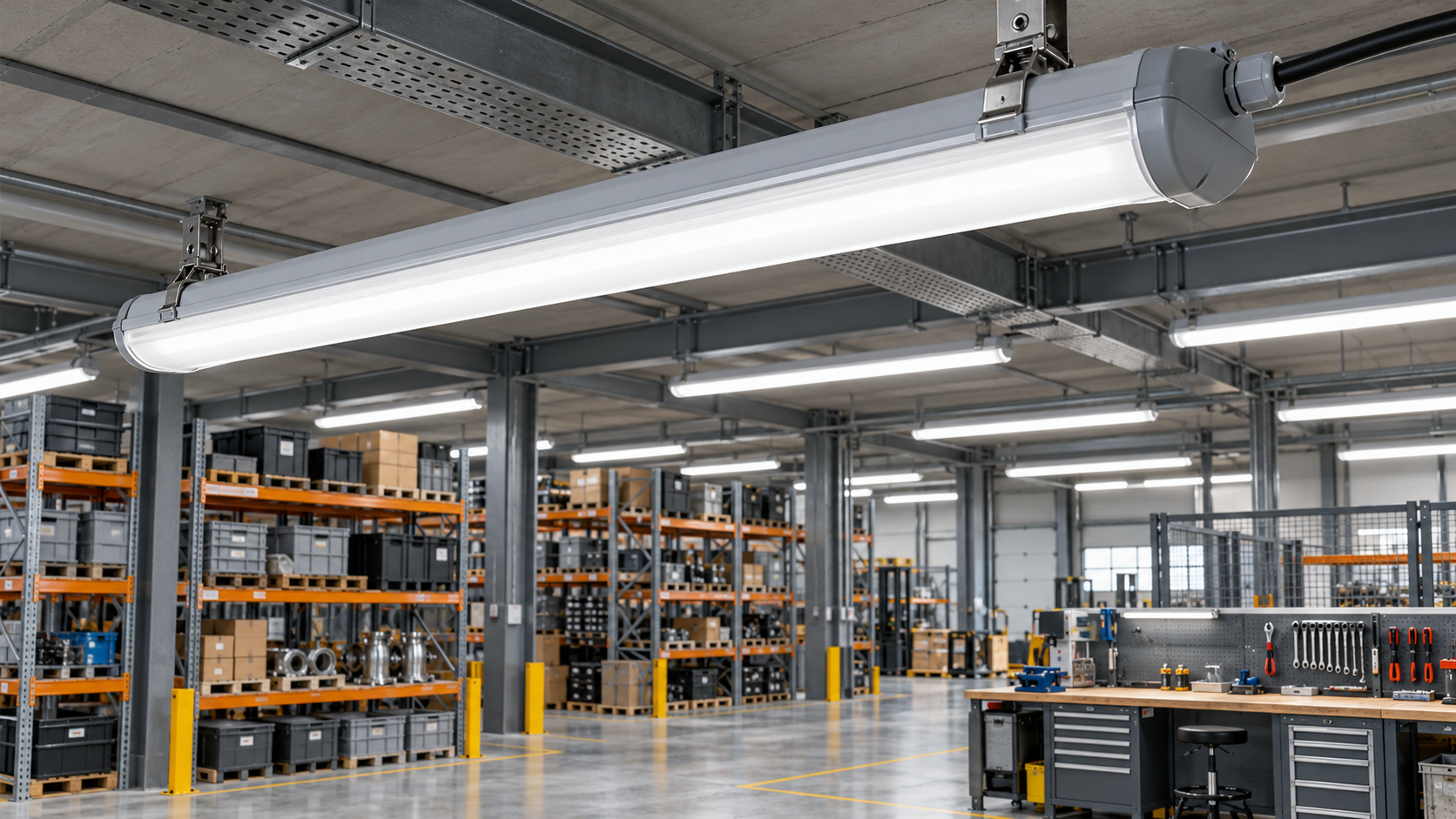
LED tri-proof lights are enclosed linear luminaires used where dust, moisture, and physical exposure make ordinary indoor fixtures unsuitable. Choosing the right unit requires checking its specific protection ratings, light output, operating conditions, and installation options.
For factories, warehouses, and parking facilities in Saudi Arabia, the term “tri-proof” alone is not enough to establish suitability. The selected model must match the conditions of the installation.
The Alrouf Linear Light Tri-Proof range includes T56 and T552 options. This guide explains how to assess these fixtures and what to confirm before ordering.
“Tri-proof” is a product description commonly associated with lighting designed for demanding environments. It does not mean that the fixture contains three protective layers or that every model offers identical protection.
Use the published ratings to understand what the selected fixture can withstand:
Protection against water or impact does not automatically establish resistance to chemicals, corrosion, or explosive atmospheres.
Alrouf’s linked catalogue presents different specifications for the two product families.
| Selection factor | Published information |
|---|---|
| T56 protection | IP69K and IK10 |
| Listed T552 models | IP65 in the specification table |
| Power options | Published options across the range extend from 20W to 110W |
| Construction | Single-mould polycarbonate housing with an internal aluminium core |
| Control options | 1–10V and DALI dimming options |
| Additional option | Microwave motion sensor, subject to configuration |
Do not apply the highest rating or output figure from the range to every unit. Confirm the exact model code, driver, protection rating, and control arrangement in the quotation.
Review the Alrouf tri-proof lighting catalogue when comparing configurations, and request clarification where tables or product descriptions differ.
Enclosed linear fixtures can be considered for production areas where dust or moisture exposure must be addressed.
Selection should also account for the work being performed. Assembly, inspection, and general circulation areas may need different illumination levels and colour-rendering performance.
If chemicals or cleaning agents are present, confirm material compatibility. An IP rating does not establish chemical resistance.
Warehouse lighting must account for shelving, stored goods, aisle widths, and mounting height. A fixture that performs well in an open room may create shadows when installed between tall racks.
Tri-proof linear lights may be appropriate for storage rooms, aisles, and lower-mounted areas. Higher spaces require a separate assessment of light distribution and the suitable luminaire type.
Parking facilities and service corridors may expose lighting to dust, moisture, and accidental contact.
Assess coverage along vehicle routes and pedestrian paths, while controlling glare for drivers. Position fixtures where structural elements will not obstruct their output.
Identify whether the installation involves airborne dust, occasional splashes, cleaning water, or potential impact.
For washdown areas, confirm that the complete installed assembly—including cable entries and connections—is suitable for the cleaning procedure. Follow the manufacturer’s installation instructions.
Wattage describes electrical power consumption; it does not show how much useful light reaches the working surface.
Assess lumens, beam distribution, mounting height, fixture spacing, and required lux levels together. A lighting layout helps determine the number and position of units needed.
Confirm the operating temperature range for the selected model, particularly around machinery or poorly ventilated spaces.
Where corrosion or chemical exposure is possible, request supporting material-compatibility information rather than relying on general descriptions such as “heavy-duty.”
Dimming and occupancy controls can help align lighting operation with actual use.
For the Alrouf range, confirm whether the proposed configuration includes the required driver and sensor. Check compatibility with the project’s control system before procurement.
Review fixture dimensions, mounting arrangements, cable routing, and access for inspection.
Suitable protection ratings do not remove the need for maintenance. Dust on the outside of a diffuser can still affect light output, even when the enclosure prevents dust from entering.
There is no fixed saving percentage for every LED tri-proof installation.
Compare the total input power of the existing and proposed systems, including the number of fixtures, operating hours, and controls. The comparison should also confirm that the new layout meets the required illumination.
For example, replacing a system drawing 100W with one drawing 50W would reduce its power demand by 50%, provided the operating schedule remains the same and the replacement delivers suitable lighting.
Use project-specific calculations rather than a blanket claim of “up to 70% savings.”
Tri-proof protection is not the same as explosion protection.
Where flammable gases, vapours, or combustible dust create a classified hazardous area, select equipment with the required approvals for that location. Do not assume that IP69K or IK10 establishes hazardous-area suitability.
Include the area classification in your enquiry so the appropriate lighting solution can be assessed.
No. Ratings vary by model. Alrouf’s catalogue lists different protection specifications for T56 and the T552 models shown.
Yes. Their external surfaces can accumulate dirt. Establish cleaning and inspection procedures suited to the environment and manufacturer’s instructions.
They can form part of a suitable design, but uniformity depends on fixture placement, beam distribution, mounting height, and shelving—not the product label alone.
Do not assume so. Confirm the driver and control configuration for the model being ordered.
Share your facility layout, mounting height, operating hours, environmental conditions, and control requirements with Alrouf Lighting Technology.
Request a recommendation for the appropriate T56 or T552 configuration, supported by model-specific specifications and a lighting assessment for your project.
