
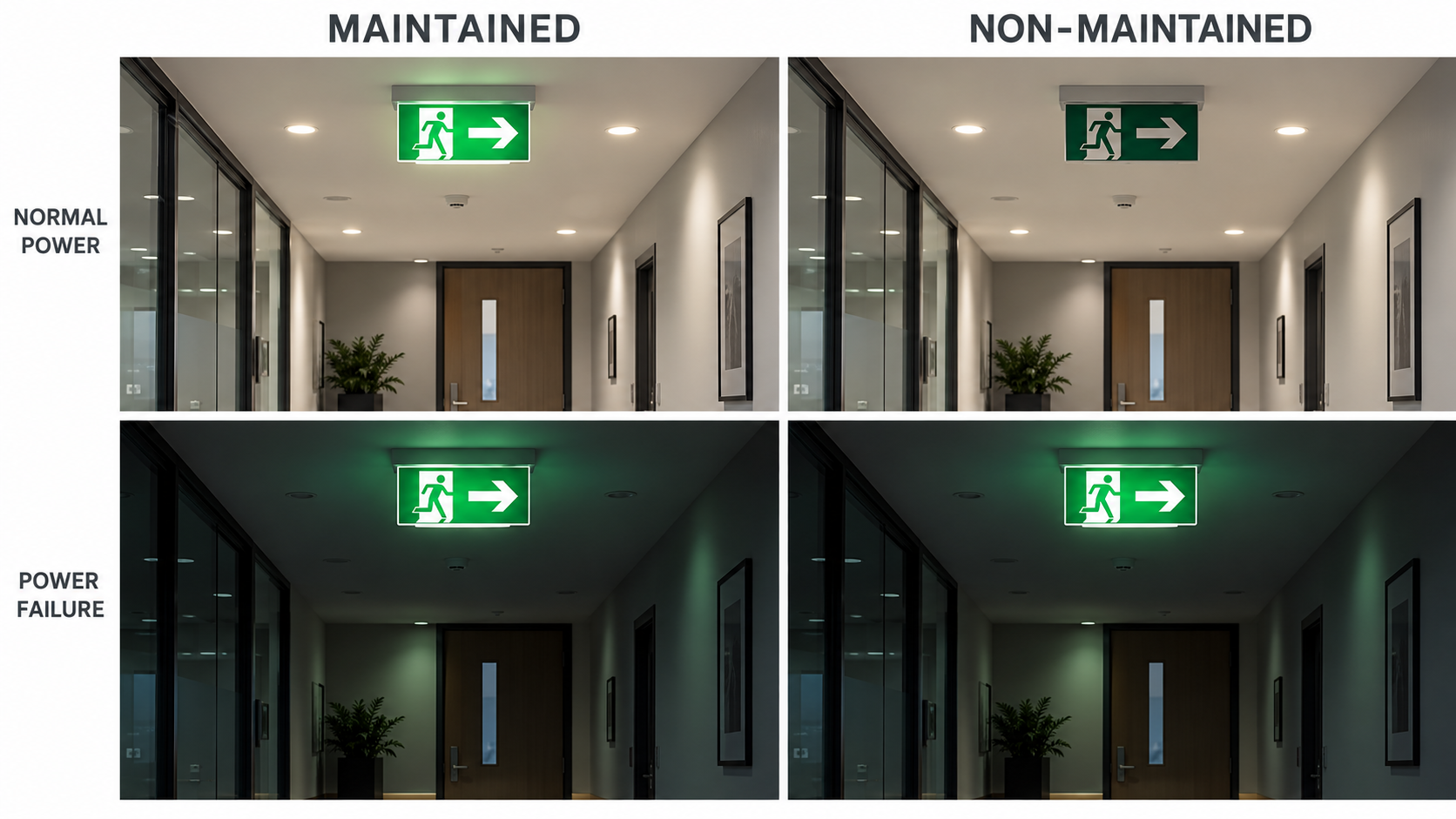
Maintained exit signs are illuminated during normal operation and continue operating from an emergency supply when the normal supply fails. Non-maintained exit signs illuminate when the normal supply fails and remain unlit during normal conditions.
The difference concerns when the sign is illuminated. It does not describe its maintenance schedule, battery duration or viewing distance.
For a building project in Saudi Arabia, select the operating mode according to the approved emergency lighting design and applicable project requirements. A product supporting non-maintained operation is not automatically suitable for every exit-sign location.
| Selection point | Maintained exit sign | Non-maintained exit sign |
|---|---|---|
| Normal supply available | Sign is illuminated in its maintained operating state | Sign is not illuminated |
| Normal supply fails | Emergency supply keeps the sign illuminated | Emergency supply activates the sign |
| Normal-condition visibility | Provides illuminated identification during normal operation | Does not provide illuminated identification during normal operation |
| Emergency duration | Depends on the selected product and power arrangement | Depends on the selected product and power arrangement |
| Testing and inspection | Required according to the applicable procedures | Required according to the applicable procedures |
| Project suitability | Must match the approved design | Must match the approved design |
For viewing distances, mounting arrangements and other selection factors, see our LED emergency exit signs guide.
A maintained exit sign provides illuminated guidance while normal power is available and continues operating when the normal supply fails.
In a self-contained battery-backed model, the normal supply powers the sign and supports battery charging. During a supply failure, the emergency battery powers the light source.
Some products support switched maintained operation or configurable modes. Confirm the exact arrangement in the manufacturer’s instructions and ensure that its use matches the approved design.
Exit identification can be needed before a power failure occurs.
A building may require evacuation while its normal electricity supply remains available. Illuminated signs can also support wayfinding where ambient lighting is reduced.
The operating mode should therefore be selected according to the required sign visibility during occupancy, rather than treating exit signage only as a response to a blackout.
A non-maintained exit sign is unlit during normal conditions and illuminates when the monitored normal supply fails.
For a self-contained unit, the charging and monitoring circuits can remain active even though the sign’s main light source is off.
“Non-maintained” does not mean:
The design must establish whether the proposed arrangement provides the required exit identification during normal and emergency conditions.
An exit sign communicates the location of an exit or the direction of travel. Escape-route lighting illuminates the route so occupants can see and move along it.
A decision to use non-maintained emergency lighting along a corridor does not automatically establish that a non-maintained exit sign is appropriate there.
Each function needs assessment within the complete emergency lighting design.
Likewise, an illuminated exit sign should not be assumed to provide sufficient floor illumination unless that function is supported by the product’s performance data and the lighting calculation.
Check the emergency lighting drawings, exit-sign schedule and project specification.
Confirm whether the sign must remain illuminated during normal occupancy. Do not choose the operating mode solely from the building’s label, such as “office,” “warehouse” or “hotel.”
Different areas within the same building can have different visibility and operational requirements.
Identify whether the area experiences:
These conditions should be considered when assessing sign visibility. The presence of general lighting alone does not settle the exit-sign requirement.
A catalogue may list a product as maintained/non-maintained, but the supplied configuration and installation determine its actual operation.
Request confirmation of:
Electrical installation and configuration should be completed by qualified personnel. Follow the product instructions rather than a generic wiring example.
Operating mode is only one part of the specification.
Also confirm the declared viewing distance, legend, arrow direction, number of faces, mounting arrangement, environmental rating and emergency duration.
A sign with the correct operating mode can still be unsuitable if it is obscured, faces the wrong direction or cannot be identified from the required viewing position.
Not normally. In a typical self-contained maintained sign, the normal electrical supply powers the light source while available. The battery provides emergency power when the normal supply fails.
The exact electrical arrangement depends on the selected product.
Do not assume that continuous illumination means continuous battery discharge, or that maintained and non-maintained versions necessarily have different rated backup durations.
A non-maintained sign does not power its main light source during normal conditions. However, a self-contained unit can still consume electricity for charging, monitoring and indicators.
Compare manufacturer-stated input power and operating conditions when assessing consumption.
Energy cost should be considered after confirming the required operating mode. A lower-consumption arrangement is not a suitable alternative if it fails to provide the specified exit identification.
Both operating modes need appropriate inspection and testing.
Checks should establish whether the sign operates correctly under the specified normal and emergency conditions, and whether it achieves its rated emergency duration.
These features should be assessed separately:
| Feature | What it describes |
|---|---|
| Maintained/non-maintained | When the sign’s light source operates |
| Emergency duration | Rated operation from the emergency supply under specified conditions |
| Auto-test | Automatic testing functions supported by the product |
| Viewing distance | Declared sign-identification distance under the relevant assessment conditions |
An auto-test feature does not determine whether a sign is maintained or non-maintained. It also does not remove the need to inspect visibility, condition and recorded faults.
Follow the applicable testing procedures and manufacturer’s instructions.
Before requesting a quotation, prepare:
Review Alrouf’s LED emergency exit signs and confirm the exact model and configuration against your project schedule.
A maintained sign is illuminated during normal operation and supply failure. A non-maintained sign illuminates when the normal supply fails.
No. The term describes the operating mode. Inspection, testing and component maintenance remain necessary.
Yes, when its emergency power arrangement is functioning as specified. Confirm the rated duration and conditions for the selected system.
Some products support maintained and non-maintained configurations. Check the exact model’s instructions and approved project arrangement before installation.
No. Building type alone is not enough to select the mode. Confirm the required sign visibility, approved design and applicable project requirements.
No. Emergency duration and operating mode are separate characteristics. A three-hour rating does not identify how the sign operates while normal power is available.
Do not substitute operating modes without confirming the design requirement and obtaining the necessary project approval. The replacement must meet the full specification.
Choose exit signage by reviewing the operating mode alongside visibility, emergency duration, mounting and environmental requirements.
Read our LED emergency exit signs selection guide for the broader selection process.
To discuss available equipment, contact Alrouf with your exit-sign schedule, required configuration and project specifications.
