
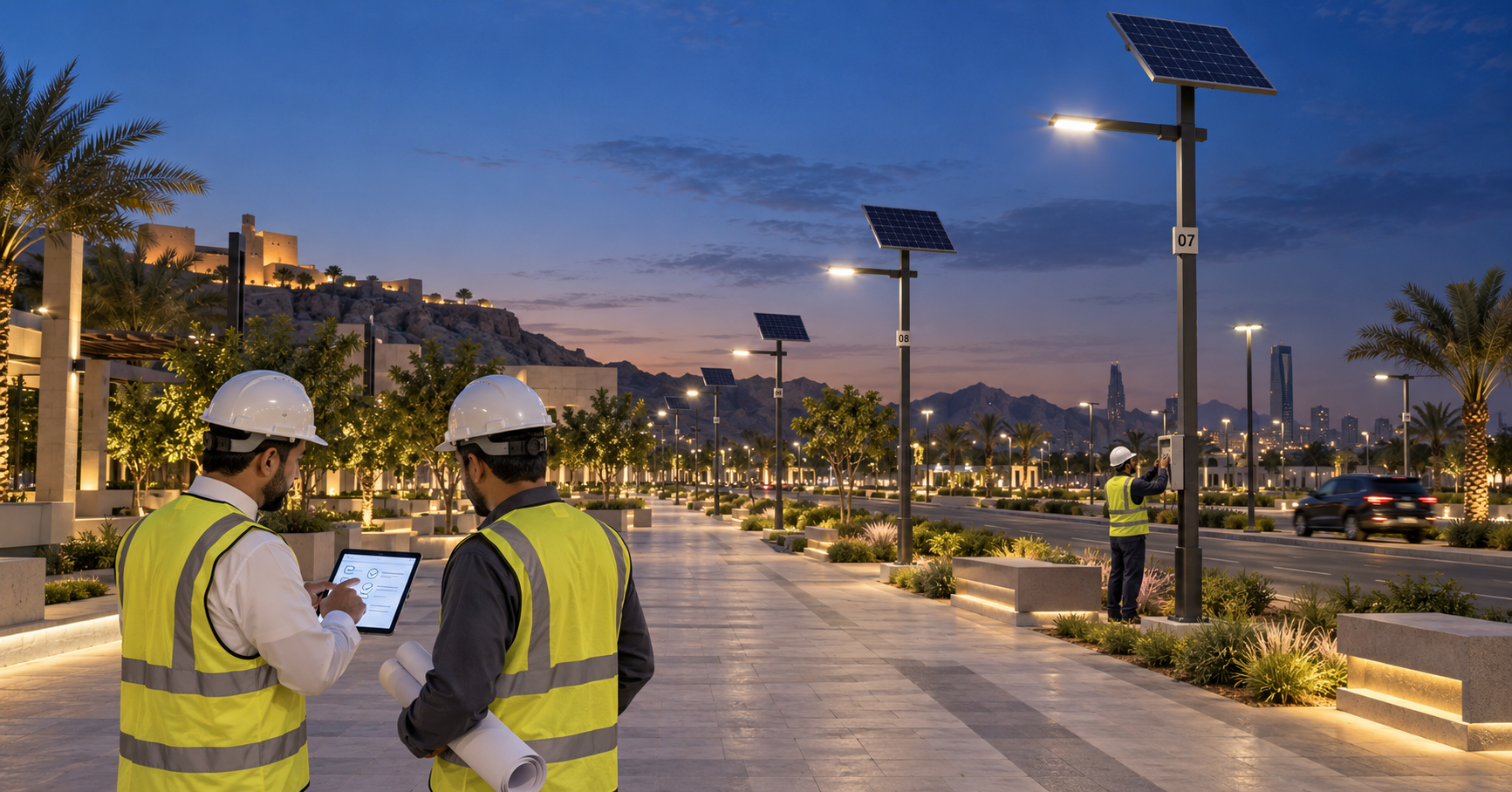
A successful public solar lighting project starts with a clear scope and ends with a system the owner can operate and maintain. For Saudi municipalities, developers, consultants, and contractors, that means defining lighting requirements, evaluating the complete solar system, checking installation quality, recording test results, and preparing a useful handover package.
Public solar lighting can serve streets, parks, pedestrian routes, municipal facilities, and other shared spaces. This guide follows the practical steps from tender preparation to long-term maintenance.
Public solar lighting is solar-powered outdoor lighting installed for community or infrastructure use. A project may include a single public space or many lighting points across roads, parks, pathways, and facilities.
Each lighting point needs a suitable luminaire, solar panel, battery, controller, mounting arrangement, and operating profile. On larger projects, these products must also fit a coordinated design, procurement, installation, and maintenance process.
For guidance on matching lighting types to different outdoor areas, read Outdoor Solar Lights in Saudi Arabia: Applications and Site Planning Guide.
Responsibilities vary by contract, but the main parties usually include:
The tender and contract should state who is responsible for each activity. This helps prevent gaps between product supply, installation, commissioning, and maintenance.
Start with the locations and the result required from each area. A public road, park path, and open square may need different fixture types and layouts.
The project scope should identify:
State what is excluded as well. For example, clarify responsibility for permits, road closures, removal of existing equipment, communication services, and restoration after civil work.
Tender documents should give bidders enough information to propose systems against the same requirements.
Depending on the project, request product model numbers, datasheets, lighting calculations, drawings, solar-system details, installation requirements, controller modes, warranty terms, delivery schedules, testing procedures, and handover documents.
Specify the required performance and evidence accurately. Any claim about certification or approval should be checked against valid documentation for the proposed model. Avoid copying a specification from an unrelated site without reviewing its lighting and solar conditions.
The LED luminaire is only one part of a solar lighting offer. Evaluators should understand what is included and whether the components work together for the required nightly schedule.
| Check | Evidence to request | Clarification to resolve |
|---|---|---|
| Lighting performance | Model datasheet and project lighting calculation | Will the proposed layout meet the required coverage? |
| Solar and battery system | Panel, battery, and controller details | What operating profile and site conditions were used in the design? |
| Installation scope | Pole, mounting, foundation, and connection details | Which items and civil works are included in the price? |
| Controls | Controller specification and operating modes | Are sensors or connected functions included or optional? |
| Delivery and support | Schedule, warranty terms, and maintenance information | Who supplies spares and handles defects? |
| Acceptance | Test procedure and handover list | What evidence must be provided before sign-off? |
Compare proposals on the same defined scope. A lower price may reflect a different battery, excluded foundations, limited testing, or different warranty responsibilities.
For road-specific product requirements, see How to Choose a Solar Street Light for Roads in Saudi Arabia.
Before approval, check that every proposed model matches its datasheet, drawings, operating modes, dimensions, and warranty documentation. Record any difference from the tender specification and resolve it in writing.
For integrated road-lighting projects, Alrouf offers the Triton Series Integrated Solar Street Light and the QH Series Integrated Solar LED Street Light. The suitable option depends on the required output, road geometry, mounting conditions, operating schedule, and other project requirements. The Triton vs QH Series comparison explains their documented differences.
Product selection should be confirmed through the project’s technical assessment; wattage alone is not enough to approve a roadway luminaire.
The procurement schedule should allow time for technical approval, product supply, site readiness, foundations, pole installation, luminaire installation, testing, and defect correction.
During installation, inspect fixture mounting, pole alignment, panel orientation, component connections, controller settings, and access for future maintenance. Work should follow the approved drawings and installation instructions.
Record site changes. If a pole moves because of utilities, access, or other conditions, update the final drawings and asset records.
Commissioning confirms that the installed system operates according to the approved requirements. The procedure may cover:
Define who performs the tests, who reviews the evidence, and who can accept the system. If connected controls form part of the project, test the specified monitoring and remote functions rather than assuming they are present in every solar streetlight.
Read Smart Solar Streetlights: IoT Control for Saudi Urban Infrastructure for an explanation of connected solar lighting systems.
The maintenance team needs a reliable record of what was installed and how it was configured. The handover package should include, as applicable:
The project owner should check the package before final acceptance. Missing settings or asset locations can make future fault diagnosis and replacement more difficult.
Public solar lighting is not maintenance-free. Assign responsibility for panel cleaning, battery-condition checks, fixture and pole inspections, fault reporting, replacement approvals, warranty claims, and maintenance records.
If the network may expand, use consistent asset names and documentation from the first phase. Review each new location separately: the lighting layout and solar conditions accepted for one road or park may not suit another.
Alrouf provides solar lighting products for Saudi road and outdoor projects, including the Triton and QH integrated solar streetlight ranges.
Contact Alrouf with the project location, tender scope, site drawings, estimated number of lighting points, required operating hours, technical requirements, and delivery schedule. These details will help the team review suitable product options and prepare a project-specific response.
It should define the areas to be illuminated, lighting requirements, complete system scope, installation responsibilities, testing criteria, documentation, warranty terms, and exclusions.
No. Evaluate lighting performance, the solar panel, battery, controller, mounting and installation scope, operating profile, documentation, support, and total quoted scope.
Check the installed assets against the approved documents, then test switching, charging, controller settings, schedules, sensors, and any connected functions included in the project.
Include approved product information, as-built drawings, asset records, operating settings, test results, manuals, warranty documents, and maintenance guidance.
Yes. Panels, batteries, controllers, fixtures, poles, and mounting components need planned inspection. Assign the work and record the results as part of the project’s operating process.
Not automatically. Road dimensions, lighting requirements, sunlight exposure, operating hours, and installation conditions should be assessed for each location.
