
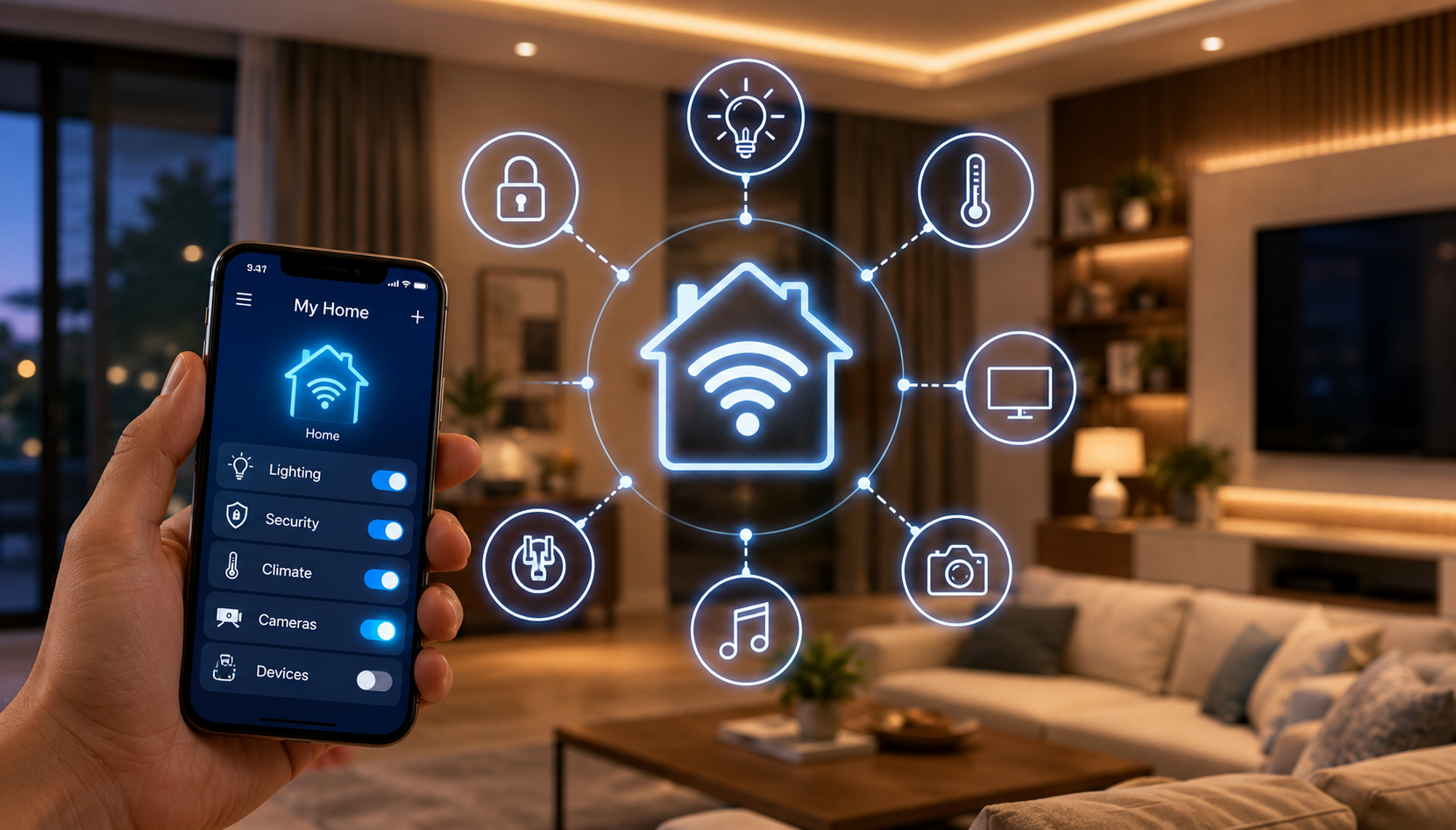
Yes. You can add smart home automation to an existing house without completely rewiring it. Wireless technologies, retrofit smart switches, relay modules, smart plugs, sensors, and smart home gateways make it possible to upgrade many existing homes without opening walls or replacing all the electrical wiring.
For homeowners in Saudi Arabia, this can be particularly useful when upgrading an existing villa or apartment where a full rewiring project would be disruptive. The right approach depends on the existing electrical system, the type of automation you want, the size of the property, and whether you own or rent the home.
If you're still exploring what a complete smart home system can include, see our guide to Smart Home Automation in Saudi Arabia: What's Included and What It Costs.
A smart home retrofit means adding automation to an existing property without replacing the home's entire electrical wiring.
Instead of running new cables throughout the house, wireless communication protocols can connect smart devices to a central hub or gateway.
Common technologies used for wireless smart home automation include:
The choice of technology depends on the devices, network requirements, property size, and desired level of automation.
This approach can allow homeowners to automate lighting, switches, sensors, plugs, and other devices while keeping much of the existing infrastructure in place.
A retrofit can be implemented gradually rather than changing everything at once.
A typical approach can include:
A smart home hub or gateway can act as the central connection point between compatible devices.
Depending on the chosen ecosystem, the hub can connect wireless devices and allow them to communicate with each other.
This is particularly useful when using protocols such as Zigbee, Z-Wave, or other compatible wireless technologies.
One option is installing smart relay modules behind existing switches.
These modules can make existing lighting fixtures controllable through a smart system without requiring the entire wall wiring to be replaced.
This approach can be useful when the homeowner wants to automate existing lights while maintaining the existing fixtures.
Smart switches can replace conventional switches and provide additional automation capabilities.
Depending on the selected product, they can allow users to control lighting remotely or integrate lights into predefined automation scenes.
For homes where changing the existing switch wiring is not desirable, wireless or battery-powered switch options can also be considered.
Smart plugs are one of the simplest ways to begin a smart home retrofit.
They can add smart control to compatible appliances and devices without modifying the home's permanent electrical installation.
This makes them particularly useful for testing automation before expanding the system to other areas of the property.
Sensors can make automation more responsive.
For example, presence or motion sensors can be used to trigger lighting or other automation actions based on occupancy.
A basic retrofit could therefore combine:
Smart devices → Sensors → Gateway/Hub → Automation rules
This allows the homeowner to gradually build a more connected system.
Yes. Smart lighting is one of the easiest areas to automate in an existing home without extensive rewiring.
Depending on the existing installation, homeowners can consider:
For example, a homeowner could create a lighting scene that combines entrance, living-room, and outdoor lighting.
For more ideas about automated lighting scenes, see our Villa Lighting Scenes: Designing Entrance, Living, and Outdoor Automation.
The best approach depends on the type of property.
Villa owners generally have more flexibility because they control the property and can implement automation gradually.
A phased approach can start with selected rooms or systems and expand over time.
For larger villas, homeowners may also consider a hybrid approach, combining wired systems in areas where new infrastructure is practical with wireless devices for existing areas where rewiring is unnecessary.
Wireless solutions can be particularly useful for apartments and rental properties.
Renters may prefer solutions that:
Battery-powered or wireless switches, smart plugs, sensors, and other portable devices can therefore be useful for renter-friendly smart home automation.
However, any electrical modification should be evaluated by a qualified professional and according to the property's requirements.
One of the most important decisions when upgrading an existing home is whether to use a wired system such as KNX or a wireless approach.
KNX is a wired building automation standard commonly considered for comprehensive automation systems.
It can provide a robust infrastructure for integrated lighting, HVAC, shading, and other building systems, but installing a fully wired KNX system in an existing property may require more extensive infrastructure work.
Wireless systems use technologies such as Zigbee, Z-Wave, Wi-Fi, Thread, and Matter to communicate between devices.
Their main advantage for retrofit projects is that they can reduce the need for new wiring.
This makes wireless automation particularly attractive when the objective is to upgrade an existing home while minimizing construction work.
The choice between KNX and wireless automation should therefore be based on the property's condition, the required level of integration, future expansion plans, and project requirements.
Wireless systems can be suitable for retrofit applications, but reliability depends on the technology, network design, device quality, property size, and placement of gateways and devices.
Large villas may require careful planning to ensure reliable wireless coverage.
For more extensive projects, a professional assessment can determine whether a fully wireless solution, wired system, or hybrid architecture is more appropriate.
The goal should not simply be to avoid wiring; it should be to create a reliable automation infrastructure that can support the required devices and future expansion.
Smart home devices still depend on electrical power or batteries.
During a power outage, mains-powered smart devices may stop operating unless the system includes appropriate backup power.
For critical automation functions, the system design should consider:
This is particularly important for larger smart home installations where lighting, security, HVAC, and access control may be integrated.
It can.
Automation can help reduce unnecessary energy consumption by allowing lighting and other systems to respond to occupancy, schedules, or predefined conditions.
For example, presence-based lighting can switch or adjust lights based on whether a space is occupied.
However, the actual energy savings depend on the devices installed, how the automation is configured, occupancy patterns, and how the system is used.
The benefit comes from better control and automation, not simply from making a home wireless.
You don't necessarily need to automate the entire house at once.
A practical starting point can include:
From there, additional systems can be added gradually.
This phased approach allows homeowners to start with high-priority areas such as lighting and then expand automation across the property.
Yes. An existing villa can be upgraded with smart home automation without completely rewiring the property.
Wireless protocols, retrofit relay modules, smart plugs, sensors, and wireless switches can allow existing spaces to become smarter while keeping much of the original infrastructure.
However, not every installation can be converted in exactly the same way. The existing electrical system, device compatibility, property size, and required automation functions should be evaluated before selecting the system architecture.
Yes. Wireless technologies, retrofit switches, relay modules, smart plugs, sensors, and gateways can be used to automate many existing homes without completely rewiring them.
Neither is universally better. KNX can be appropriate for comprehensive building automation and projects where wired infrastructure is practical, while wireless systems can be more suitable for retrofitting existing properties with minimal construction work.
Wireless and portable devices such as smart plugs, battery-powered switches, and sensors can be suitable for rental properties because they can reduce the need for permanent modifications. Electrical changes should be evaluated according to the property and applicable requirements.
The installation time depends on the size of the property, number of devices, existing infrastructure, selected technology, and level of automation. A phased installation can allow homeowners to automate selected areas first and expand later.
A typical starting point can include a smart home hub or gateway, smart switches or retrofit modules, smart plugs, and sensors. The exact combination depends on the automation goals and existing installation.
They can be, provided the system is properly designed. Large villas require careful consideration of wireless coverage, gateway placement, device compatibility, and network architecture. A professional assessment can help determine whether wireless, wired, or hybrid automation is appropriate.
Automation can help reduce unnecessary energy use by controlling systems according to occupancy, schedules, and predefined conditions. Actual savings depend on the devices, configuration, occupancy, and how the system is operated.
In many cases, yes. Retrofit relay modules, smart switches, smart bulbs, and other compatible controllers can add automation to existing lighting systems without replacing every fixture.
Retrofitting an existing home does not necessarily mean starting from scratch. With the right combination of wireless devices, retrofit controllers, sensors, gateways, and smart lighting solutions, homeowners can gradually introduce automation while minimizing disruption to the existing property.
The right solution depends on the home's existing infrastructure, automation requirements, property type, and plans for future expansion.
Explore Smart Home Solutions to learn more about how connected technologies can be integrated into residential environments. You can also explore our guide to Smart Home Automation in Saudi Arabia for a broader overview of smart home systems and applications.
