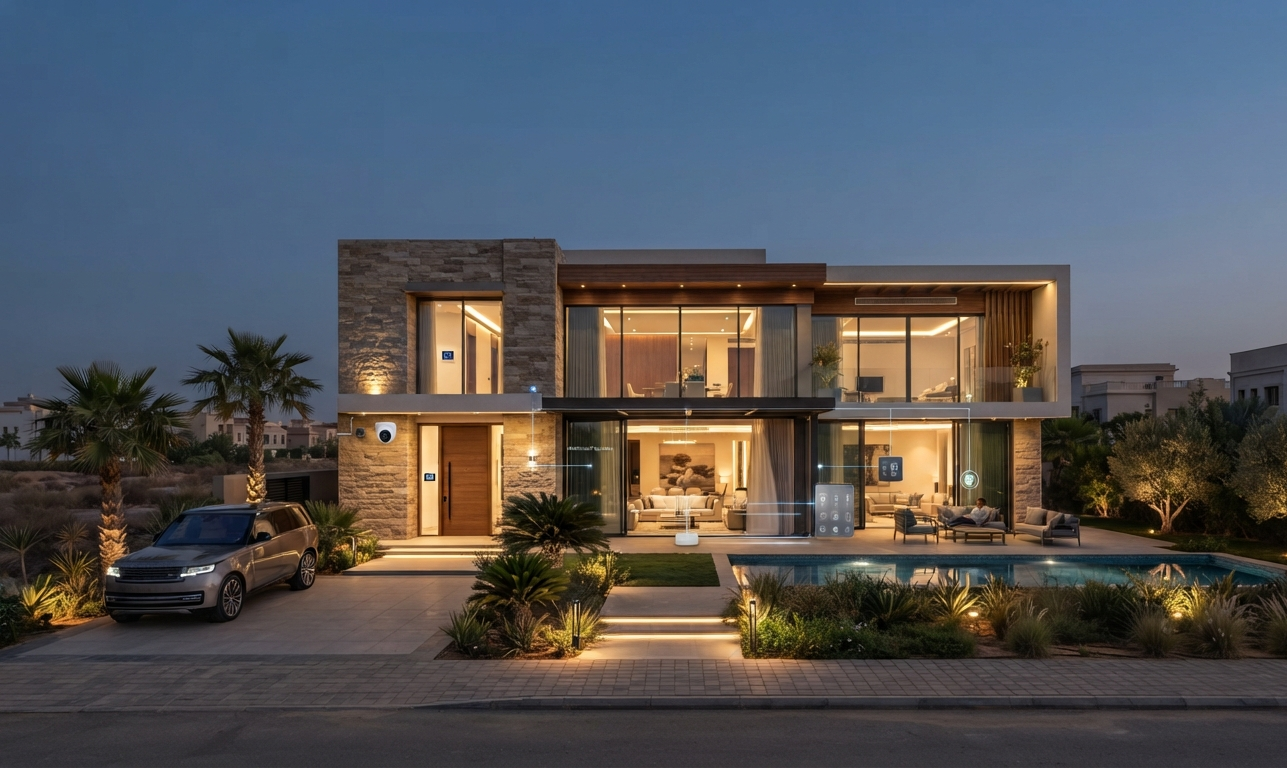
Smart home automation in Saudi Arabia for a fully automated luxury villa. A standard package includes smart lighting, security cameras and locks, climate (AC) control, and app or voice control, all connected through a central hub. Pricing depends mainly on villa size, brand tier, and whether the system is wired or wireless.
This guide breaks down exactly what's included at each price tier, which technologies Saudi installers use, and how to avoid the most common cost mistakes homeowners make.
What Is Smart Home Automation?
Key takeaway: Smart home automation is the use of connected devices and a central control system to automatically manage lighting, security, climate, and appliances in a home, either on a schedule, through sensors, or via an app.
Smart home automation refers to a network of connected devices lights, locks, thermostats, cameras, curtains, and sensors that communicate with each other through a hub or gateway. Instead of operating each device manually, homeowners control them from a smartphone app, a wall panel, a voice assistant, or automated routines (for example, curtains closing automatically at sunset to reduce cooling load).
In Saudi Arabia, smart home automation is most commonly installed in three property types: new-build villas (where wiring is integrated during construction), existing villas and apartments (retrofitted with wireless systems), and compounds or residential towers in cities like Riyadh, Jeddah, and Dammam, where developers increasingly offer automation as a built-in feature.
What Does a Smart Home Automation System in Saudi Arabia Typically Include?
Key takeaway: A standard Saudi smart home package includes five core categories: lighting control, security, climate control, motorized curtains/blinds, and a central control hub — with energy management as a growing sixth category.
Smart Lighting Control
Smart lighting lets homeowners dim, schedule, or group lights by room, and control them remotely. In Saudi villas, lighting automation is often the entry point into a larger system because it's relatively low-cost and delivers immediate, visible convenience.
- Dimmable smart switches and bulbs
- Scene presets (e.g., "Majlis Evening," "Away Mode")
- Motion-triggered lighting for hallways, garages, and entrances
- Scheduling tied to prayer times or sunset/sunrise, a feature increasingly requested by Saudi homeowners
Smart Security: Cameras, Locks, and Alarms
Security is consistently the highest-priority category for Saudi buyers, ahead of lighting or entertainment automation.
- HD/4K cameras with night vision and mobile alerts
- Smart door locks (PIN code, fingerprint, or app-based)
- Video doorbells with two-way audio
- Door/window sensors linked to an alarm system
- Integration with gate motors and intercoms, common in villa compounds
Climate and AC Automation
Given Saudi Arabia's extreme summer heat, climate automation is one of the categories with the fastest payback period through energy savings.
- Smart thermostats for centralized or split AC units
- Room-by-room temperature scheduling
- Occupancy-based cooling (AC reduces output in empty rooms)
- Integration with curtain automation to reduce solar heat gain
Smart Curtains and Blinds
Motorized curtains are more popular in Saudi homes than in many other markets, largely because they directly reduce cooling costs during peak sun hours.
- Motorized tracks for existing curtains
- Scheduled opening/closing by time or sun position
- Integration with the AC system for heat-load reduction
Central Hub and Control (Voice/App)
Every automation category above connects through a central hub, which is the "brain" of the system.
- Mobile app control (iOS/Android)
- Voice control via Alexa, Google Assistant, or Arabic-language voice assistants
- Wall-mounted touch panels for shared spaces (majlis, kitchen)
- Automation "scenes" that combine multiple devices into one command (e.g., "Good Morning" triggers lights, curtains, and AC together)
Energy Management (Emerging Category)
An increasing number of Saudi installations now include energy monitoring, driven by rising utility costs and Vision 2030's sustainability targets.
- Real-time electricity usage dashboards
- Smart plugs with per-device consumption tracking
- Solar integration for villas with rooftop panels
What Factors Affect the Cost of Smart Home Automation in KSA?
Key takeaway: The five biggest cost drivers are property size, wired vs. wireless technology, brand tier, number of automated categories, and whether the home is new-build or retrofit.
- Property size: Larger villas need more devices, more wiring runs, and more zones, which scales cost close to linearly with square meterage.
- Wired vs. wireless: Wired systems (like KNX) cost more upfront due to cabling and labor but are more reliable long-term; wireless systems are cheaper to install but may need battery/hub maintenance.
- New-build vs. retrofit: Installing automation during construction is 20–40% cheaper than retrofitting an already-finished villa, since wiring can be run before walls are closed.
- Brand tier: European premium brands (common in KNX ecosystems) cost significantly more than mainstream Wi-Fi/Zigbee brands, but often come with longer warranties and professional certification.
- Number of integrated categories: A system that only handles lighting is far cheaper than one integrating lighting, security, climate, curtains, and energy management together.
Post-installation costs to plan for: most homeowners underestimate ongoing costs. Budget for annual maintenance (typically 5–10% of system cost), app/cloud subscription fees for some camera or security platforms, and occasional firmware or hub upgrades every 3–5 years.
What Are the Benefits of Smart Home Automation for Saudi Homeowners?
Key takeaway: The three most valued benefits among Saudi homeowners are energy savings on cooling, stronger home security, and convenience for large multi-generational households.
- Energy savings: Automated AC and curtain scheduling can meaningfully cut cooling costs, which typically represent the largest share of a Saudi household's electricity bill.
- Enhanced security: Remote monitoring and smart locks are especially valued for villas where family members travel frequently or where staff/domestic help need managed access.
- Convenience for large households: Multi-generational Saudi homes benefit from room-specific scenes and scheduling that accommodate different family members' routines.
- Higher property value: Pre-installed automation is increasingly a selling point in villa listings in Riyadh and Jeddah.
- Accessibility: Voice and app control benefit elderly residents or those with mobility limitations.
What Are Common Use Cases for Smart Home Automation in Saudi Villas and Apartments?
Key takeaway: The most common real-world use cases are pre-cooling a villa before arrival, automated Ramadan lighting schedules, and remote monitoring of domestic staff access.
- Pre-arrival cooling: Homeowners trigger AC remotely before returning home, especially useful during summer commutes.
- Ramadan and prayer-time automation: Lighting and curtain schedules are adjusted automatically around iftar and prayer times.
- Guest access management: Temporary PIN codes for smart locks are issued to guests, drivers, or maintenance staff without sharing permanent keys.
- Vacation/travel mode: Randomized lighting schedules simulate occupancy while the family is traveling.
- Multi-zone entertaining: Majlis and outdoor majlis areas get dedicated lighting and audio scenes for gatherings.
How Do You Implement Smart Home Automation in a New or Existing Home?
Key takeaway: Implementation follows five steps: assess needs, choose wired or wireless, select a certified installer, install in phases, and test/commission the full system.
- Assess your needs and budget. Decide which categories matter most (security is usually the priority) and set a realistic budget tier from the table above.
- Choose wired or wireless based on construction stage. New-build favors wired (KNX); existing homes favor wireless (Zigbee/Z-Wave/Wi-Fi/Matter).
- Select a licensed, experienced installer. Ask for SASO-compliant electrical work, references from completed Saudi projects, and a clear warranty on both hardware and labor.
- Install in phases if budget is limited. Start with security and lighting, then expand to climate control and curtains later — most hubs are designed to scale.
- Test and commission the system. A proper installer should walk through every scene and automation rule with you before final handover, not just install hardware.
Homeowners planning a residential lighting project can explore Al Rouf’s smart home lighting installation solutions in Saudi Arabia for wired, wireless and hybrid control options.
What Are Best Practices When Choosing a Smart Home Automation Company in Saudi Arabia?
Key takeaway: Prioritize installers with verifiable local project experience, transparent itemized quotes, and post-installation support plans — not just the lowest price.
- Request an itemized quote broken down by device and labor, not a single lump sum.
- Confirm the installer is certified for the specific protocol they're proposing (KNX certification is a recognized, verifiable credential).
- Ask about local support response times — remote or overseas-only support is a common source of post-installation frustration.
- Check whether cameras and locks are SASO-compliant for the Saudi market.
- Get the warranty terms in writing, covering both hardware failure and labor for repairs.
What Common Mistakes Should You Avoid When Installing a Smart Home System?
Key takeaway: The most costly mistakes are choosing wireless for a large villa, skipping professional design, and ignoring ongoing subscription costs.
- Using wireless systems in very large villas: Wi-Fi/Zigbee signals can struggle across thick walls and multiple floors, causing reliability issues; large properties often need wired backbones or mesh extenders.
- Skipping a proper design phase: Homeowners who buy devices piecemeal without a system plan often end up with incompatible ecosystems that can't be unified under one hub.
- Ignoring subscription and maintenance costs: Some camera and security platforms charge ongoing cloud storage fees — factor this into your total cost of ownership, not just the installation price.
- Choosing based on price alone: The cheapest quote often excludes labor for concealed wiring, panel programming, or post-installation training.
- Not planning for future expansion: Choosing a closed, proprietary ecosystem can make it expensive or impossible to add devices from other brands later; Matter-compatible systems avoid this lock-in.
How Does Smart Home Automation Support Saudi Vision 2030 and Smart City Goals?
Key takeaway: Smart home adoption in Saudi Arabia is accelerating alongside Vision 2030's smart city initiatives, including NEOM, which are driving demand for energy-efficient, connected residential technology.
Saudi Arabia's Vision 2030 strategy includes significant investment in smart city infrastructure, most visibly through projects like NEOM, which has publicly emphasized connected, sustainable living environments. This national push is a major reason smart home adoption among individual villa owners has grown steadily, as energy efficiency and connected living become mainstream expectations rather than luxury add-ons. Homeowners investing in automation now are generally aligning with, rather than working against, where residential building standards in the Kingdom are headed.
Frequently Asked Questions
Is smart home automation worth the cost in Saudi Arabia?
For most villa owners, yes, the combination of AC energy savings, security, and convenience typically justifies the investment within a few years, especially for mid-range and premium packages.
Can I add smart home automation to an existing villa without rewiring?
Yes. Wireless systems using Zigbee, Z-Wave, or Wi-Fi can be retrofitted without major rewiring, though very large villas may still need a few wired components for reliability.
Which is better for Saudi homes: KNX or Zigbee?
KNX is better for new-build villas seeking maximum reliability and long-term value; Zigbee is better for existing homes needing a faster, lower-cost retrofit.
Do smart home systems work during power outages?
Most systems lose functionality during outages unless paired with a UPS or backup battery; ask your installer about backup power options for critical devices like locks and alarms.