
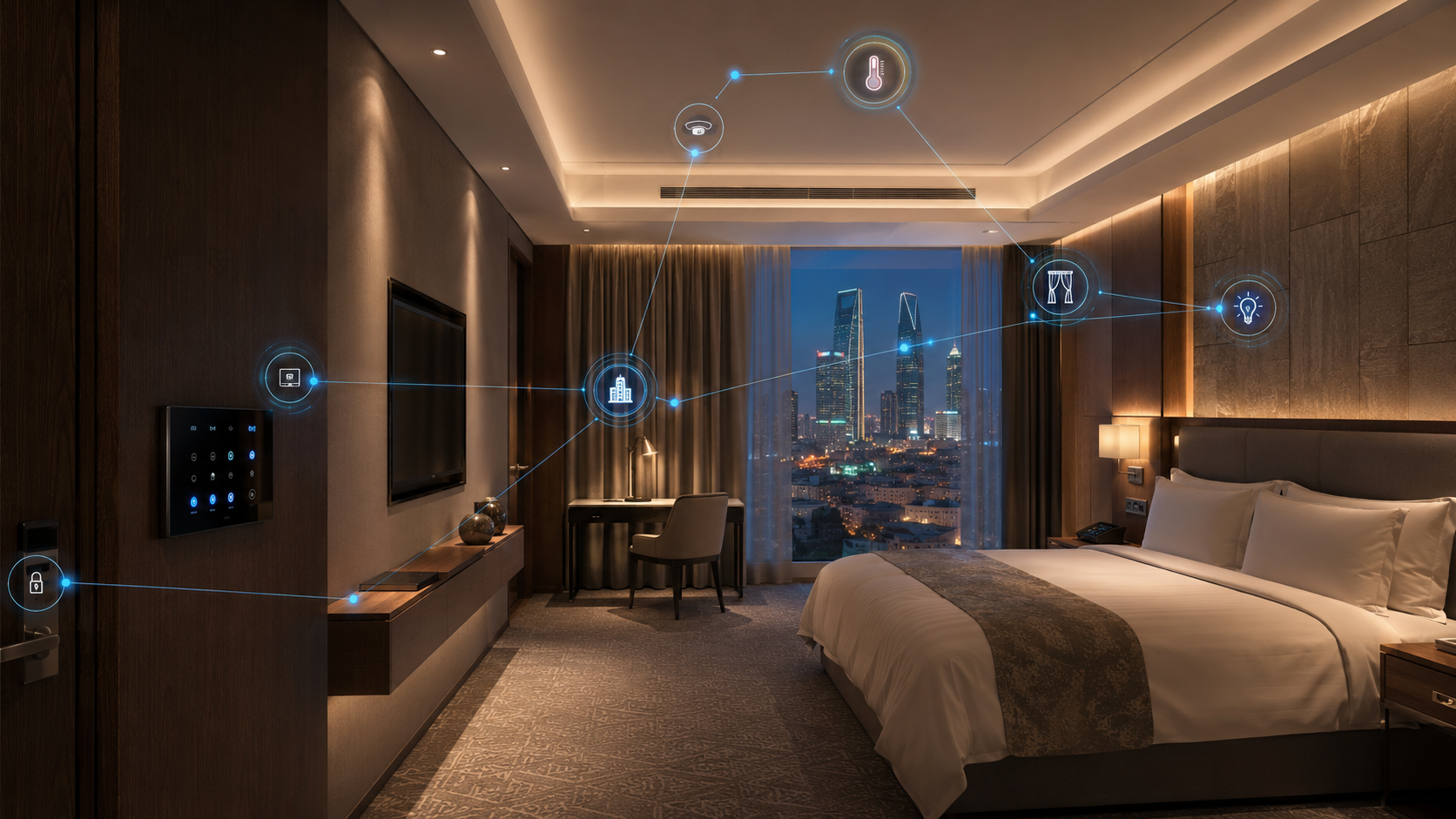
Smart hotel technology connects guest room controls including lighting, HVAC, curtains, access and occupancy sensors with platforms such as the Guest Room Management System (GRMS), Property Management System (PMS) and Building Management System (BMS). This integration improves guest comfort, automates hotel operations and reduces unnecessary energy use throughout the guest journey.
Modern hotel automation is not simply a collection of smart switches or mobile applications. Its real value comes from enabling room devices and management platforms to exchange information and respond together, from check-in to check-out.
Smart hotel technology is an integrated network of sensors, controllers, guest interfaces and management platforms that automates hotel rooms, public areas and building services.
A smart hotel ecosystem may include:
These technologies can operate separately, but integration creates greater value. For example, when the PMS registers a check-in, the GRMS can prepare the assigned room by changing the HVAC from an energy-saving setting to comfort mode. When the guest enters, the room can activate a welcome lighting scene and enable the guest controls.
Guest room automation uses sensors, controllers and programmed sequences to coordinate lighting, temperature, curtains and other functions. The Room Control Unit receives information from guest commands, sensors, schedules and hotel-management platforms, then sends instructions to the appropriate equipment.
Guests may interact with the system through wall-mounted keypads, bedside panels, touchscreens, thermostats, remote controls or mobile interfaces. The interface should hide the technical complexity. Guests should be able to activate a scene or adjust the temperature without understanding the automation architecture behind it.
Smart lighting enables control of zones, brightness, colour temperature and preset scenes. A room can be divided into entrance, sleeping, bedside, workspace, bathroom, closet and decorative-lighting zones.
Independent zoning gives guests flexibility. A reading light can operate without illuminating the whole room, while dimmable bathroom lighting can prevent an uncomfortable transition from a dark bedroom.
Useful guest room scenes include:
All automatic scenes should allow manual guest control. Automation should support guest choice, not restrict it.
Hotel HVAC automation regulates heating, cooling, ventilation and fan-coil operation according to room conditions and occupancy status.
The system may respond to guest-selected temperature, actual room temperature, check-in status, temporary absence, door or window position, schedules and energy rules.
An unoccupied room may use an economical setpoint. After check-in, it can enter comfort mode and move toward the desired temperature. Energy-saving sequences must be carefully configured so that a guest is not made uncomfortable simply because a sensor temporarily detects no movement.
Automated curtains can support comfort, privacy and energy management. They may open with a morning scene, close during sleep mode, respond to sunlight or coordinate with daylight-based lighting.
They can also help reduce solar heat gain during hot periods. However, the guest should always have a clear manual override because privacy and comfort preferences vary.
Sensors provide the information required for intelligent decisions. A hotel may use occupancy, temperature, humidity, daylight, door, window and water-leak sensors.
Occupancy information can help turn off unnecessary lights, adjust HVAC setpoints, dim corridors, support housekeeping and identify unusual conditions. Sensor selection and positioning matter: a poorly positioned sensor can create false triggers or fail to detect a guest who is resting without significant movement.
A Guest Room Management System is the platform responsible for monitoring and controlling automated functions inside hotel rooms.
A GRMS may manage:
The GRMS primarily manages the guest room experience. It should maintain essential local operation if communication with another platform becomes temporarily unavailable.
GRMS, PMS and BMS perform separate but connected roles. The GRMS controls the room, the PMS manages the guest’s stay and the BMS supervises building-wide services.
| System | Primary responsibility | Typical information |
|---|---|---|
| GRMS | Guest room automation | Lighting, HVAC, curtains, occupancy and room status |
| PMS | Reservations and operations | Bookings, room assignments, check-in and check-out |
| BMS | Building-wide services | HVAC equipment, energy meters, alarms and central plant |
| Access control | Door security | Credentials, permissions and door status |
Keeping these responsibilities clear prevents duplicated commands and conflicts between systems.
Integration allows hotel systems to respond to changes in guest and room status. A typical sequence works as follows:
Not every piece of guest data needs to be shared. The integration scope should specify which information is necessary, who can access it and what happens if communication fails.
BMS integration connects room automation with the hotel’s centralized platform for monitoring building services. A hotel BMS may supervise central HVAC equipment, pumps, electrical distribution, energy meters, water systems, public-area lighting and equipment alarms.
The GRMS may provide selected information such as occupancy, room temperature, HVAC demand or device alarms. The BMS can use it to improve building-level monitoring without taking inappropriate control away from the guest room system.
Smart hotel projects may use KNX, BACnet, Modbus, DALI, LON, 0–10V and IP-based communication. These technologies have different roles and are not automatically interchangeable.
An integrated hotel may require gateways or multi-protocol interfaces. Supporting the same protocol does not guarantee full interoperability, so compatibility must be verified before installation.
Smart hotel technology reduces consumption by matching lighting and HVAC operation to actual occupancy, daylight and room status.
Common strategies include occupancy-based lighting, daylight harvesting, scheduled public-area lighting, HVAC setbacks, check-in automation, blind control, energy metering and dimming.
For example, corridor lights may remain at a reduced level during low-traffic periods and increase when movement is detected. An unoccupied room may use an economical temperature setpoint until the PMS registers a check-in.
Energy-saving percentages should not be presented as guaranteed results. Actual performance depends on the baseline, occupancy, climate, daylight, HVAC design, control sequences and commissioning. A site assessment and baseline analysis are needed before estimating savings.
When correctly designed, smart hotel automation can benefit guests, operators and building owners.
Smart hotel controls should be designed around measurable objectives. Before installation, the hotel can record baseline energy consumption, guest comfort complaints, maintenance response times and room preparation procedures. After commissioning, the same indicators can be reviewed to determine whether the system is delivering its intended value. Useful performance measures may include guest room energy use, HVAC operating hours, lighting runtime, equipment alarms, response time and the number of manual overrides. Monitoring these results helps hotel teams improve control sequences without relying on assumptions or reducing the quality of the guest experience.
The cost depends on the number of rooms, automation scope, existing infrastructure and required integrations. Hotels should evaluate lifecycle value rather than hardware price alone.
Important cost factors include:
A technical assessment is required before producing an accurate budget.
Existing hotels can be upgraded, but the right approach depends on wiring, room design, current controls and renovation constraints.
Retrofit options may include wireless sensors, kinetic switches, smart thermostats, replacement room controllers, BMS gateways or hybrid systems. Wireless products may reduce disruption, but signal coverage, interference, cybersecurity and maintenance must still be assessed.
Before selecting a solution, survey the lighting circuits, HVAC controls, networks, electrical panels and existing PMS and BMS platforms.
A successful project should begin with the required guest and operational outcomes, not a list of smart devices.
Define what should happen during check-in, first entry, temporary absence, sleep, housekeeping, maintenance and check-out.
Specify which functions belong to the GRMS, PMS, BMS, access platform and energy-management system.
Create a written sequence for normal use, manual override, open windows, alarms, network failure and check-out.
Confirm that controllers, gateways, luminaires, HVAC equipment and software communicate as required. Test compatibility rather than relying only on protocol names.
Use network segmentation, secure authentication, role-based access, controlled remote access and clear update procedures. Exchange only the information needed for the approved function.
Test full workflows rather than individual devices. Commissioning should cover check-in, scenes, HVAC response, sensors, PMS communication, BMS monitoring, manual overrides, alarms and failures.
Facility, IT, front-office, housekeeping and maintenance teams should understand the functions relevant to their roles.
The most common mistake is installing connected devices without defining how the complete system should operate.
Other mistakes include complicated interfaces, dependence on a mobile app, poorly positioned sensors, energy logic that reduces comfort, no manual override, incompatible products, undefined data ownership, weak cybersecurity, missing failure testing and incomplete commissioning.
If guests need instructions for basic functions, the automation may be too complicated.
Alrouf’s experience in lighting technology and lighting-control applications can support the planning of integrated, energy-conscious hotel environments in Saudi Arabia.
Depending on the confirmed scope, a technical assessment can evaluate guest room lighting zones, control strategies, sensors, dimming, hotel scenes, public-area controls, energy-saving opportunities, product compatibility and integration requirements.
Every hotel has different room types and infrastructure. Contact Alrouf to discuss your room count, existing systems, lighting requirements and automation objectives before selecting the final solution.
Smart hotel technology connects guest room controls and hotel platforms to automate lighting, HVAC, curtains, access, energy use and operational workflows.
A GRMS controls and monitors room functions such as lighting, temperature, curtains, occupancy and service indicators.
GRMS focuses on individual guest rooms. BMS monitors building-wide mechanical, electrical and energy systems.
Yes. Integration can allow the GRMS to respond to room assignment, check-in and check-out, depending on the supported interfaces.
Yes. Existing hotels may use wired, wireless or hybrid solutions after a technical survey of infrastructure and compatibility.
No. Essential guest functions should retain intuitive manual controls and appropriate fallback operation.
