
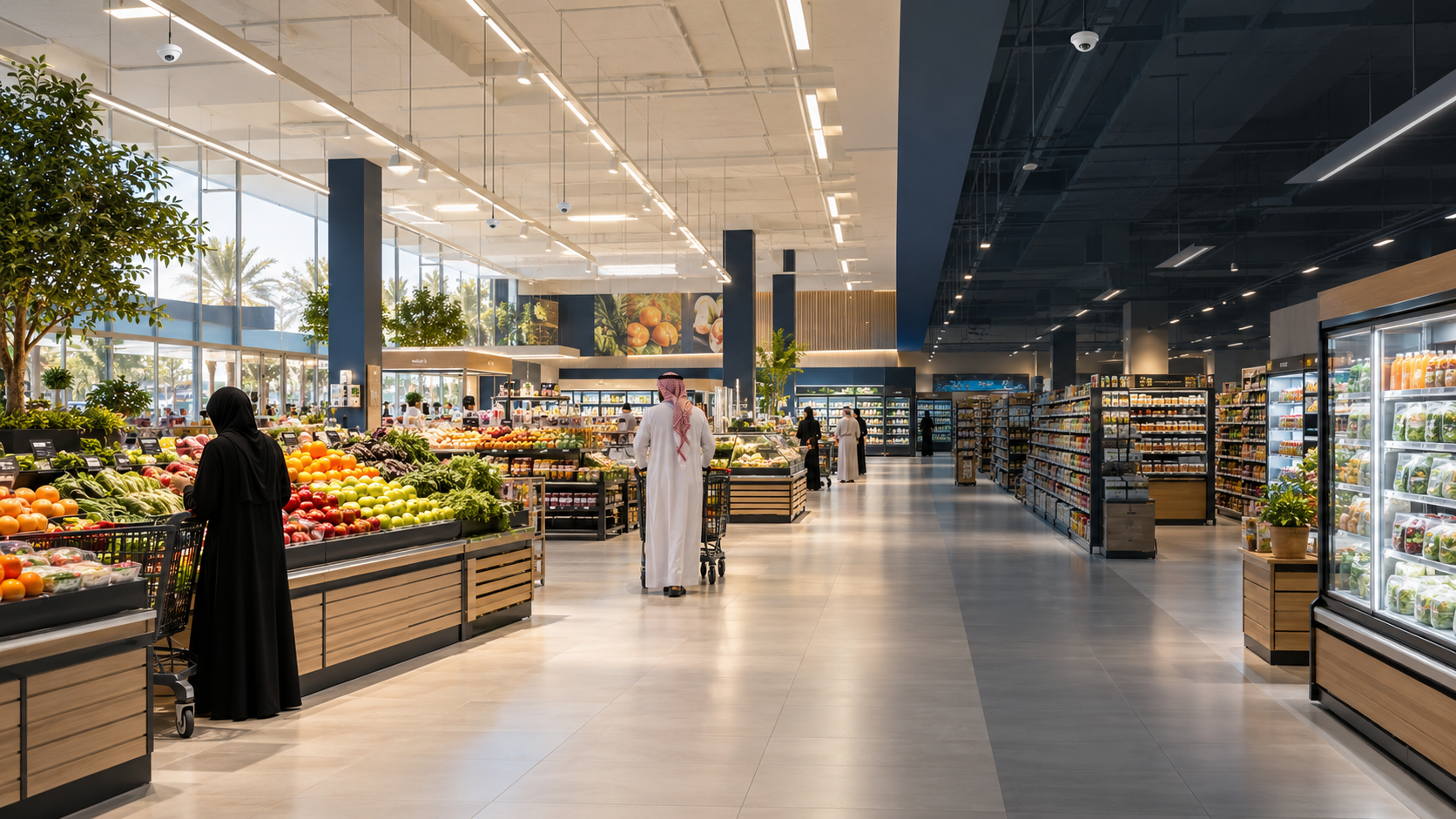
Smart lighting for supermarkets reduces energy costs by combining efficient LED luminaires with scheduling, occupancy sensors, daylight sensors, dimming and zone-based control. Instead of operating every light at full output throughout the day, the system provides the required illumination only where and when it is needed. This reduces lighting consumption, cooling demand and maintenance costs without compromising product visibility or customer comfort.
For supermarkets and hypermarkets in Saudi Arabia, these savings are particularly valuable because stores have large floor areas, long operating hours and substantial air-conditioning requirements.
Supermarkets require continuous lighting across sales floors, checkout counters, fresh-food departments, refrigerated displays, warehouses, offices, parking areas and exterior façades.
Energy is often wasted when:
A smart lighting control system addresses these problems by adjusting lighting according to actual store conditions.
Smart lighting is an automated system connecting LED luminaires, sensors, switches, controllers and management software. It allows the lighting to respond to store schedules, occupancy, daylight and the operational requirements of individual departments.
A commercial smart lighting system may include:
The objective is to deliver the correct amount of light in each area while minimizing unnecessary electricity consumption.
LED luminaires reduce the wattage required to produce light. Smart lighting reduces the number of hours and output level at which those luminaires operate.
Replacing conventional fixtures with commercial LED lighting can reduce the connected lighting load. However, energy is still wasted if every LED operates at 100% throughout shopping, cleaning, restocking and security periods.
A complete energy-saving strategy combines:
LED lighting is therefore the efficiency foundation, while smart controls capture additional operational savings.
Lighting schedules can follow the supermarket’s actual timetable instead of relying on employees to switch lights manually.
Different scenes can be created for:
During cleaning or restocking, only active departments need full illumination. Other areas can be switched off or dimmed to a safe background level.
Occupancy sensors detect whether an area is being used and automatically switch or dim the lighting after it becomes vacant.
Suitable locations include:
Customer-facing areas should usually use gradual dimming instead of abrupt switching. Sensor positioning must also account for tall shelves and promotional displays that could block movement detection.
Daylight harvesting uses light sensors to measure natural illumination. When sufficient sunlight enters the building, nearby fixtures are automatically dimmed while the required light level is maintained.
Potential applications include:
Each daylight zone should be calibrated separately because daylight availability decreases farther from the façade or skylight.
A hypermarket should not be controlled as one large lighting circuit. Each area has different operating hours and lighting requirements.
Separate zones may be created for:
For example, closed checkout lanes can be dimmed while active lanes retain full task lighting. Warehouse lighting can also remain at a minimum level until an employee enters a specific aisle.
Some supermarkets provide more light than their activities require because of conservative designs or later changes to shelves and displays.
Smart dimming allows each zone to operate at its required level rather than forcing every fixture to run at 100%.
Appropriate levels should be established through:
The objective is not to make the store darker. It is to eliminate unnecessary output while maintaining comfortable, uniform and commercially effective illumination.
Photocells, astronomical clocks, motion sensors and programmed schedules can manage:
These controls prevent exterior lights from remaining on during daylight because of incorrect schedules, failed sensors or forgotten manual overrides.
Lighting releases heat into the building. Air-conditioning and refrigeration systems may then consume additional energy to remove that heat.
When LEDs and smart controls reduce lighting power:
This secondary benefit is especially relevant in Saudi Arabia, where air-conditioning demand remains high for much of the year.
The exact cooling reduction depends on the climate, building design, lighting location, refrigeration configuration and HVAC efficiency. It should be calculated separately rather than presented as a guaranteed percentage.
Scheduled operation, zoning and dimming allow aisle lighting to operate at shopping levels during business hours and lower levels during cleaning or restocking.
Bakery, produce, meat and fish departments require carefully selected light levels and color characteristics. Scene control can support product presentation while avoiding unnecessary output.
Efficient LED lighting produces less heat than older technologies and can be coordinated with store schedules. This can reduce direct lighting consumption and limit heat around chilled products.
Checkout lighting can be divided according to active lanes. Closed counters can be dimmed while occupied counters retain appropriate task illumination.
These areas often provide strong opportunities for occupancy control because traffic is intermittent. Lighting can rise when employees enter and return to a safe minimum level when the area becomes vacant.
Occupancy and daylight sensors can prevent lights from operating unnecessarily in offices, meeting rooms, staff rooms, toilets and corridors.
Photocells and schedules can prevent daytime operation while maintaining appropriate illumination for vehicles, pedestrians, deliveries and security.
The Alrouf Smart Lighting Control Product Catalog 2026 presents integrated solutions for commercial and smart-building projects.
The documented range includes:
This range allows a solution to be designed according to the supermarket’s size, existing infrastructure, integration requirements and future expansion plans.
Alrouf wireless kinetic switches generate the energy needed to transmit a command when pressed. They require no control wiring or batteries at the switch location.
Potential retail benefits include:
The primary benefit is installation and operational flexibility. The largest energy savings still come from correct scheduling, sensing, dimming and zoning.
There is no universal energy-saving percentage for every store. Results depend on the existing lighting, annual operating hours, control strategy, daylight and occupancy patterns.
Annual baseline consumption can be estimated as:
Annual financial savings can then be calculated as:
A reliable assessment should consider:
Savings from LEDs, sensors, schedules and dimming should not simply be added together because these measures interact and may overlap.
Collect utility bills, fixture information, operating schedules and maintenance records. Lighting submetering can provide more reliable results than using the total store electricity bill.
Document fixture types, wattages, quantities, lux levels, operating hours, daylight availability and occupancy patterns.
Create control zones based on actual functions and operating schedules rather than treating the building as one circuit.
Use occupancy sensors in intermittent-use spaces, daylight sensors near windows, and scheduling and dimming across customer-facing areas.
A representative department or branch can be used to evaluate sensor coverage, customer comfort, system reliability and actual energy savings.
Sensors, schedules, dimming limits and daylight setpoints must be calibrated. Settings should be reviewed whenever store layouts or operating hours change.
Supermarkets can evaluate smart lighting performance using:
For retail chains, comparing similar branches can reveal poor-performing stores and control-system problems.
Savings vary according to the existing fixtures, operating hours, occupancy, daylight and selected controls. A lighting audit and baseline measurement are needed before providing a reliable estimate.
Yes. Wired and wireless control systems can support retrofit projects. Existing luminaires and drivers must first be checked for compatibility with dimming and automated controls.
The correct system depends on store size, existing infrastructure, integration requirements and budget. DALI, KNX, Casambi, Zigbee and RF solutions serve different project needs.
A properly commissioned system should maintain comfortable, consistent illumination. Customer areas should use smooth dimming and carefully designed scenes rather than distracting on-and-off changes.
Payback depends on the project cost, lighting load, annual operating hours, electricity tariff and maintenance savings. It must be calculated using site-specific data.
Smart lighting for supermarkets reduces energy costs by controlling both the wattage and operating time of the lighting system. LEDs lower the connected load, while scheduling, occupancy detection, daylight harvesting, dimming and zoning eliminate unnecessary consumption.
For supermarkets and hypermarkets in Saudi Arabia, an effective system must balance energy efficiency with product presentation, visual comfort, safety and store operations. The project should begin with a professional audit, apply the right controls to each zone and measure performance against an established energy baseline.
