
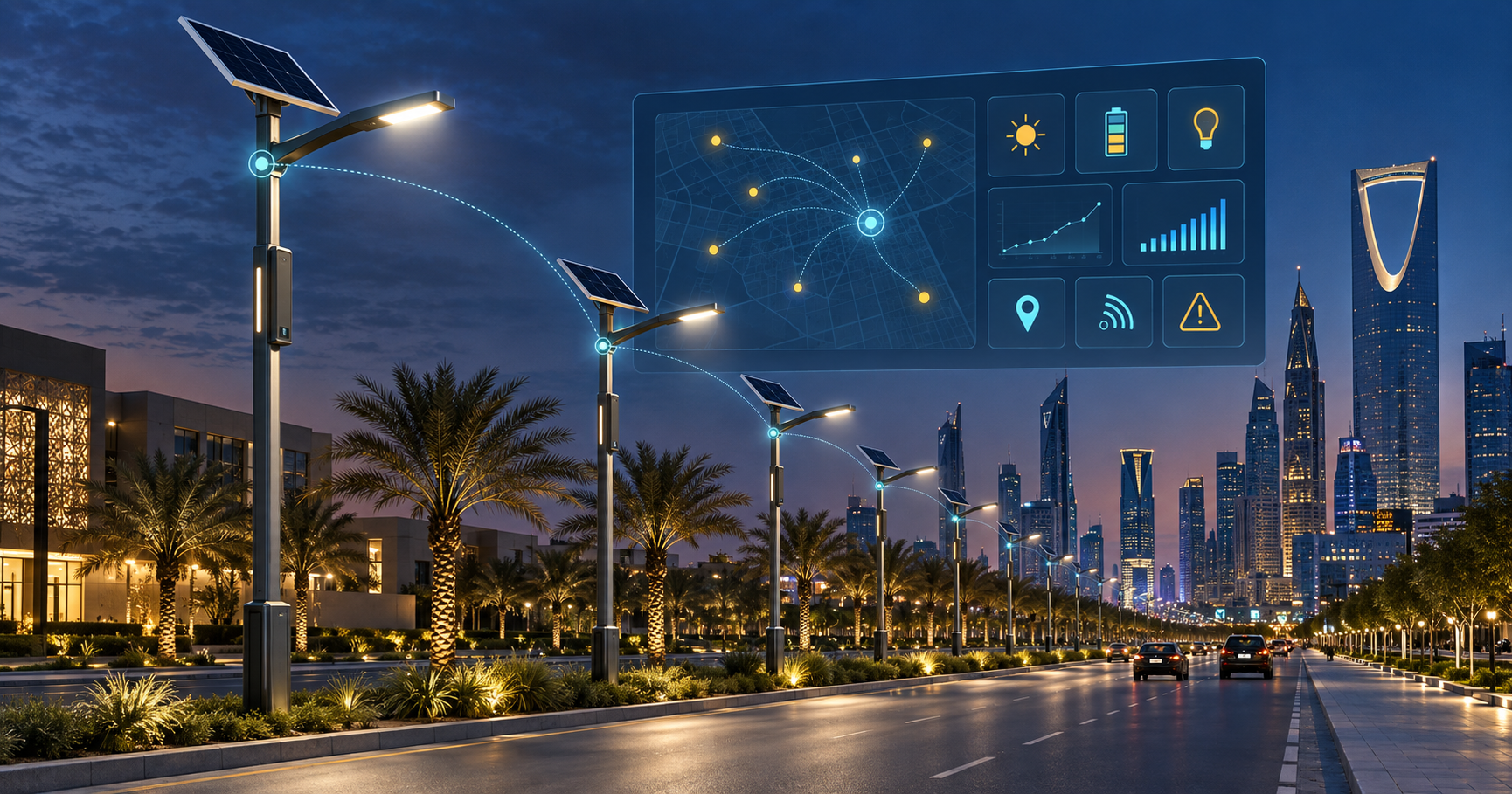
Smart solar streetlights combine solar-powered LED lighting with connected controls that can share operating data and, where supported, receive commands from a central management platform. This can help operators monitor lighting points, adjust schedules, and identify assets that may need attention.
The distinction matters: a solar streetlight can switch on at dusk or follow a programmed dimming schedule without being connected to an IoT network. Remote monitoring requires compatible equipment, communications, a management platform, and an operating process.
For Saudi municipalities, developers, and infrastructure teams, the right system depends on the number of lighting points, their locations, and what the operations team needs to see or control.
An integrated solar streetlight typically uses a panel to generate electricity, a battery to store it, an LED luminaire to provide light, and a controller to manage operation. Local controls may handle dusk-to-dawn switching, timers, or sensor-based dimming.
A connected solar streetlight adds a way to exchange information with a management system. Depending on the specified equipment, that system may show asset status, receive alerts, or allow authorized users to change lighting schedules remotely.
Not every solar streetlight includes connectivity. The required monitoring and control functions should be defined and confirmed for the specific product configuration before procurement.
A network has three main parts:
| Layer | Role |
|---|---|
| Lighting point | The solar luminaire and its controller operate the light. Compatible equipment may collect status information. |
| Communication network | Transfers supported data between lighting points and a gateway or management platform. |
| Management platform | Presents available data and controls to authorized operators. |
The information available from a lighting point depends on its hardware and configuration. A connected controller may report whether a luminaire is operating, its current lighting level, or selected battery and charging information. Those data points should be listed explicitly in the project specification.
The communication design depends on fixture spacing, obstructions, available coverage, data needs, and the power used by network equipment. Technologies such as RF networks, cellular connections, LoRaWAN, or NB-IoT may be considered in different projects, but compatibility must be verified for the proposed system.
A central platform can give operators a view of connected assets instead of relying only on site inspections or public fault reports. The usefulness of that view depends on which components can actually send data.
For example, a project may require reporting for the luminaire, controller, battery, or communications connection. The tender should identify each required data point and the expected reporting frequency.
Where remote control is supported, authorized operators may change operating times or brightness profiles across individual lights or groups. This can help manage lighting in areas with different nighttime activity.
Any revised profile must still meet the approved lighting requirements. A control platform does not replace the road or public-space lighting design.
A connected system may flag an asset that is not operating as expected or has stopped communicating. The alert can help a maintenance team identify where to investigate.
An alert does not always establish the cause of a fault. The team may still need to inspect the luminaire, battery, panel, controller, or communications equipment on site.
The two functions are often described together, but they answer different needs.
| Function | What it does | Does it require a central network? |
|---|---|---|
| Dusk-to-dawn switching | Turns the light on and off according to daylight conditions | Generally no |
| Local timer or sensor dimming | Changes brightness according to a programmed profile or detected activity | Generally no |
| Remote status monitoring | Sends supported asset information to operators | Yes |
| Remote schedule changes | Allows authorized operators to update settings through a platform | Yes |
The Alrouf Triton Series Integrated Solar Street Light is an off-grid product range with controller-dependent lighting modes. Its documented local controls should not be confused with confirmed IoT connectivity. If a project requires remote monitoring or commands, ask Alrouf to identify a compatible product and control-system configuration.
For help choosing the physical luminaire, panel, battery, and optics for a road, read How to Choose a Solar Street Light for Roads in Saudi Arabia.
A standalone solar streetlight may meet the needs of a small site where automatic local operation is sufficient and maintenance staff can inspect fixtures easily.
A connected system may offer more value when a project has many lighting points spread across roads or public spaces, when inspection routes are long, or when the operator needs a central record of status and faults.
The decision should begin with an operational question: What information or action would help the team run the lighting network? Connectivity adds equipment, configuration, and management responsibilities, so each requested function should have a clear purpose.
Roads, parks, compounds, and public facilities can contain lighting assets distributed over a wide area. A connected system may help the owner identify assets, apply schedules to defined zones, record faults, and plan maintenance visits.
If the lighting network must connect to a municipal platform, building system, or another smart-city environment, specify the required interfaces and verify technical compatibility before purchase. Data access, user permissions, hosting, and cybersecurity responsibilities should also be agreed during the design stage.
For the wider procurement, installation, and handover process, see Public Solar Lighting in Saudi Arabia: From Procurement to Handover.
A useful smart solar lighting brief should answer these questions:
Capabilities such as location reporting, movement alerts, or detailed battery monitoring should be written as project requirements only when needed. Their availability must be confirmed for the product and platform offered; they should not be assumed for every solar streetlight.
Alrouf offers solar lighting products for road and outdoor applications, including integrated streetlights with local lighting controls. The suitable approach to connected monitoring must be confirmed against the selected equipment and project specification.
Contact Alrouf with your project location, number of lighting points, required operating hours, monitoring data, remote-control needs, and any existing platform requirements. The team can then review the product and control options appropriate to the project.
A solar streetlight generates and stores energy to operate its LED luminaire. A connected smart solar streetlight also uses compatible communications and a management platform to share supported data or receive remote commands.
No. A timer or motion sensor can adjust brightness locally without connecting the light to a central platform.
Yes, when the selected equipment, communications network, and platform support remote monitoring. The available data must be confirmed for the proposed configuration.
It may report a fault state or unusual condition, but a site inspection can still be needed to identify the cause and complete a repair.
Remote monitoring is not established by the Triton product specification reviewed here. Triton has documented local control modes; any connected-control requirement should be confirmed separately for the proposed project configuration.
They may be useful when many distributed lighting points need central oversight, remote schedule changes, or structured fault reporting. A smaller installation may only need standalone automatic operation
