
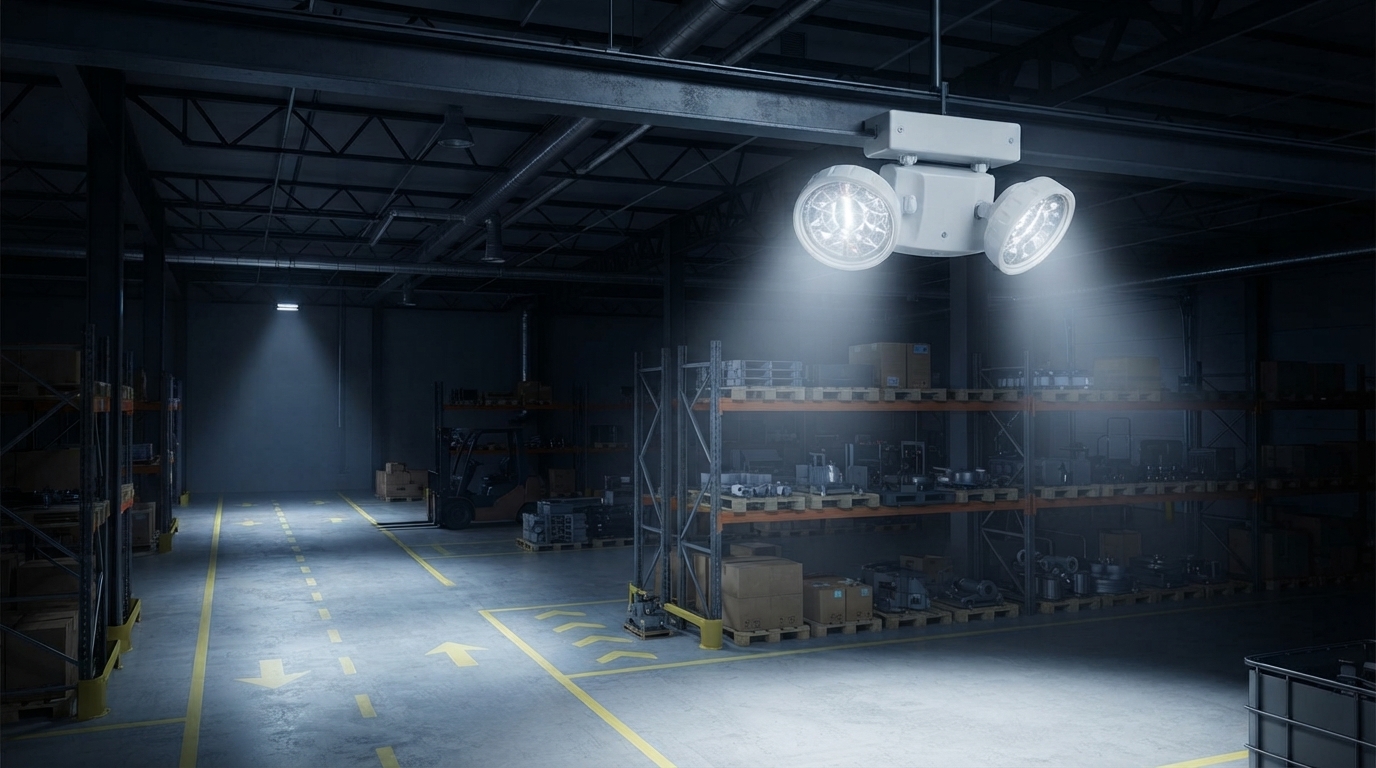
When power fails in an industrial or commercial facility, emergency lighting helps maintain visibility and support safe movement through critical areas. A Twin Head Emergency Light provides a practical solution by using two LED heads to distribute emergency illumination across a wider area.
The BY-Z2035C Twin Head Light from Al Rouf LED is designed for emergency lighting applications where directional illumination is required during a power outage. The unit uses LED technology, operates in non-maintained mode, and provides approximately three hours of emergency operation.
A Twin Head Emergency Light is an emergency lighting fixture equipped with two LED lighting heads. The two-head configuration allows emergency illumination to be directed toward different areas, helping improve visibility across corridors, access routes, open areas, and other critical spaces.
Unlike standard single-head emergency lights, the twin-head configuration can provide more flexible light distribution because the two heads can be positioned to illuminate different directions.
For industrial and commercial facilities, this can be useful where one emergency light needs to cover more than one pathway or area.
The BY-Z2035C operates in Non-Maintained Operation Mode. Under normal conditions, the emergency light remains connected to the AC power supply and maintains its battery charge. During a power failure, the emergency lighting function activates to provide backup illumination.
The model is designed for an emergency duration of approximately 3 hours and includes overcharge and over-discharge protection. A test switch and AC-ON indicator are also included.
This makes the Twin Head Emergency Light suitable for facilities where emergency illumination needs to remain available during temporary power interruptions.
The BY-Z2035C combines LED illumination with battery-backed emergency operation.
Its main features include:
The product catalogue also provides a light distribution curve for the BY-Z2035C, showing an average beam angle of approximately 84.7°, which helps describe how the emergency illumination is distributed.
The main advantage of a twin-head design is flexibility.
Two adjustable lighting heads can be directed toward different areas, allowing the emergency light to support wider or more targeted illumination depending on the installation.
This can be particularly useful when emergency lighting needs to cover:
The twin-head configuration can therefore provide more flexibility than a fixed single-direction emergency light.
Twin Head Emergency Lights can be considered for a range of commercial and industrial environments where emergency illumination is required.
Warehouses often contain large open areas, storage aisles, and access routes that require adequate emergency visibility during a power failure.
A twin-head configuration can help direct illumination toward different sections of the space.
Industrial facilities may contain machinery zones, production areas, and internal access routes. Emergency lighting can help maintain visibility when normal lighting is unavailable.
Workshops can contain equipment and work areas distributed across a relatively large space. Directional emergency illumination can help provide visibility along important access routes.
Emergency lighting can support visibility in indoor parking areas and other enclosed spaces where normal lighting may be interrupted.
Storage facilities may require emergency illumination across aisles and access paths. The two-head design provides flexibility when positioning the light for the required coverage.
The BY-Z2035C is designed around a compact LED emergency lighting system.
According to the product catalogue, the model uses:
Model: BY-Z2035C
Input Voltage: AC 220–240 V, 50/60 Hz, 30 mA
Light Source: SMD 2835, 32 pcs
Input Power: 2.5 W
Operation Mode: Non-Maintained
Emergency Duration: 3 hours
Emergency Luminous Flux: 180 lm
Recharge Time: 24 hours
Battery: Lead Acid 4.0 V 2500 mAh
Protection: IP20
Operating Temperature: 0°C to 40°C
Auto Test: No
Certification: CE & CB-TÜV
A non-maintained emergency light is designed to provide illumination when the normal power supply fails rather than remaining continuously illuminated as an emergency light during normal operation.
The BY-Z2035C is specifically listed as a Non-Maintained emergency lighting model in the product catalogue.
This operating mode can be suitable for installations where emergency illumination is required specifically as backup lighting during a power interruption.
Battery performance is an important consideration when selecting emergency lighting.
The BY-Z2035C uses a 4.0 V 2500 mAh sealed lead-acid battery and provides approximately 3 hours of emergency operation. The catalogue specifies a 24-hour recharge time.
The model also incorporates overcharge and over-discharge protection, supporting the battery charging and emergency operation system.
Before selecting a twin-head emergency light for a warehouse, factory or commercial building in Saudi Arabia, check the exact installation conditions and the approved emergency lighting requirements.
Use the following checklist when evaluating the Alrouf BY-Z2035C:
| Selection Question | What to Check for BY-Z2035C |
|---|---|
| Does the location suit the enclosure protection? | The catalogue lists IP20. Do not select this model for locations requiring higher protection against dust or water. |
| Is the operating temperature suitable? | The stated operating range is 0°C to 40°C. Check conditions at the actual mounting position, including heat near roofs or equipment. |
| Is non-maintained operation required? | This model provides emergency illumination when the normal supply fails. Confirm that this operating mode matches the project specification. |
| Will the proposed arrangement provide sufficient coverage? | Assess the listed 180 lm emergency output using photometric data, mounting height, head orientation and the actual layout. |
| Does the rated duration meet the requirement? | The catalogue specifies three hours of emergency operation and a 24-hour recharge time. Confirm the current product documentation and applicable operating conditions. |
| How will testing and maintenance be managed? | The model includes a test switch and AC-ON indicator. Auto-Test is listed as “No”; plan testing, inspection and records accordingly. |
Two adjustable heads allow light to be directed toward different areas, but they do not establish how many units a building needs.
Storage racks, machinery, changes in direction and mounting positions can affect the illumination reaching the required surfaces. Use the selected product’s emergency photometric data to assess coverage rather than relying on fixture appearance or beam angle alone.
If the location requires different environmental protection, operating features or light distribution, compare other products in the Alrouf emergency lighting range. Confirm the suitability of the exact alternative model.
The main difference is the number and arrangement of lighting heads.
A single-head emergency light generally provides illumination in one primary direction, while a twin-head emergency light provides two adjustable heads that can be positioned to direct light toward different areas.
For larger or more complex indoor spaces, the twin-head configuration can provide greater flexibility when planning emergency illumination.
However, the appropriate solution should always be selected according to the actual lighting layout, required coverage, installation environment, and project specifications.
The BY-Z2035C can be considered for indoor emergency lighting applications such as:
The product's IP20 protection rating and 0°C to 40°C operating temperature range should be considered when evaluating its suitability for a specific installation.
Twin Head Emergency Light is one option within a broader emergency lighting system. Different projects may require different emergency lighting configurations based on the location, required illumination, mounting arrangement, operating mode, and environmental conditions.
For projects requiring multiple emergency lighting products, you can explore the full Emergency Lighting Solutions from Al Rouf LED to compare available solutions.
For the specific BY-Z2035C model and its complete product information, visit the Twin Head Emergency Light product page.
A Twin Head Emergency Light is an emergency lighting fixture with two LED lighting heads that can provide directional illumination during a power failure.
The BY-Z2035C provides approximately 3 hours of emergency operation.
The model covered in the product catalogue is BY-Z2035C.
The BY-Z2035C uses a Lead Acid 4.0 V 2500 mAh battery with a specified recharge time of 24 hours.
The BY-Z2035C has an emergency luminous flux of 180 lm.
The BY-Z2035C operates in Non-Maintained mode.
The BY-Z2035C has an IP20 protection rating.
No. The product catalogue specifies Auto Test: No for the BY-Z2035C.
The BY-Z2035C is listed with CE and CB-TÜV certification.
A Twin Head Emergency Light can provide flexible emergency illumination for industrial and commercial spaces where directional backup lighting is required. The BY-Z2035C combines two LED heads, non-maintained operation, approximately three hours of emergency duration, 180 lm emergency output, and a 4.0 V 2500 mAh lead-acid battery in a compact emergency lighting solution.
For complete technical details, configurations, and project suitability, explore the BY-Z2035C Twin Head Emergency Light from Al Rouf LED.
