
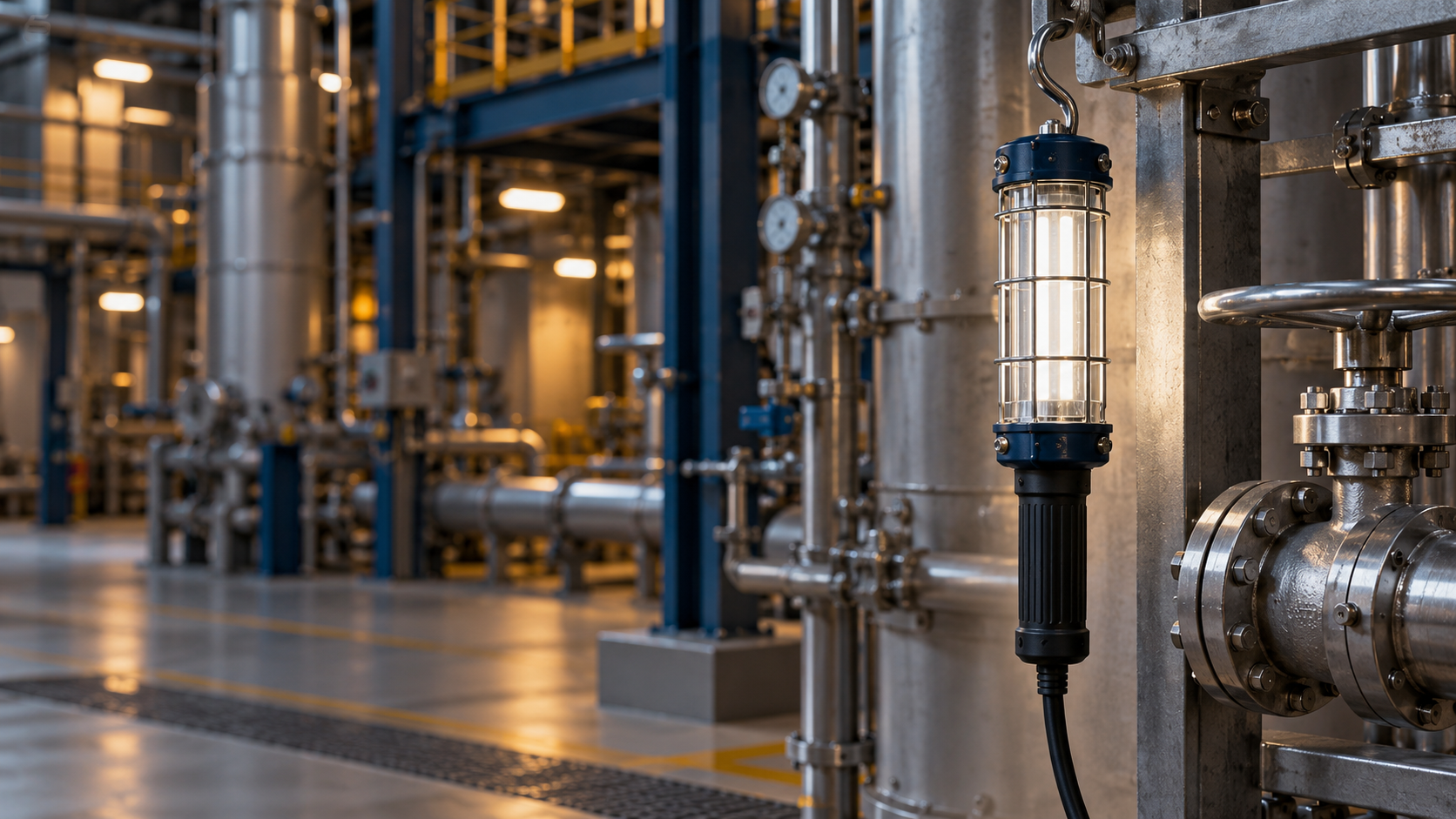
To choose an explosion-proof hand lamp, match its documented hazardous-area suitability, electrical supply, light output and cable arrangement to the inspection task. Then check whether its size, weight and suspension options allow workers to position it effectively.
For maintenance and procurement teams in Saudi Arabia and the GCC, “portable” should not be confused with “battery-powered.” A portable hand lamp may need an external electrical supply and a project-specific cable assembly.
This guide explains the main questions to resolve before requesting a quotation.
An explosion-proof hand lamp provides movable task lighting for inspection, maintenance and temporary work in locations requiring appropriate explosion protection.
Potential tasks include examining equipment, illuminating service areas and supporting maintenance activities where fixed lighting does not adequately illuminate the work.
The selected lamp must suit the actual classified location. Its rugged appearance, protective cage or LED technology does not independently demonstrate that suitability.
For background on protection terminology, read our Explosion-Proof Lighting Guide.
Start with the approved area-classification information and project specification.
Ask the supplier to confirm that the exact model and configuration meet the relevant requirements, including:
A catalogue statement covering several zones should be checked against the product’s certificate, nameplate and instructions.
IECEx identifies separate standards for area classification, equipment protection techniques and installation selection. These are related parts of the assessment, rather than one interchangeable product label.
Choose the electrical configuration around the approved supply arrangement and site requirements.
Before comparing products, confirm:
For example, the Alrouf AR-EX-SC brochure lists configurations for 110–277V AC, 220–240V AC, 24V DC and 12V DC.
These are ordering options. Do not assume that one lamp accepts every listed voltage.
Low voltage alone also does not establish intrinsic safety. The equipment’s assessed protection method and complete configuration remain essential.
Select output around the inspection task, working distance, obstructions and surface conditions.
More lumens may help illuminate a larger area, but the highest-output model is not automatically the most useful choice for close inspection. Consider positioning, reflections, shadows and glare alongside brightness.
The AR-EX-SC brochure provides the following selection example:
| Model | Rated power | Brochure nominal output |
|---|---|---|
| AR-EX-SC-10W | 10W | 1,300 lm |
| AR-EX-SC-20W | 20W | 2,600 lm |
| AR-EX-SC-30W | 30W | 3,900 lm |
The brochure states that these nominal lumen values are calculated using 130 lm/W efficacy. Confirm final output against the approved photometric information and selected driver configuration.
Review the Alrouf Explosion-Proof Hand Lamp product page when preparing a model enquiry.
It depends on the task.
Wide luminous coverage can help illuminate the surrounding work area. A focused inspection task may require more controlled light distribution or a different lamp position.
The AR-EX-SC brochure describes 360° luminous coverage. Check how this distribution will interact with nearby equipment and reflective surfaces rather than selecting solely by total lumen output.
Where practical, request a demonstration under representative working conditions.
A lamp should fit the working space and allow stable positioning without placing unnecessary strain on the cable.
Check:
The AR-EX-SC brochure shows top-hook and side-hook configurations, with a listed net weight of approximately 2.4kg for each.
Their dimensions differ, so specify the suspension arrangement when requesting a quotation. Do not assume that every configuration has the same overall dimensions.
Treat the cable and associated equipment as part of the selection.
The AR-EX-SC brochure lists a standard 0.5m, three-core rubber cable and an M20 × 1.5 cable entry. Extended cable lengths and a remote enclosure are shown as project-specific arrangements.
For your enquiry, identify:
| Item | Information to confirm |
|---|---|
| Cable length | Required working reach and routing |
| Cable construction | Suitability for handling and installation conditions |
| Cable entries | Compatible glands, sealing and retention arrangements |
| Connections | Approved supply and connection method |
| Associated equipment | Location and suitability of any remote enclosure or power supply |
| Delivered scope | Components included in the quotation |
An illustrated assembly should not be treated as the standard supplied package. Obtain confirmation of the complete arrangement.
No. IP66 describes ingress protection. It does not independently establish explosion protection.
The AR-EX-SC brochure lists IP66 alongside separate ATEX and IECEx references. It also states that final certificate applicability, nameplate information and brand authorization must follow approved certification documentation.
Request those documents for the offered model before approval.
Potentially, where the exact lamp and electrical arrangement meet the assessed requirements.
A lamp’s hazardous-area suitability does not establish that entry into the space is safe. Lighting selection forms one part of the site’s confined-space assessment and approved work arrangements.
Provide the responsible team with the proposed lamp, supply arrangement, cable routing and associated equipment for review.
A clear enquiry should include:
Ask the supplier to identify any assumptions or departures from your specification.
No. Portable describes equipment that can be moved. Check whether the selected model uses an external supply or an integrated battery.
No. Mechanical protection does not replace documented hazardous-area suitability.
Confirm permitted replacements with the manufacturer or responsible supplier. Electrical characteristics, cable entries and the complete assembly can affect suitability.
Choose the output and distribution needed for the task. Consider handling, glare, positioning and the required electrical configuration alongside wattage.
Review the AR-EX-SC hand lamp and Alrouf’s broader hazardous-area lighting range.
Contact Alrouf with your task details, classification information, supply requirements and cable arrangement to confirm the available configuration and supporting documents.
