
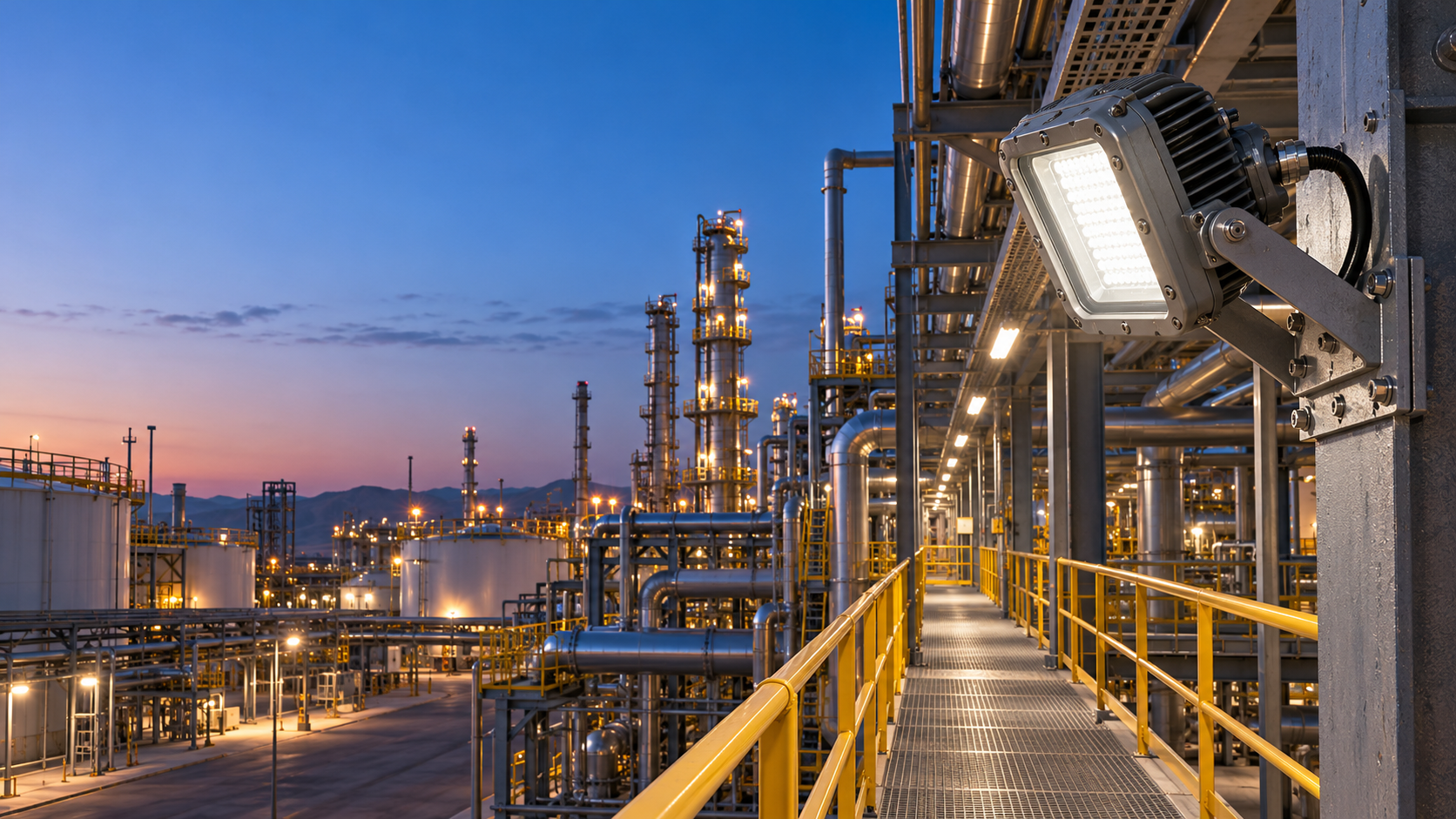
Explosion-proof lighting refers to luminaires designed and assessed for use in specified explosive atmospheres. Selecting a suitable fixture requires matching its protection marking, certification, temperature limits and operating conditions to the installation’s hazardous-area classification.
For contractors, engineers and procurement teams in Saudi Arabia and the GCC, this means looking beyond wattage and enclosure strength. The lighting must suit both the hazardous atmosphere and the task being illuminated.
This guide explains the main lighting types, where they are used and what to check before requesting a quotation.
In industrial procurement, “explosion-proof lighting” is often used broadly to describe lighting for hazardous locations. However, hazardous-area luminaires can use different explosion-protection techniques.
Flameproof protection uses an enclosure designed to withstand an internal explosion and prevent its transmission to the surrounding explosive atmosphere. Other protection techniques address ignition risks through different design measures, such as increased safety or encapsulation.
A luminaire may combine several protection techniques. Its Ex marking and supporting documentation identify the protection provided; its appearance alone cannot establish suitability.
Hazardous-area lighting is selected for locations where an assessment identifies a risk from explosive gas, vapour, mist or combustible dust atmospheres.
Potential applications include classified areas within:
The industry name does not determine whether every location requires Ex lighting. Selection starts with the approved area-classification information for the actual installation point.
Different fixture formats serve different lighting tasks. Their suitability for a hazardous location must be checked separately from their optical performance.
| Lighting type | Typical lighting task | Key selection considerations |
|---|---|---|
| Floodlight | Broad-area illumination | Beam distribution, mounting position, glare and coverage |
| High bay | Illumination from elevated mounting positions | Mounting height, spacing, uniformity and maintenance access |
| Linear light | Illumination along walkways or equipment routes | Distribution, mounting arrangement and obstructions |
| Hand lamp | Local inspection or maintenance lighting | Power supply, cable arrangement, handling and permitted use |
Alrouf’s listed range includes the Ex-Proof Flood Light A-Series, Ex-Proof B-Series Highbay and Ex-Proof Linear Light.
Review the individual product documents and confirm the exact model and configuration before specifying a fixture.
A useful selection process connects the site requirements, product evidence and lighting design.
Obtain the approved area-classification drawing and relevant specification. Confirm whether the location presents a gas or dust hazard and identify the applicable zone.
Classification depends on the likelihood and persistence of an explosive atmosphere. A fixture described only as “industrial” or “heavy duty” does not establish suitability for that classified location.
Ask the supplier to provide a technical submission covering:
The documents should describe the configuration being offered, including any emergency battery or control options.
For Saudi and GCC projects, give suppliers the installation conditions rather than requesting a fixture simply described as “suitable for the Gulf.”
The enquiry should identify relevant exposure to heat, direct sunlight, dust, humidity, salt or corrosive substances. Ask the supplier to confirm suitability and any operating restrictions against those conditions.
Compare how the proposed fixture will illuminate the work area.
A quotation should support the required mounting height, coverage, uniformity and glare control. Request photometric information where a lighting calculation is needed.
Selecting the highest wattage does not establish that the installation will deliver the required visibility.
Clarify whether the quotation includes mounting brackets, glands, stopping plugs, cables or other accessories.
You can review Alrouf’s hazardous-area lighting accessories when preparing the enquiry. Ask the team to confirm compatibility with the selected luminaire and installation requirements.
A clear enquiry helps suppliers respond with fewer assumptions.
| Information | What to provide |
|---|---|
| Project scope | Location, application and quantities |
| Hazardous-area requirements | Classification drawing and project specification |
| Lighting task | Area dimensions, mounting height and required performance |
| Electrical supply | Available voltage and frequency |
| Environment | Temperature and relevant exposure conditions |
| Installation | Mounting arrangement, cable entries and accessory requirements |
| Delivery | Required date, documentation and inspection milestones |
For replacement projects, include the existing fixture details and any constraints affecting access, wiring or mounting.
Installation and maintenance requirements should come from the selected product’s instructions and the site’s approved procedures.
Before installation, confirm that the delivered model matches the approved technical submission. Keep its documentation accessible to the people responsible for inspection and maintenance.
Do not assume that replacement drivers, batteries, seals or other components are interchangeable between models. Ask the manufacturer or responsible supplier to identify permitted replacements and repair arrangements.
Hazardous-area lighting has specified explosion-protection characteristics for its intended application. Mechanical strength or suitability for a demanding industrial environment does not independently demonstrate those characteristics.
No. Several explosion-protection techniques exist, and a luminaire may combine them. Check the product’s marking and supporting documents to understand its protection.
Choose the format around the lighting task, mounting position and required distribution. Then verify that the exact model meets the hazardous-area and environmental requirements.
No. Compare the light distribution and calculated performance alongside the electrical rating, operating limits and product documentation.
Request the model-specific datasheet, relevant certification documents, photometric information, installation instructions and a written quotation identifying the supplied configuration and accessories.
Explore Alrouf’s hazardous-area lighting range and send your project specification, classification details, quantities and installation conditions.
Contact Alrouf to confirm the available models, supporting documents and quotation scope for your project.
