
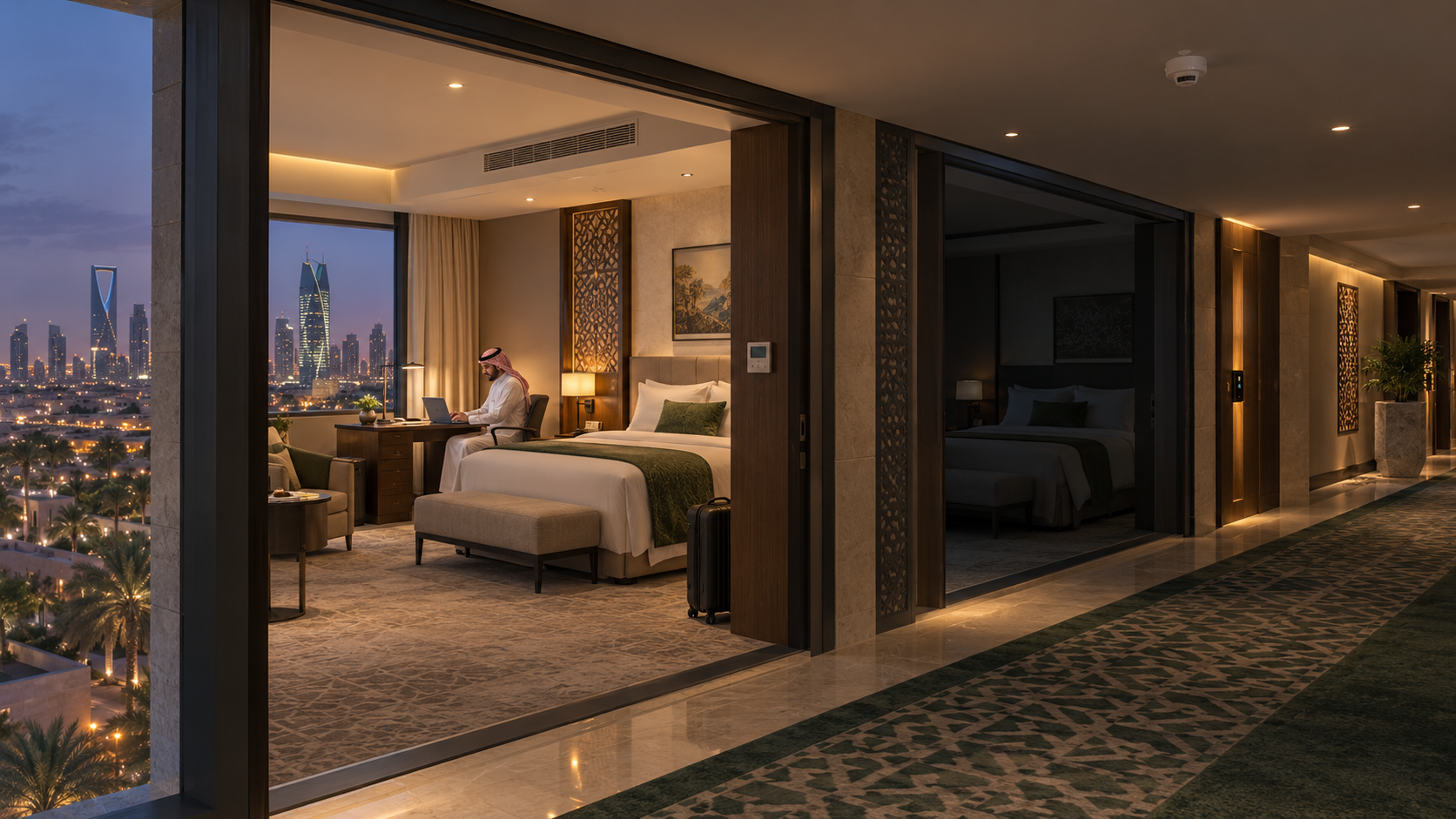
Occupancy-based lighting and HVAC can reduce hotel energy costs by matching equipment operation to actual room and space usage. By using occupancy sensors, room status, schedules and hotel-management data, a hotel energy management system can switch off unnecessary lights, adjust vacant-room temperatures and reduce waste without compromising guest comfort.
Hotels operate continuously, but not every room, corridor, meeting space or service area requires full lighting and air conditioning at all times. Occupancy-based control helps hotels respond to actual demand instead of operating every system according to fixed assumptions.
The objective is not to minimize consumption at every moment. It is to eliminate avoidable energy use while maintaining the comfort, safety and service standards expected by hotel guests.
An occupancy-based hotel energy management system uses sensors, room-status information and programmed control sequences to adjust lighting and HVAC according to whether a room or space is occupied.
The system may receive information from:
Instead of treating every room as continuously occupied, the system can apply different settings for occupied rooms, temporarily vacant rooms, unsold rooms, housekeeping periods and checkout.
An effective system should combine automation with intuitive manual controls. Guests must remain able to adjust their environment within the hotel’s approved operating range.
To understand the wider hotel automation ecosystem, read our guide to smart hotel technology, guest room automation and BMS integration.
Hotels may waste energy when lighting and HVAC continue to operate even though a room or space is not being used.
Common sources of avoidable consumption include:
Some energy use must continue in unoccupied spaces for ventilation, humidity management, safety, asset protection or operational reasons. Occupancy-based control does not mean switching everything off. It means applying the correct operating level for each condition.
Occupancy-based lighting uses sensors and programmed rules to switch, dim or restore lighting according to space usage.
When a person enters a controlled area, the system can raise the lighting to the required level. When the area becomes vacant, it may reduce the brightness or switch off nonessential luminaires after an appropriate delay.
The correct response depends on the type of space.
Inside a guestroom, the system may switch off selected lighting circuits after confirming vacancy. In a corridor, it may maintain a safe background level and increase the illumination when movement is detected. In a meeting room, lighting may remain off until the room is booked or occupied.
Occupancy-based lighting can be applied in:
Lighting controls must always respect applicable safety, accessibility and emergency-lighting requirements.
Hotels can combine several lighting-control strategies rather than depending on a single sensor.
Nonessential lighting can switch off after the system confirms that a space is vacant and an appropriate delay has passed.
The delay helps prevent lights from switching off during brief periods without detected movement.
Some hotel areas should not become completely dark. Corridor lighting, for example, may remain at a reduced but safe level and increase when a guest or employee enters the area.
Daylight sensors can reduce artificial lighting when sufficient natural light is available near windows, atriums, restaurants or lobby areas.
The hotel can create schedules for restaurants, meeting rooms, façades, landscapes and back-of-house areas. Occupancy sensors can then provide an additional level of control within those schedules.
Dividing a space into zones allows the hotel to illuminate only the areas being used. A large meeting room or restaurant does not always require every lighting circuit to operate simultaneously.
Guestrooms can use Welcome, Work, Relax, Night, Sleep, Housekeeping and Vacant scenes. Each scene activates the lighting zones and brightness levels needed for its purpose.
Hotels planning these functions can explore Alrouf’s smart hotel technology and lighting-control solutions.
Occupancy-based HVAC adjusts temperature settings and equipment operation according to room usage.
Instead of maintaining the same condition continuously, the system can apply different operating modes based on check-in status, occupancy, guest preferences and temporary absence.
A vacant, unsold room may use an economical temperature range while maintaining the ventilation, humidity and asset-protection conditions required by the hotel.
The purpose is to avoid unnecessary full-capacity cooling or heating without allowing the room to reach an unsuitable condition.
A reserved room can remain in an efficient condition until the hotel’s preparation sequence begins. The timing may depend on the expected arrival, operational policy and HVAC recovery time.
When the guest is present, the room enters its normal comfort mode. The guest should be able to adjust the temperature through a clear thermostat or room-control interface.
When a checked-in guest leaves temporarily, the system may apply a moderate temperature setback instead of switching the HVAC off completely.
A moderate adjustment can reduce unnecessary operation while allowing the room to recover quickly when the guest returns.
After the Property Management System confirms checkout, the room can return to its approved vacant setting.
The room may then use a separate housekeeping mode while employees clean and inspect it.
A motion sensor alone may not provide reliable hotel-room occupancy detection because an occupied guestroom can remain still for long periods.
A sensor may fail to detect a guest who is:
If the system interprets an absence of motion as vacancy, it may switch off lighting or change the temperature while the guest is still inside.
This can reduce comfort and create complaints—the opposite of what a hotel energy management system should achieve.
A more reliable occupancy strategy may combine:
The appropriate logic depends on the room layout, sensor technology and hotel operating requirements.
All essential functions should retain clear manual control. Automation should support guests rather than make decisions they cannot reverse.
PMS, GRMS and BMS perform different but connected roles in smart hotel energy management.
The Property Management System manages reservations, room assignments, check-ins and checkouts.
Its room-status information can help determine whether a room should operate in vacant, preparation or occupied mode.
The Guest Room Management System controls functions inside individual guestrooms, such as:
The GRMS can apply the room’s programmed energy and comfort sequences.
The Building Management System supervises building-wide services, which may include:
The BMS may receive selected room information from the GRMS and use it to improve building-level monitoring and operation.
A typical sequence could work as follows:
Only the information required for approved functions should be exchanged between hotel platforms.
Hotels can reduce unnecessary HVAC operation while protecting guest comfort through carefully designed control sequences.
Useful strategies include:
Hotels should avoid aggressive temperature setbacks that make guestrooms slow to recover.
If a guest returns to a room that is noticeably uncomfortable, the energy-saving strategy may create dissatisfaction and increase the likelihood of manual overrides.
The right setting depends on climate, room construction, HVAC capacity, recovery time and the hotel’s service level. Conditions suitable for one property should not automatically be copied to another.
Occupancy-based lighting and HVAC can provide value across guestrooms, public spaces and operational areas.
Guestrooms can use room status, occupancy detection and manual controls to coordinate lighting, temperature and curtains.
Because guest comfort is critical, room settings should use conservative energy-saving sequences and quick recovery.
Corridor lighting can remain at a safe reduced level during quiet periods and increase when guests or employees enter.
The minimum level, response time and sensor placement must satisfy safety and project requirements.
Lighting and HVAC can respond to reservations, schedules and actual occupancy. This helps prevent systems from operating for hours before or after an event.
Large event spaces can use lighting zones, event scenes and operating schedules. Different areas can be activated according to the event layout and occupancy.
Lighting and HVAC can follow breakfast, lunch, dinner, cleaning and closure periods. Lighting scenes can also maintain the required atmosphere at different times.
Staff offices, storage rooms, service corridors and selected technical spaces may use occupancy-based controls where appropriate.
Parking lighting may be zoned or dimmed based on use, provided that safety, visibility and security requirements are maintained.
Occupancy information can support hotel operations in addition to reducing unnecessary energy consumption.
Depending on the approved system design, it may help teams identify:
Facility teams can use this information to investigate abnormal conditions instead of waiting for a guest complaint or reviewing equipment manually.
Occupancy information must be handled responsibly. Hotels should define what information is collected, why it is required, who can access it and how long it is retained.
Occupancy controls can improve the guest experience when energy-saving actions remain comfortable, predictable and easy to override.
Well-designed automation may help:
Poorly designed automation can have the opposite effect.
Common problems include:
The system should be tested from the guest’s perspective, not only from the control panel or technical dashboard.
Hotels should establish a baseline before installing or significantly changing an occupancy-based system.
Useful performance indicators include:
Results should be assessed by room type, floor, season and occupancy level. Comparing only the hotel’s total monthly electricity bills may produce misleading conclusions because weather and occupancy can change significantly.
Hotels should also monitor guest feedback. Lower energy consumption should not be considered a successful result if temperature complaints or room-control problems increase.
There is no single saving percentage that applies to every hotel.
Potential savings depend on:
An accurate estimate should follow a structured process:
Hotels should avoid treating manufacturer estimates or results from another property as guaranteed savings for their own project.
Existing hotels can add occupancy-based controls through wired, wireless or hybrid solutions.
The right retrofit strategy depends on:
Wireless controls may reduce construction work and disturbance to existing walls. This can be valuable when a hotel needs to renovate rooms in stages while remaining operational.
Wireless installation still requires proper design. Signal range, interference, system capacity, cybersecurity, maintenance and product compatibility must be evaluated.
The most common mistake is installing occupancy sensors without defining how lighting and HVAC should behave in every room condition.
Other mistakes include:
Technology selection is only one part of the project. Control logic, commissioning, training and performance monitoring determine whether the system delivers its intended value.
A successful project should progress from measurement and planning to testing and continuous improvement.
Review energy consumption, room occupancy, equipment runtime and guest complaints before making changes.
Define occupied, temporarily vacant, unsold, preparation, housekeeping and checkout conditions.
Specify how lighting and HVAC should respond to every relevant input, including sensor detection, door status, guest control and system failure.
Confirm that sensors, switches, controllers, luminaires, drivers, thermostats, gateways and software provide the required functions together.
Test a complete guestroom before applying the design across the hotel.
Test check-in, entry, temporary absence, sleep, open windows, manual overrides, housekeeping, checkout and network failure.
Facility, maintenance, IT, housekeeping and front-office employees should understand the relevant system functions.
Compare performance with the original baseline and adjust control sequences according to energy data, seasonal conditions and guest feedback.
Alrouf Lighting Technology provides smart-lighting and control solutions for hospitality and smart-building projects in Saudi Arabia.
According to the Alrouf Smart Lighting Control Product Catalog 2026, its portfolio includes:
Alrouf’s wireless kinetic switches generate the energy required to transmit a command when pressed. The switch itself therefore does not require control wiring or routine battery replacement.
Depending on the project, these switches may support:
The suitability of every product should be verified according to its controller, load, operating range, installation conditions and project requirements.
DALI can support compatible luminaires through digital switching, dimming, grouping, addressing and scene control.
These functions may be applied to:
KNX can support coordinated control of compatible lighting, sensors, curtains and other building functions.
However, supporting a shared protocol does not automatically guarantee complete interoperability. Controllers, gateways, drivers and software functions must be confirmed and tested for the specific project.
Explore Alrouf’s smart hotel technology and lighting-control solutions or contact Alrouf Lighting Technology to discuss the hotel’s rooms, existing infrastructure and energy-management objectives.
Occupancy-based lighting automatically switches or dims lights according to whether a space is being used. It combines sensors with programmed delays and control rules.
Occupancy-based HVAC adjusts room temperature settings and equipment operation according to occupancy, room status and guest requirements.
Occupancy sensors can help reduce unnecessary lighting and HVAC operation. Actual savings depend on the existing systems, hotel occupancy, control settings, climate and commissioning.
Not necessarily. A moderate temperature adjustment may protect comfort and allow the room to recover quickly when the guest returns. The appropriate response depends on the property and HVAC design.
Motion sensors may fail to detect guests who are sleeping, reading or sitting quietly. Reliable occupancy detection may require several signals and appropriate time delays.
The PMS manages reservations and room status, the GRMS controls individual guestroom functions, and the BMS supervises wider building systems and energy information.
Yes. Existing properties can use wired, wireless or hybrid controls after completing a technical assessment of their lighting, HVAC, networks and integration requirements.
Well-designed controls should reduce waste without affecting comfort. Poorly configured sensors, delays or temperature settings can create guest complaints, so manual control and commissioning are essential.
The hotel should establish a baseline, measure existing runtime, identify waste, test the proposed sequences and compare actual performance while accounting for weather and occupancy.
Alrouf’s smart-lighting portfolio includes wireless kinetic switches, RF controls, dimming, scene control, DALI, KNX, Zigbee 3.0 and other control technologies suitable for consideration in hospitality projects.
