
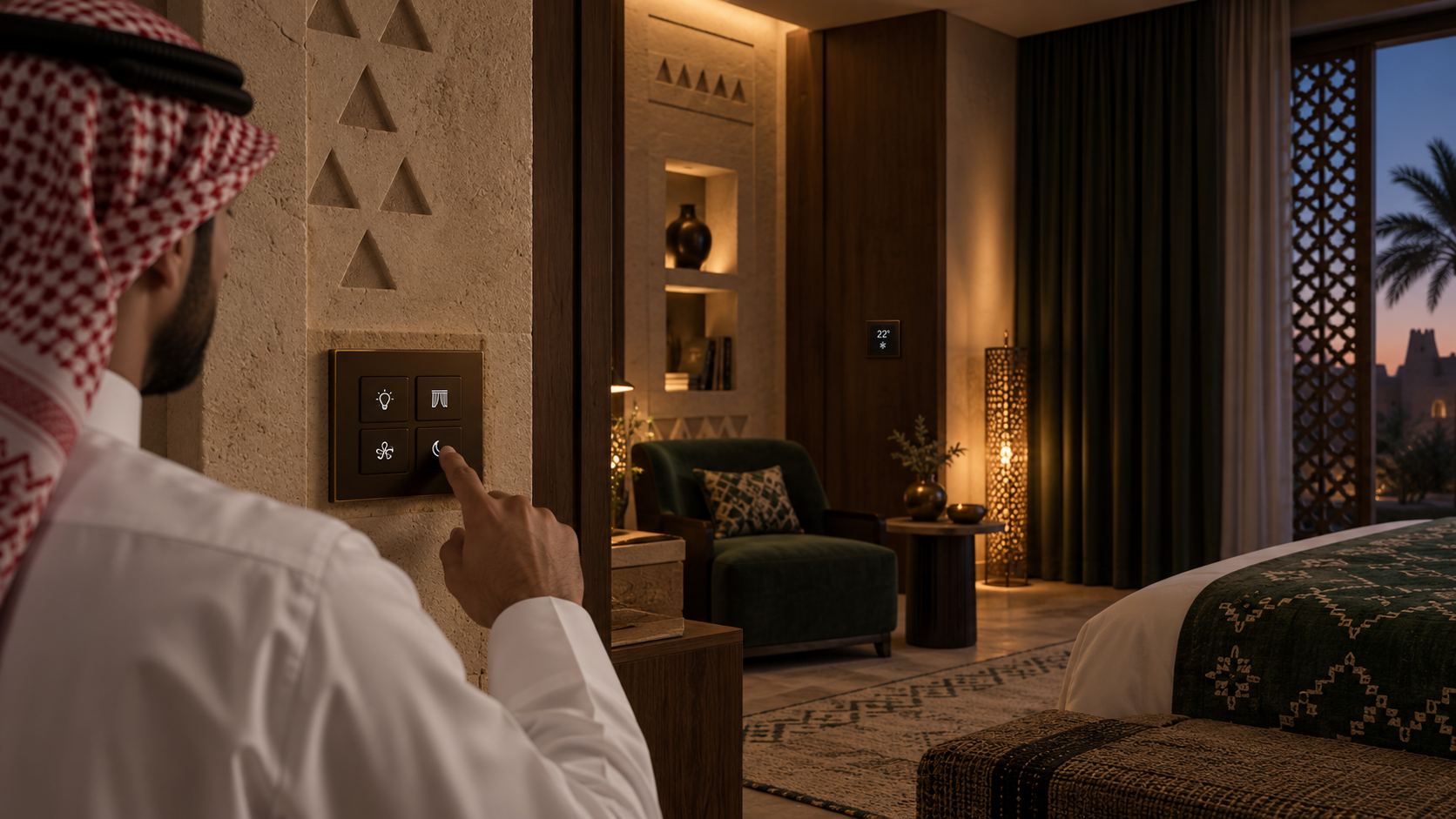
Hotel room automation improves guest experience by making lighting, temperature, curtains, privacy settings and service requests easier to control. When these systems are intuitive and reliable, they can reduce common frustrations, improve comfort and help hotels deliver the consistent experience that contributes to stronger guest satisfaction and more positive reviews.
Guests rarely mention the technical protocols or controllers operating behind a hotel room. They remember whether the room felt welcoming, whether they could switch off the lights easily, whether the temperature was comfortable and how quickly the hotel responded when something went wrong.
Effective hotel room automation improves these practical moments without requiring guests to understand the technology behind them.
Hotel room automation is the coordinated control of lighting, HVAC, curtains, sensors, privacy indicators and other room functions through connected controllers and guest interfaces.
A hotel room automation system may include:
These components can operate separately, but integration allows the room to respond more consistently throughout the guest journey.
For example, once the guest checks in, the assigned room may move from an energy-saving setting towards a comfortable arrival condition. When the guest enters, a welcome lighting scene can activate and provide immediate access to lighting, temperature and curtain controls.
To understand how the complete technology ecosystem works, read our guide to smart hotel technology, guest room automation and BMS integration.
Hotel room automation improves arrival by helping prepare a comfortable environment and reducing the effort required to understand an unfamiliar room.
After travelling, a guest does not want to enter a dark or uncomfortable room and search for several unlabelled switches. A coordinated arrival sequence can make the room feel prepared from the first moment.
Depending on the hotel’s systems and policies, room automation may:
The objective is not to impress the guest with complicated technology. It is to create a smooth first interaction with the room.
A welcome scene should also allow immediate manual adjustment. Some guests may prefer brighter lighting, while others may want to lower the lights or close the curtains as soon as they arrive.
Smart lighting scenes improve guest comfort by adjusting several lighting zones through one simple command.
A hotel room can be divided into entrance, sleeping, bedside, workspace, bathroom, wardrobe and decorative-lighting zones. Instead of operating each zone separately, guests can select a scene designed around a particular activity.
A welcome scene can activate entrance and decorative lighting when the guest enters. It creates a comfortable first impression without necessarily operating every luminaire at full brightness.
A relaxation scene can dim selected lights and create a softer atmosphere for resting, watching television or spending time in the room during the evening.
A work scene can increase illumination around the desk and other task areas. This is particularly valuable for business travellers who need suitable lighting for reading, working or participating in video calls.
A reading scene can provide focused illumination around the bed or seating area without lighting the whole room.
A night scene can activate low-level pathway or bathroom lighting. This helps guests move through an unfamiliar room without switching on bright general lighting or disturbing another occupant.
A sleep scene can switch off selected lighting circuits and, when supported, close motorized blackout curtains. A bedside master-off control also prevents the guest from searching around the room for lights that remain on.
A housekeeping scene provides brighter and more uniform illumination for cleaning and room inspection. This supports hotel operations while keeping guest-facing scenes focused on comfort.
Hotels exploring these functions can review Alrouf’s smart hotel technology and lighting-control solutions.
Simple controls improve the guest experience because hotel visitors should not need instructions for basic room functions.
Guests may interact with hotel automation through:
Providing more interfaces does not automatically create a better experience. Too many options can make the room harder to understand, particularly when each interface behaves differently.
Essential controls should be:
Mobile applications and touchscreens can provide additional functions, but they should not be the only way to operate essential lighting, temperature or curtain controls.
Good automation is almost invisible. The guest experiences the result without needing to think about the system producing it.
Temperature automation can improve satisfaction by preparing comfortable rooms and giving guests clear control over their indoor environment.
An automated hotel HVAC system may respond to:
Before arrival, an assigned room may move from an economical setting towards the hotel’s defined comfort range. During the stay, the guest should be able to adjust the temperature without navigating a complicated interface.
Energy-saving rules must be configured carefully. A motion sensor may incorrectly assume that a guest who is sleeping, reading or sitting quietly has left the room. Automatically changing the temperature in this situation could turn an efficiency feature into a source of discomfort.
Reliable occupancy logic may therefore consider multiple signals, including motion, door status, room status and manual interaction, instead of relying on one sensor.
Automated curtains and blinds can improve privacy, daylight control and sleeping conditions when they are integrated with understandable guest controls.
Motorized curtains may form part of:
Allowing guests to close the curtains from the bed can be especially convenient for people with limited mobility or guests sharing the room.
Automated blackout curtains can also support daytime rest, which may be important for international travellers, airline crews and guests arriving after long journeys.
Privacy preferences differ, so the guest must always have an obvious way to open, close or stop the curtains manually.
Hotel room automation can support better sleep by coordinating lighting, curtains and temperature while reducing unnecessary nighttime disturbance.
Useful sleep-related functions include:
A technologically advanced room can still create a poor experience if guests cannot switch off every light, the touchscreen remains excessively bright or sensors activate unnecessarily during the night.
The automation strategy should therefore focus on eliminating interruptions and giving guests straightforward control over their sleeping environment.
Accessible room automation makes important functions easier to operate for guests with different physical, visual and cognitive requirements.
Hotels should consider:
Automation can help guests with limited mobility control lighting, curtains and temperature from accessible locations. However, replacing every physical switch with a touchscreen may create new accessibility barriers.
An inclusive room should offer more than one practical way to operate essential functions.
Room automation can help authorized employees identify guest requests and technical problems more quickly.
Depending on the system design and approved integrations, connected room functions may communicate:
This information can help housekeeping, maintenance and front-office teams direct attention to the right room at the right time.
For example, if the system reports a lighting-control fault before a new guest arrives, the maintenance team may be able to investigate it proactively. If a Make Up Room request is sent to the appropriate team, housekeeping can respond without relying on repeated calls.
Automation does not replace attentive hotel employees. It gives them clearer information that can support faster and more consistent service.
Hotel room automation can contribute to positive reviews when it improves the aspects of the stay that guests notice directly: comfort, convenience, privacy, sleep and service.
Guests may positively remember:
Automation may also help hotels reduce conditions that can lead to negative feedback, including:
Hotel room automation cannot guarantee higher review scores. Reviews are also influenced by cleanliness, employee behaviour, noise, food, location, price and many other factors.
Its value lies in helping the hotel deliver a smoother and more consistent room experience.
Automation may prevent some negative reviews when it detects problems early, simplifies room controls and improves communication between guests and hotel teams.
A minor problem is more likely to affect a review when it remains unresolved. For example, a faulty lighting controller may become a complaint if the hotel discovers it only after the guest reports it late at night.
Connected monitoring can help the hotel identify some equipment faults sooner. Clear service indicators can also help employees respond to guest requests without unnecessary delays.
However, technology can create negative reviews when:
The goal should be to remove friction rather than add technology for its own sake.
Hotels should compare guest and operational indicators before and after implementing room automation.
Useful measurements may include:
Hotels can categorize review comments to identify recurring references to lighting, temperature, curtains, controls and sleep.
Manual overrides should not automatically be treated as a system failure. Frequent overrides may reveal that a scene, temperature setting or occupancy rule does not match guest preferences. That information can help the hotel refine its control sequences.
The most common mistake is adding connected devices without defining how the complete room should work for a real guest.
If guests require instructions to switch on a light or change the temperature, the interface needs to be simplified.
A hotel application can offer additional convenience, but essential room functions should not require guests to download it.
Guests should be able to adjust important functions when automatic settings do not match their needs.
Poor sensor placement can cause false triggers or fail to detect guests who are sleeping or sitting quietly.
When a light or curtain does not respond immediately, guests may press controls repeatedly and assume the system is broken.
Different layouts, labels or symbols across similar rooms make controls harder for guests and employees to understand.
Not every possible room function needs automation. A simple and reliable control may provide more value than a complicated feature with little guest benefit.
Testing individual switches, sensors and controllers is not sufficient. Hotels should test full guest scenarios, including arrival, relaxation, sleep, service requests, temporary absence, checkout and system failure.
Existing hotels can introduce room automation, but the appropriate solution depends on the building, current wiring, room layout and renovation restrictions.
A retrofit assessment should examine:
Wireless and kinetic controls may reduce the requirement for new control wiring at switch locations. This can help limit disturbance to hotel walls and finishes during renovation.
Wireless solutions still require careful assessment of range, interference, system capacity, security and product compatibility.
Alrouf Lighting Technology provides smart-lighting and control solutions for hospitality and smart-building projects in Saudi Arabia.
According to the Alrouf Smart Lighting Control Product Catalog 2026, its portfolio includes:
The availability of different control approaches allows a hotel solution to be considered according to room requirements, building infrastructure and the required level of integration.
Alrouf’s wireless kinetic switches generate the power required to transmit a command when the switch is pressed. The switch therefore does not require control wiring or routine battery replacement.
For hotel applications, this can provide:
The suitability of each product must be confirmed according to the connected controller, lighting load, range, room construction and project requirements.
DALI can support digital switching, dimming, grouping and scene control when used with compatible luminaires, drivers and controllers.
In hotels, these capabilities can support guest-room scenes, meeting rooms, restaurants, reception areas and other spaces that require flexible lighting conditions.
KNX can coordinate lighting, sensors, blinds and other compatible building functions. It may be suitable for projects requiring broader room or building automation.
Supporting the same protocol does not automatically guarantee that two products will provide all required functions together. Compatibility between controllers, drivers, gateways and software should be verified during design and tested before full deployment.
Learn more about Alrouf’s smart hotel lighting and room-control solutions.
A successful hotel room automation project should begin with guest and operational requirements rather than a list of smart devices.
Define what should happen during arrival, working, relaxing, sleeping, temporary absence, service requests and checkout.
Make lighting, temperature, curtains and privacy easy to use before adding secondary features.
Each lighting or automation scene should have a clear purpose. Avoid providing numerous scenes with unclear or overlapping functions.
A full mock-up allows the hotel owner, operator, designer and technical team to assess control positions, labels, lighting levels, dimming, temperature behaviour and curtain operation.
Ask people who were not involved in the project to use the room without instructions. Observe whether they can find and operate all essential functions.
Confirm what happens during communication, network, sensor and equipment failures. Essential controls should maintain appropriate local operation.
Front-office, housekeeping, maintenance, facility and IT teams should understand the functions relevant to their roles.
Use guest comments, maintenance records and control data to adjust room sequences. Commissioning should continue after occupancy rather than ending when the equipment is installed.
Hotel room automation can provide long-term value when it improves guest comfort, supports hotel employees and reduces unnecessary operation without making rooms harder to use.
Its value depends on:
Hotels should evaluate lifecycle value rather than hardware cost alone. A simpler, dependable system that guests understand may provide more value than an advanced system that causes confusion.
Alrouf can support hospitality projects with smart-lighting controls, wireless kinetic switches, dimming, lighting scenes and building-automation technologies.
The appropriate solution should be selected after reviewing:
A project-specific technical assessment helps ensure that the selected controls support guest comfort, operational requirements and future flexibility.
Contact Alrouf Lighting Technology to discuss your hotel’s room count, lighting requirements, existing infrastructure and automation objectives.
Hotel room automation coordinates lighting, HVAC, curtains, sensors, privacy indicators and other room functions to make the room more comfortable, convenient and efficient.
It gives guests easier control over lighting, temperature, curtains and privacy while helping the hotel prepare rooms consistently and respond to service or maintenance requirements.
It can contribute to better reviews by improving comfort, convenience, sleep and service responsiveness. Review scores also depend on cleanliness, staff service, food, location, noise and value.
Useful scenes include Welcome, Relax, Work, Reading, Night, Sleep and Housekeeping. The appropriate scenes depend on the room design and target guest profile.
An application can provide additional functions, but essential lighting, temperature and curtain controls should remain available through intuitive physical interfaces.
A Guest Room Management System, or GRMS, controls and monitors room functions such as lighting, temperature, curtains, occupancy and service indicators.
Yes. Existing hotels may use wired, wireless or hybrid solutions after assessing the wiring, room layout, HVAC configuration, networks and integration requirements.
A wireless kinetic switch generates enough energy from the pressing action to transmit a control command. The switch does not require a battery or control wiring at its location.
No. Automation supports hotel teams by communicating useful room status, service requests and equipment alerts. Employees remain essential to hospitality and problem resolution.
Usability is the most important feature. Guests should be able to control essential room functions quickly and confidently without requiring technical knowledge.
