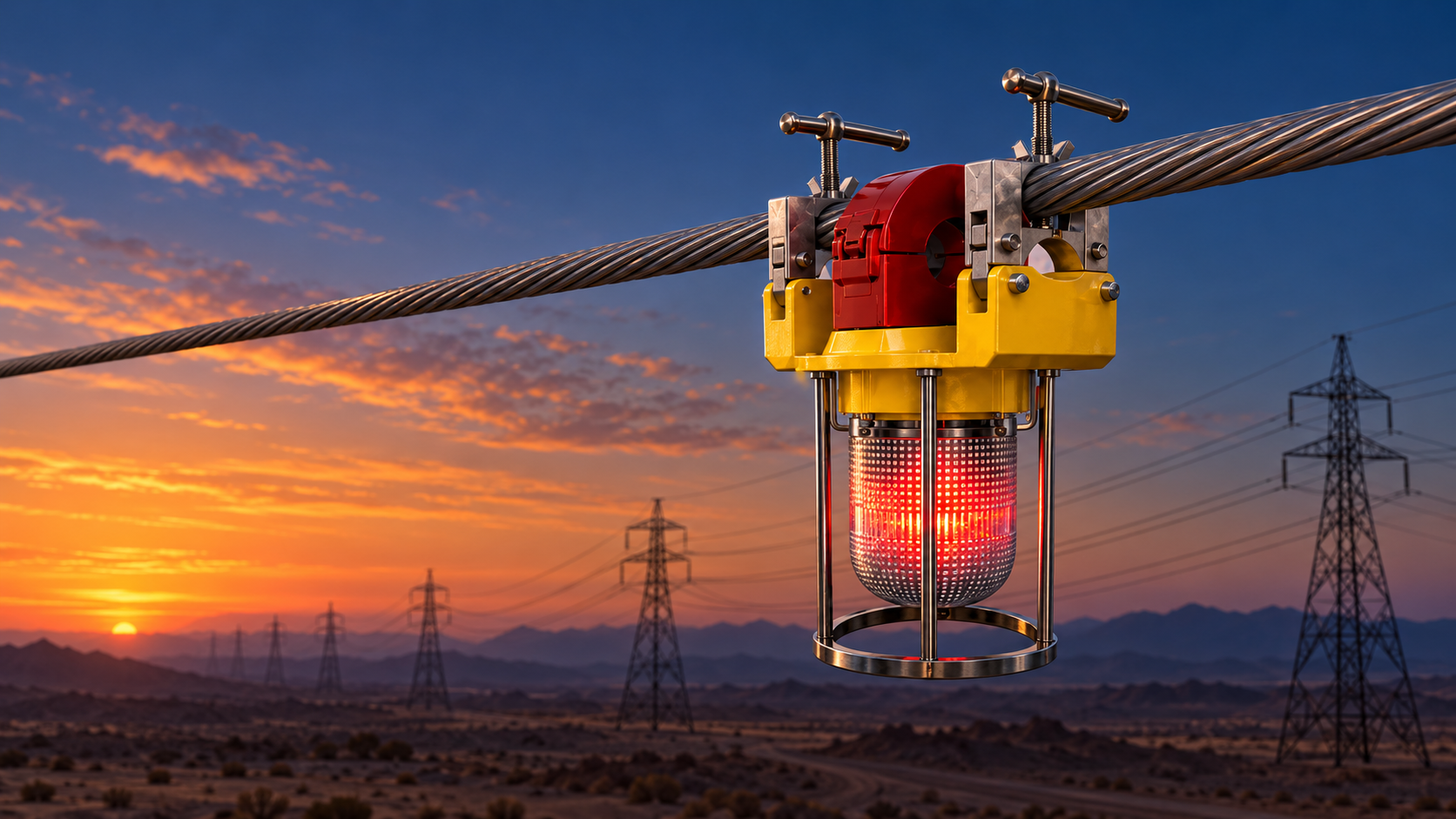
A conductor marking light is an aircraft warning light mounted directly on an overhead power line conductor. It provides a visible signal to help aircraft identify the position of the wire.
The Alrouf AR-CM-001 uses red LED illumination with 360° horizontal coverage. Its defining feature is how it receives power: it harvests energy through electromagnetic induction from the current flowing through the conductor.
For buyers specifying warning lights for overhead power line projects in Saudi Arabia, understanding this operating principle helps identify the electrical and mechanical information needed before selecting the product.
A conductor marking light places warning illumination directly on an overhead wire. The AR-CM-001 is described in the Alrouf catalogue as a low-intensity, Type B LED obstruction light intended for overhead power transmission lines.
The assembly includes an upper mounting section that clamps around the conductor and a light unit positioned below it. Its red light has a horizontal beam coverage of 360° and a listed vertical beam angle of 10°.
The catalogue identifies applications associated with airports, heliports, power lines and river crossings.
The AR-CM-001 operates through inductive power harvesting. The catalogue explains this using Faraday’s law of electromagnetic induction.
As electrical current flows through the overhead conductor, it produces a magnetic field around the wire.
The conductor-mounted assembly uses an induction mechanism to extract energy from the magnetic field. The catalogue describes a coil-based system that converts this energy into electricity.
The harvested electrical energy powers the LED assembly, producing the red warning light.
This operating method makes the current flowing through the conductor an essential part of product selection. Line voltage alone does not establish whether the light will operate correctly.
The AR-CM-001 includes an integrated photocell that controls operation according to ambient light conditions.
The catalogue describes automatic day and night working modes and lists a photocell activation threshold of 50 lux. This allows the light’s operation to respond to changes in surrounding illumination.
The photocell controls when the light operates; the induction assembly supplies its operating energy.
The catalogue lists the following features:
| Feature | Catalogue specification |
|---|---|
| Light source | LED |
| Light colour | Red |
| Light classification | Low intensity, Type B |
| Horizontal coverage | 360° |
| Vertical beam angle | 10° |
| Compatible conductor diameter | 15–40 mm |
| Line voltage suitability | Up to 500 kV |
| Operating line frequency | 50/60 Hz |
| Power consumption | Less than 5 W |
| Ingress protection | IP66 |
| Listed service life | Up to 100,000 hours |
| Listed warranty | Five years |
The construction combines a stainless steel frame, die-cast aluminium components and a UV-protected polycarbonate lens. The catalogue also describes internal resin filling intended to resist vibration.
Mounting features include self-locking screws, anti-drop provisions and an anti-rotation nut.
For an overhead transmission line project, begin with the conductor and its operating conditions.
Conductor diameter: The AR-CM-001 catalogue specifies a compatible range of 15–40 mm. Check the actual conductor dimensions against the mounting requirements.
Line current: Because the light uses inductive power harvesting, confirm the required operating current with Alrouf before selection.
Voltage and frequency: Review the project’s line voltage and frequency against the product specifications.
Project documentation: The catalogue references ICAO Annex 14 Type B and FAA L-810 requirements. Request supporting documentation for review against the project specification.
The catalogue contains different operating-current and temperature figures across its pages. These values should be clarified before final technical approval.
The AR-CM-001’s described power source is electromagnetic induction from the current-carrying conductor. The catalogue does not list a solar panel.
The described operating principle depends on current flowing through the conductor. The catalogue does not specify a backup power source or operation during a line outage.
It produces red LED illumination with 360° horizontal coverage.
Selecting a conductor marking light starts with matching the product to the conductor and the line’s electrical conditions.
It describes mounting components but does not provide a live-line installation procedure. Installation methods and requirements need separate technical confirmation.
For an AR-CM-001 enquiry, share the conductor diameter, line voltage, operating current, required quantity and project location with Alrouf.
