
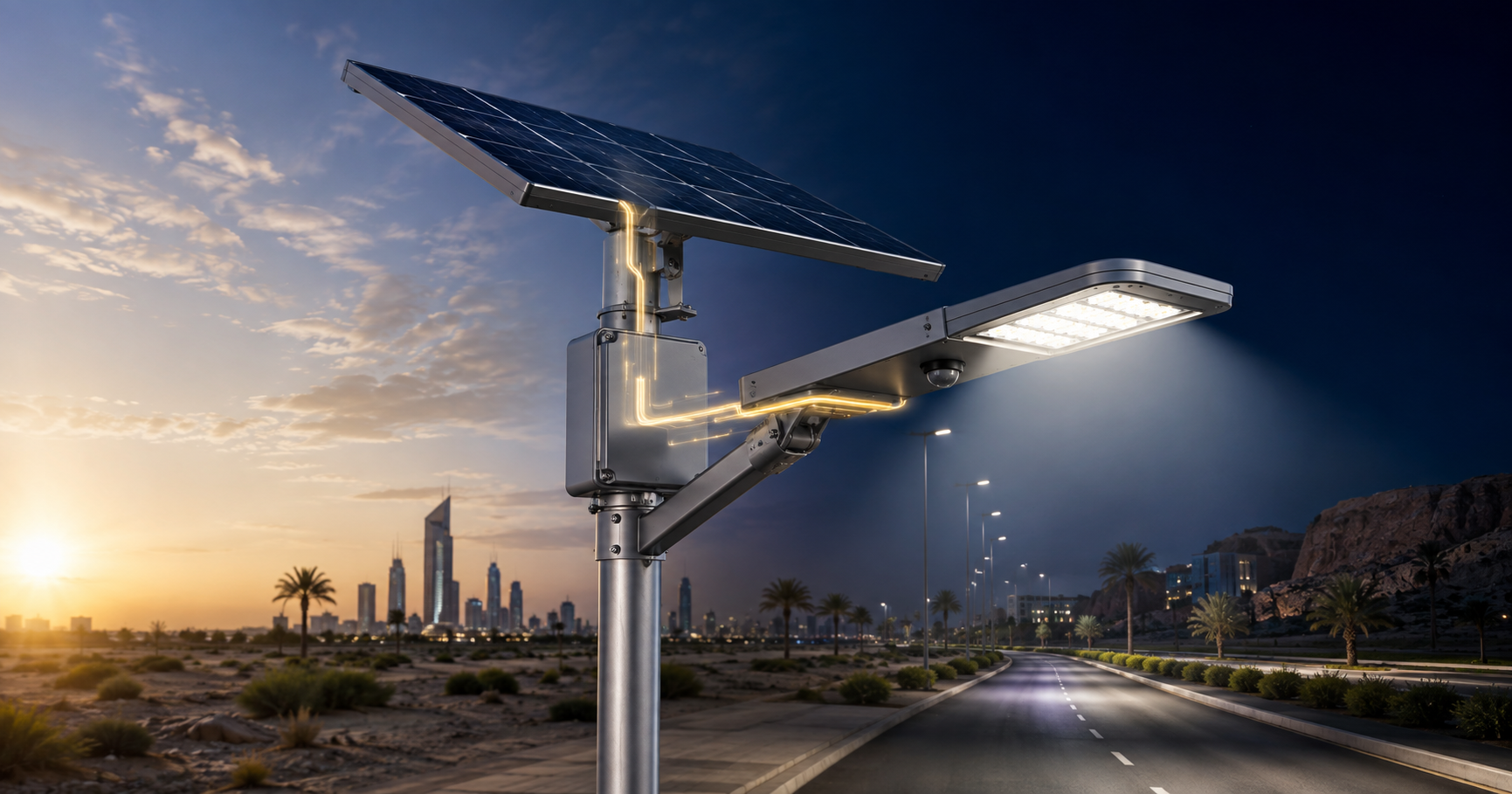
An integrated solar street light converts sunlight into electricity during the day, stores it in a rechargeable battery and uses that energy to power an LED luminaire at night. The solar panel, battery, LED modules and controller operate as one system, providing automatic outdoor lighting without depending on conventional electrical infrastructure.
This self-contained design makes integrated solar street lights suitable for roads, pathways, parks, campuses, industrial locations and remote areas where connecting to the electrical grid may be difficult or expensive.
Understanding how these systems work helps project owners select the correct wattage, battery capacity, solar-panel size, lighting controls, installation height and pole spacing for their projects.
An integrated solar street light is an outdoor luminaire that combines its major energy-generation and lighting components in one compact platform.
A complete system normally includes:
Unlike conventional street lights, an off-grid solar street light does not need to be connected to the utility network. It generates and stores its own electricity, which can reduce the need for trenching, underground cabling and electrical connection work.
The Alrouf QH Series is an example of this integrated approach. It combines monocrystalline solar panels, LiFePO4 batteries, Bridgelux 5050 LED chips and smart microwave-sensor controls in a modular outdoor-lighting platform.
The performance of an integrated solar street light depends on how well its solar panel, battery, controller and LED module work together. Selecting one component without considering the others can result in insufficient charging, shorter operating hours or unnecessary system cost.
The solar panel converts sunlight into direct-current electricity through photovoltaic cells. During daylight hours, the electricity generated by the panel is sent through the charge controller and stored in the battery.
Solar-panel performance depends on several factors:
The QH Series uses monocrystalline solar panels. Depending on the model, panel capacity ranges from 18V/80W for the 60W luminaire to 36V/250W for the 250W luminaire.
The panel must provide enough energy to recharge the battery after the previous night’s operation. This is why solar-panel wattage and luminaire wattage should be evaluated together rather than treated as unrelated specifications.
The battery stores the electricity generated during the day and supplies it to the LED module at night.
Battery capacity affects:
The QH Series uses LiFePO4 batteries. LiFePO4, or lithium iron phosphate, is commonly selected for solar-lighting systems because of its cycle performance, thermal stability and suitability for repeated charging and discharging.
Battery specifications vary across the QH range. The 60W model uses a DC12.8V 30Ah battery, while the 250W model uses a DC25.6V 60Ah battery. Intermediate models use battery capacities matched to their output and solar-panel configurations.
The QH catalog states more than 2,000 battery cycles at 90% depth of discharge and a calendar life exceeding ten years for the specified battery group. Actual battery life can still be affected by temperature, charging conditions, operating profiles and maintenance.
The controller manages the flow of energy between the solar panel, battery and LED luminaire. It acts as the system’s operational control point.
Depending on the design, a solar controller can:
A correctly configured controller allows the luminaire to provide the necessary light while conserving battery energy when full output is unnecessary.
The LED module converts the electrical energy stored in the battery into visible light. Its luminous efficacy indicates how many lumens are produced for each watt consumed.
The QH Series delivers 190 lm/W across its seven configurations. Its total outputs range from 11,400 lumens for the 60W model to 47,500 lumens for the 250W model.
All QH models use Type II light distribution, which is commonly used to direct light along roadways and similar elongated areas. The LED modules can also be adjusted upward or downward by 15 degrees to help refine their direction during installation.
Available colour temperatures include 3000K, 4000K, 5000K and 6500K, allowing the selected light appearance to match the project environment and technical requirements.
An integrated solar street light operates through a repeating four-stage cycle.
During the day, sunlight reaches the photovoltaic cells and is converted into direct-current electricity. The amount of electricity generated depends on solar radiation, panel capacity, orientation and shading.
The controller directs the generated energy to the battery. The battery stores this electricity so it remains available after sunset.
When available daylight falls below the programmed threshold, the controller activates the LED luminaire. No daily manual switching is required.
The light can operate at full output, reduced output or different brightness levels during separate periods of the night. When daylight returns, the controller turns the luminaire off and the charging cycle begins again.
This automated cycle enables the system to operate independently when it is properly sized for the location and required lighting schedule.
Timer and microwave-sensor controls reduce unnecessary energy consumption while maintaining light when it is needed.
The QH Series supports timer control, microwave sensing and mixed-mode operation.
One documented timer profile provides:
This produces a total programmed lighting period of 12 hours while reducing output during later, lower-activity hours.
In the documented microwave-sensor mode, the luminaire increases to 100% brightness when movement is detected. After 30 seconds without detected movement, it reduces to 30% brightness.
This operating method can be useful for pathways, private roads, compounds and areas where traffic or pedestrian activity varies throughout the night.
The control profile should be selected according to the project’s safety requirements, traffic activity, battery capacity and required operating time.
Solar street lights can continue operating during cloudy or rainy periods when their batteries and solar panels are properly sized for the required autonomy.
The QH Series is specified to support approximately five to seven cloudy or rainy days. This published figure refers to the configured QH system, but actual performance can vary according to:
Clouds reduce the amount of solar energy reaching the panel, but they do not necessarily stop energy generation completely. The battery’s stored reserve helps the luminaire continue operating when daily charging is lower than normal.
For critical projects, the system should be designed using the site’s lowest seasonal solar conditions rather than its annual average.
The QH Series has a stated charging time of approximately six to eight hours under suitable solar conditions.
Charging time is affected by panel wattage, sunlight intensity, battery capacity, panel orientation and the amount of energy used during the previous night.
A published charging time should not be treated as a fixed guarantee for every location. A site with shading, dust or fewer peak sun hours may require more time to restore the battery to full charge.
In dusty climates such as Saudi Arabia, periodic panel cleaning is particularly important. Dust accumulation can reduce the sunlight reaching the photovoltaic cells and consequently reduce available charging energy.
The correct wattage depends on the required lighting result, not simply on choosing the highest available number.
Project teams should consider:
The QH Series includes 60W, 80W, 100W, 120W, 150W, 200W and 250W models. Their outputs range from 11,400 to 47,500 lumens.
Lower-wattage models may be appropriate for smaller roads and lower mounting heights. Higher-output models may be considered for taller poles, wider roads or applications requiring more light. However, wattage and lumens alone cannot confirm compliance with a project’s lighting requirements.
A photometric study should be used to evaluate light levels and uniformity before the model, quantity and pole arrangement are finalised.
Pole height and spacing directly affect how light reaches the road or surrounding area. Higher mounting positions can cover a broader area, but they may also require greater output to maintain the required illuminance.
The QH catalog provides these preliminary recommendations:
| QH model | Output | Installation height | Suggested spacing |
|---|---|---|---|
| 60W | 11,400 lm | 6–8 m | 20–25 m |
| 80W | 15,200 lm | 8–9 m | 25–30 m |
| 100W | 19,000 lm | 9–10 m | 30–35 m |
| 120W | 22,800 lm | 10–11 m | 35–40 m |
| 150W | 28,500 lm | 10–12 m | 35–40 m |
| 200W | 38,000 lm | 10–12 m | 35–40 m |
| 250W | 47,500 lm | 10–12 m | 35–40 m |
These values are general product recommendations rather than substitutes for a project-specific lighting calculation.
Road width, pole arrangement, surface reflectance, obstacles and required lighting classifications can all change the appropriate height and spacing.
Integrated solar street lights provide several potential project benefits:
Off-grid systems can remove the need for electrical trenching, underground cabling and grid connection, depending on the project configuration.
Daylight sensing allows the luminaire to turn on at night and turn off during the day without manual intervention.
The system generates electricity from sunlight, reducing dependence on electricity produced from conventional energy sources.
Solar street lights can be installed in areas where extending the electrical network would be difficult, disruptive or expensive.
Timer and motion-sensor profiles can reduce brightness when full output is unnecessary, helping preserve stored battery energy.
The QH Series uses modular construction and waterproof connectors, which can make individual components easier to access during installation or maintenance.
The QH Series is rated IP66 and IK09, providing protection against dust, water jets and mechanical impact for outdoor applications.
Integrated solar street lights can be suitable for Saudi projects when they are configured for local heat, dust, solar radiation and required operating conditions.
The QH Series has a published operating-temperature range from -25°C to +65°C, making it relevant to locations exposed to high ambient temperatures.
For Saudi installations, project planning should also consider:
The system should be selected using actual site information rather than general climate assumptions.
An integrated solar street light combines the major lighting and energy components in a compact structure. A split system installs the solar panel, battery and LED luminaire as separate components.
Integrated systems can provide simpler installation, fewer exposed connections and a compact appearance. Split systems can provide more freedom to orient the solar panel independently or install a larger battery.
The best architecture depends on power requirements, solar conditions, maintenance preferences and installation constraints.
If you are evaluating Alrouf’s two integrated product ranges, read the complete Alrouf Triton vs QH Series comparison to compare their wattages, efficiency, output, environmental protection and control options.
Integrated solar street lights generally require limited but regular preventive maintenance.
Recommended checks include:
A reduction in nightly operating time can indicate insufficient charging, excessive shading, a dirty panel or declining battery capacity.
Maintenance frequency should be adjusted according to dust levels, weather conditions and the importance of the illuminated area.
A fully off-grid solar street light generates and stores its own electricity and does not require a conventional grid connection.
The documented QH timer profile provides up to 12 hours of programmed lighting. Actual performance depends on charging conditions, battery capacity and the selected brightness profile.
The controller manages charging and protects the battery according to the system’s programmed electrical limits.
Yes. The controller can detect changing daylight conditions and automatically activate the LED luminaire after sunset.
A microwave sensor detects movement and allows the controller to increase or reduce brightness according to activity in the illuminated area.
The QH 100W, 120W, 150W, 200W and 250W configurations include installation-height recommendations that reach 10 metres. Final selection depends on road width, required light levels and pole spacing.
The QH Series states a 50,000-hour L70 lifetime at 25°C for the luminaire. Battery and component life can vary according to temperature, operating profile, charging and maintenance.
Selecting the right integrated solar street light requires matching the LED output, solar panel, battery, controller and optical distribution to the actual project.
The Alrouf QH Series offers seven configurations from 60W to 250W, with 190 lm/W efficiency, IP66/IK09 protection, LiFePO4 batteries and smart timer or microwave-sensor control.
Before selecting a model, provide the project’s road dimensions, pole height, spacing, required illuminance, lighting hours, environmental conditions and desired autonomy. Alrouf Lighting Technology Ltd. can then recommend an appropriate configuration and support the selection with project-specific technical information.
Contact Alrouf to request an integrated solar street lighting recommendation for your project.