
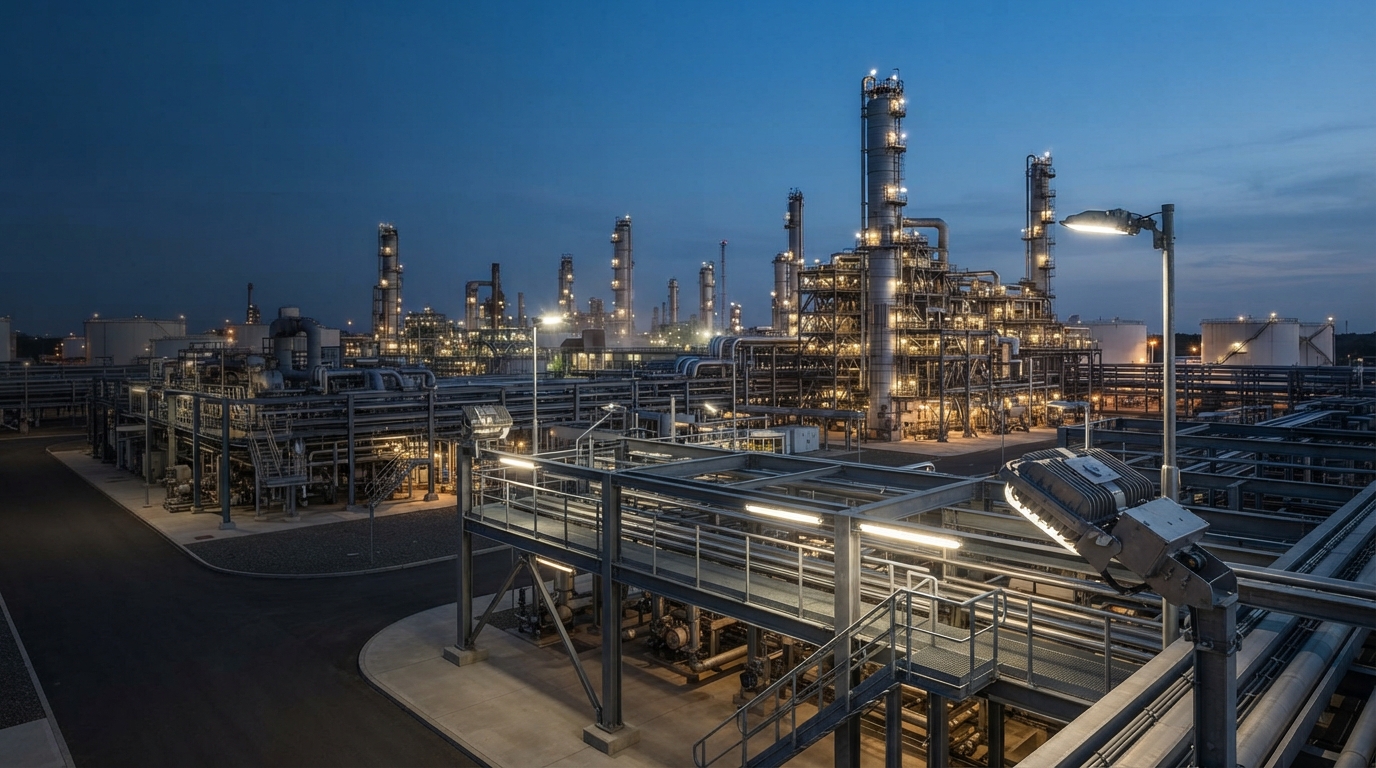
Hazardous area lighting is designed for industrial environments where flammable gases, vapors, dust, or other potentially combustible materials may be present. Unlike conventional lighting, hazardous area lighting must be selected according to the conditions and classification of the installation to support safe and reliable illumination.
At Al Rouf Lighting Technology, hazardous area lighting solutions are part of a broader industrial lighting portfolio developed for demanding environments across sectors such as oil and gas, chemical processing, mining, marine operations, metal processing, and other industrial facilities. The portfolio includes different lighting formats for hazardous-area applications, allowing lighting solutions to be selected according to the environment and application.
Hazardous area lighting refers to lighting equipment intended for locations where an explosive atmosphere may occur because of flammable gases, vapors, dust, or other combustible substances.
In these environments, lighting equipment needs to be appropriate for the identified hazardous conditions. This makes factors such as area classification, protection method, certification, installation requirements, and environmental conditions important considerations when selecting a lighting solution.
Hazardous area lighting is commonly associated with industrial facilities where lighting systems must operate reliably while meeting the safety requirements of the surrounding environment.
Lighting plays an essential role in industrial operations, particularly in facilities where maintenance, inspection, production, and movement of personnel take place around potentially hazardous materials.
Using lighting designed for the specific environment can help support:
The importance of choosing the right lighting becomes particularly clear in industries such as petroleum production and refining, petroleum storage and transportation, LNG, chemical production and storage, mining, and metal processing. These are among the application environments identified across Al Rouf's hazardous-area lighting materials.
Selecting hazardous area lighting is not simply a matter of choosing a light with a suitable brightness level. The lighting solution should correspond to the characteristics and requirements of the installation.
The first consideration is understanding the classification of the area where the lighting will be installed. Different hazardous environments may involve gases, vapors, dust, or other combustible materials.
For example, Al Rouf's hazardous-area portfolio includes lighting intended for environments identified by different hazardous-area zone classifications, demonstrating the importance of matching the lighting solution to the application.
Certification is a key consideration for hazardous-area lighting because it provides a basis for evaluating whether equipment is suitable for specified hazardous environments.
Al Rouf's product documentation references recognized certification frameworks including ATEX, IECEx, and UL 844, depending on the lighting category and intended application.
The appropriate certification should always be evaluated according to the requirements of the specific project, installation, and applicable regulations.
Industrial facilities can expose lighting equipment to challenging conditions, including dust, vapor, humidity, elevated temperatures, and other environmental stresses.
Hazardous-area lighting therefore needs to be considered not only from a protection perspective but also according to the physical conditions in which it will operate. Al Rouf's hazardous-area lighting materials cover applications involving high humidity, dust, temperature, and vapor conditions.
Hazardous-area lighting is not limited to one type of fixture. Different industrial applications may require different lighting formats and installation approaches.
Al Rouf's hazardous-area portfolio includes solutions such as explosion-proof linear lights, explosion-proof flood lights, explosion-proof highbay lighting, and portable explosion-proof lighting, supporting different requirements across industrial facilities.
Hazardous area lighting is used across a wide range of industrial environments where specialized lighting may be required.
Oil and gas facilities are among the most common applications for hazardous-area lighting. Lighting may be required across production, refining, loading, transportation, storage, and LNG facilities.
Chemical production and storage environments can involve flammable materials and demanding operating conditions. Hazardous-area lighting can support visibility throughout processing and storage areas while addressing the requirements of the classified environment.
Mining operations, steel and aluminum facilities, metal treatment, smelting, foundries, and fabrication environments can also require lighting designed for challenging industrial conditions.
Hazardous-area lighting can also be relevant to offshore platforms, marine facilities, and vessel operations, where environmental conditions can add further challenges to lighting installations.
Certain food, flour, and fine-particle production or storage environments can involve combustible dust considerations, making appropriate lighting selection an important part of the overall facility design.
LED technology has become an important part of modern industrial lighting because it can provide efficient illumination while supporting a range of lighting applications.
For hazardous environments, however, the use of LED technology alone does not determine whether a lighting product is suitable. The complete lighting solution must be evaluated according to its protection method, certification, construction, environmental requirements, and intended application.
This distinction is important for project owners, consultants, engineers, and contractors selecting lighting for classified industrial areas.
Al Rouf Lighting Technology provides hazardous-area and explosion-proof lighting solutions for demanding industrial environments. Its portfolio covers multiple lighting formats and applications, including oil and gas, chemical industries, mining, marine and offshore environments, metal processing, food-related applications, and other locations exposed to challenging industrial conditions.
The portfolio also includes lighting categories such as explosion-proof linear lighting, flood lighting, highbay lighting, and portable lighting, providing options for different installation and operational requirements.
For projects where hazardous-area requirements are critical, selecting the appropriate lighting solution begins with understanding the area classification, applicable certifications, environmental conditions, and application requirements.
Before specifying hazardous area lighting for an industrial project, consider:
A properly selected hazardous-area lighting system should address both safety requirements and the practical lighting needs of the facility.
Hazardous area lighting is an essential consideration for industrial facilities where flammable gases, vapors, dust, or other combustible materials may be present. The right solution should be selected according to the area's classification, certification requirements, environmental conditions, and intended application.
With a portfolio covering multiple hazardous-area lighting formats and industrial applications, Al Rouf Lighting Technology provides lighting solutions designed for demanding environments across key industrial sectors.
Explore Al Rouf's hazardous area lighting solutions to learn more about solutions for industrial and hazardous environments.
