
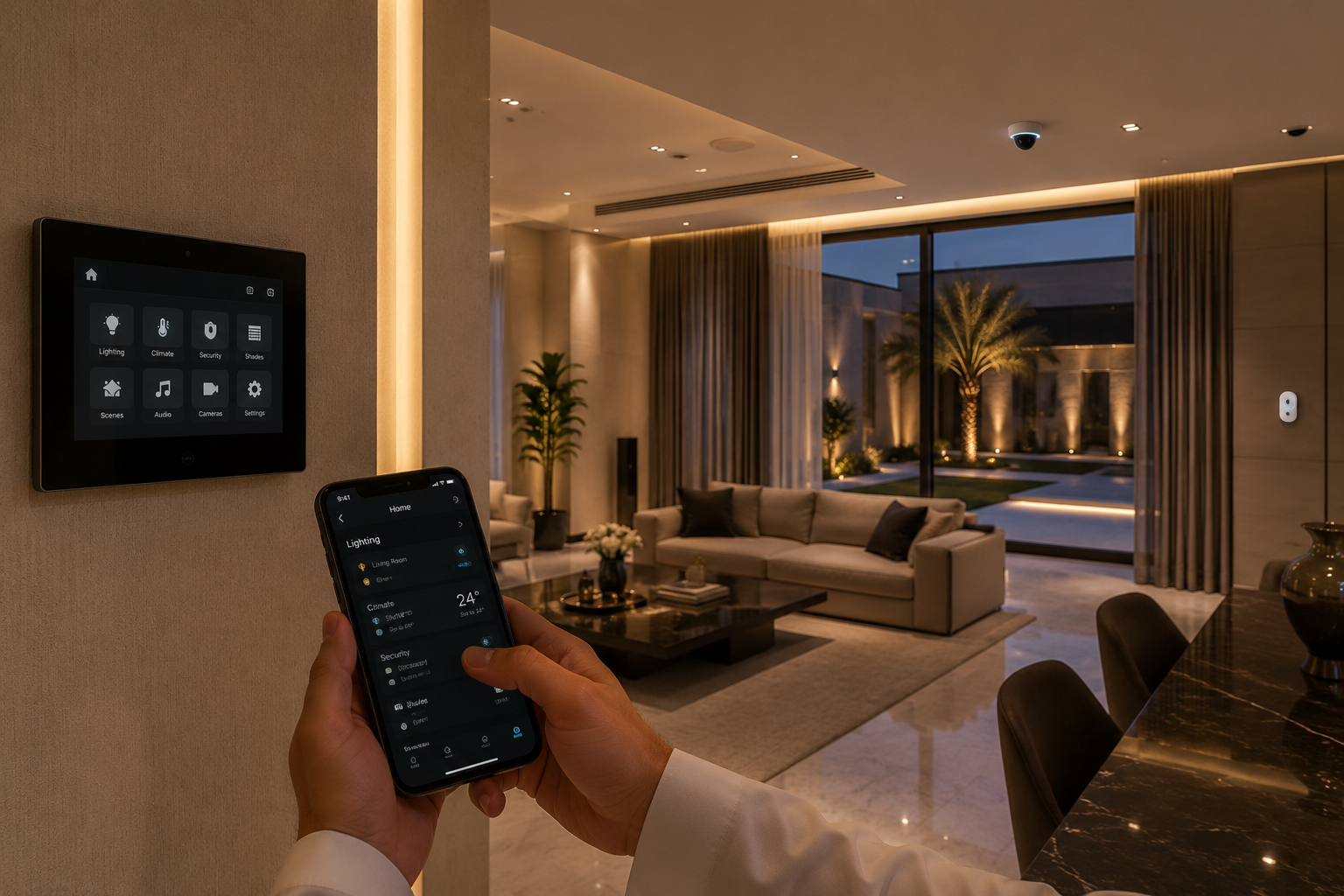
The main difference between KNX, Control4 and Crestron is their approach to automation. KNX is an open building automation standard supported by multiple manufacturers. Control4 provides an integrated smart home platform for controlling compatible lighting, climate, entertainment and other devices. Crestron offers residential and commercial control solutions, including Crestron Home and systems developed through custom programming.
When comparing KNX vs Control4, start with your property’s infrastructure, required integrations and preferred daily controls. Include Crestron in the assessment when its residential platform or custom control capabilities match the project.
For a Saudi villa or renovation, the right choice depends on the lighting circuits, HVAC equipment, shading, entertainment systems, installation scope and long-term support.
| Consideration | KNX | Control4 | Crestron |
|---|---|---|---|
| System approach | Open, multi-manufacturer building automation standard | Manufacturer-led smart home platform with compatible third-party integrations | Manufacturer-led control ecosystem, including Crestron Home and custom-programmed systems |
| Infrastructure | Twisted-pair bus, RF and IP options | Wired and wireless options, depending on equipment | Wired and wireless options, depending on equipment |
| Lighting | Compatible actuators, sensors, dimming interfaces and gateways | Compatible lighting devices and supported third-party systems | Compatible lighting systems through Crestron Home or custom control |
| HVAC | Compatible controllers and equipment-specific interfaces | Compatible thermostats, drivers and interfaces | Compatible thermostats, interfaces and control logic |
| Entertainment | Usually requires a separate AV platform or integration | Integrated control of supported audio, video and entertainment equipment | Residential and commercial AV control, depending on architecture |
| User interface | Depends on the selected visualization system, panels or apps | Control4 interfaces, apps, remotes and keypads | Crestron Home interfaces or custom interfaces |
| Main decision factor | Building control architecture and manufacturer flexibility | Supported devices and a coordinated household interface | Choice between configured residential control and custom requirements |
Features depend on the selected devices, software, interfaces and commissioning. This table describes approaches rather than guaranteeing identical capabilities across every installation.
KNX is an open standard for building automation. Certified products from different manufacturers can form part of the same installation, subject to appropriate device selection and configuration.
A KNX project can coordinate lighting, shading, room controls, sensors and compatible climate equipment.
KNX is not exclusively wired. It supports twisted-pair, radio-frequency and IP technologies, allowing different installation approaches. A project may use wired infrastructure, wireless extensions or a combination.
KNX is worth considering when a project needs:
Its open standard does not make every device interchangeable. Replacement equipment still needs suitable functions, electrical compatibility and correct configuration.
Control4 is a professionally installed smart home platform that brings compatible devices into a coordinated control environment.
A household can use supported keypads, remotes, touchscreens and apps to operate lighting scenes, entertainment, shading and climate functions.
Control4 can be considered when the project needs:
Compatibility should be checked against exact device models and available drivers. A device being “smart” does not automatically mean every function will be available through Control4.
Crestron provides automation and control technologies for residential and commercial applications.
For homes, distinguish between two approaches:
Crestron Home provides a residential control environment configured using supported equipment and setup tools.
Custom-programmed Crestron systems allow an integrator to develop project-specific interfaces and control logic.
Not every Crestron installation requires a fully bespoke program. The proposed architecture should identify which approach is being supplied and its capabilities.
Crestron can be considered for coordinated residential control, extensive AV integration or projects with requirements that justify custom development.
The distinction is between a building automation standard and an integrated smart home platform.
KNX may suit a project where building functions are the starting point: lighting circuits, shading, room sensors and compatible climate controls.
Control4 may suit a project where the household interface and entertainment integration are central: controlling supported lighting, music, television, climate and other devices through a coordinated experience.
Both can be relevant to new construction and existing properties. The installation method depends on the equipment and available infrastructure.
| Project priority | What to assess |
|---|---|
| Coordinated lighting and shading | Circuit design, actuators, sensors and scene requirements |
| Existing home renovation | Wiring access, electrical compatibility and wireless coverage |
| Entertainment integration | Supported AV models, control functions and user interface |
| Manufacturer flexibility | Device compatibility, documentation and replacement options |
| Future expansion | Spare capacity, infrastructure and integration support |
If you are planning a renovation, read our guide to smart home automation without rewiring to understand the installation questions to discuss.
KNX provides a common standard for compatible building automation devices. Crestron provides a control ecosystem with residential and custom-programming options.
A KNX installation may provide the building control layer, while a separate platform handles entertainment or visualization. A Crestron proposal may combine these functions through supported integrations.
When comparing them, ask:
A large property does not automatically require custom programming. Define the functions first, then assess the architecture.
Both platforms can coordinate compatible home systems.
The decision should compare the proposed solution rather than rely on broad labels such as “simple” or “advanced.”
Request a demonstration of everyday tasks:
Also compare supported devices, commissioning scope, future changes and maintenance arrangements.
For Crestron, confirm whether the quote covers Crestron Home or a custom-programmed system. For either platform, request written confirmation of the required integrations.
Yes. A project can combine KNX building controls with Control4 entertainment and user-facing controls through supported integration.
Control4 has documented KNX integration, but the integrator should confirm current driver, interface and software compatibility for the proposed equipment.
Define responsibilities before installation:
Combining platforms adds integration work. Use a combined architecture when it provides a clear benefit.
Specify the lighting system before selecting automation devices.
Check the dimming method, driver compatibility, circuit loads, sensors and required scenes. A control platform cannot guarantee smooth dimming with an incompatible driver.
Explore Alrouf’s smart lighting solutions for project-specific lighting control options.
Confirm the actual AC equipment, zoning and available interfaces.
For each zone, establish whether the proposed integration supports temperature adjustment, operating modes, fan speeds, scheduling and status feedback.
“HVAC compatible” is too broad without identifying the equipment and supported functions.
Check motor interfaces for curtains and blinds, and verify exact camera, lock and alarm models.
Automation can coordinate supported functions, but security equipment should retain its intended operation and safeguards.
There is no universal price order for KNX, Control4 and Crestron. Compare quotations with the same scope.
Costs depend on:
Read our smart home automation cost guide for Saudi Arabia to prepare a clearer project brief.
Long-term flexibility depends on more than the platform name.
Before handover, confirm:
KNX’s multi-manufacturer approach can provide product-selection flexibility, but maintenance still depends on documentation and competent support. Control4 and Crestron projects also need clear records and an agreed support plan.
Neither is universally better. Compare building control requirements, entertainment integration, installation constraints and the desired user interface.
Yes. KNX includes wired and wireless options. Suitability depends on available infrastructure, device compatibility and the proposed scope.
No. Suitability depends on the selected solution and requirements. Crestron Home and custom-programmed systems serve different project needs.
Some local functions can operate without internet access, depending on architecture. Remote access, cloud integrations and online services may require connectivity. Ask the integrator to demonstrate outage behavior.
Savings depend on schedules, occupancy control, setpoints, equipment and commissioning. A brand name alone does not establish a savings percentage.
Alrouf provides home automation and lighting control services covering design, supply, installation and commissioning. The proposed solution should reflect the property’s infrastructure and required integrations.
Explore Alrouf Smart Home Solutions, then share your floor plans, project location, construction stage and the systems you want to control.
Request a smart home consultation to discuss a suitable wired, wireless or combined approach.
