
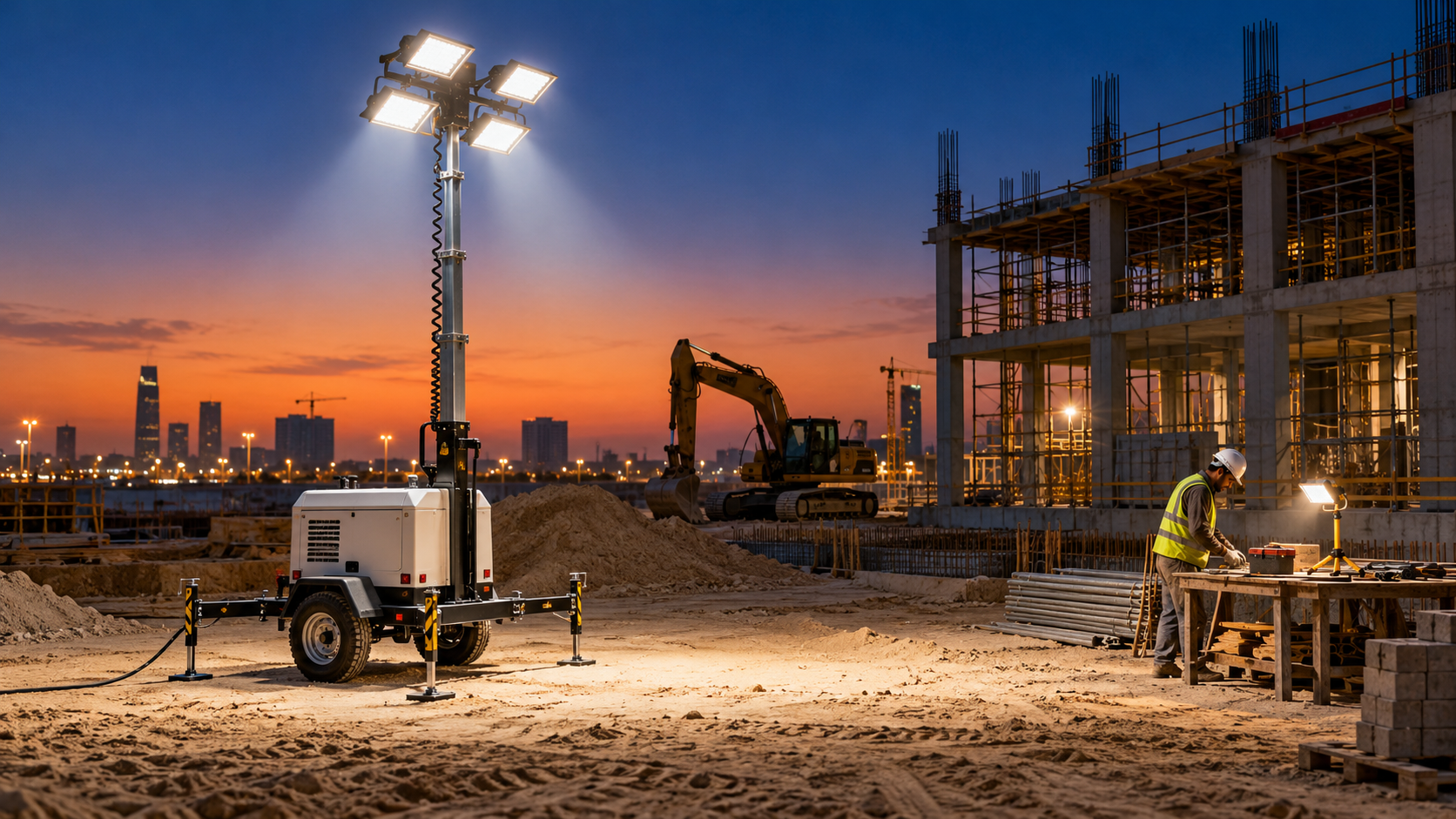
Portable site lighting provides temporary illumination where permanent lighting is unavailable or where work areas change. Choosing the right solution depends on the task, the area to be illuminated, the available power supply, and how frequently the equipment needs to move.
A portable work light such as the PS-200 and an elevated light tower serve different purposes. For construction projects, maintenance areas, and outdoor operations in Saudi Arabia, the first step is to identify whether you need focused lighting near a task or wider illumination across a work area.
This guide explains what to check before selecting portable lighting and introduces relevant Alrouf light tower solutions.
A portable work light is typically used close to a specific task. It can help illuminate an inspection point, maintenance station, or smaller working area where equipment must be repositioned frequently.
A light tower raises luminaires above the ground to distribute light across a larger area. It may be appropriate for temporary construction zones, outdoor staging areas, and other operations requiring elevated lighting.
Neither solution should be selected on brightness alone. Mounting height, beam direction, obstacles, and the required illumination at ground level all affect the result.
For a project with several work zones, a combination of area lighting and local task lighting may be more practical than relying on one unit.
Start with the dimensions of the site and the activities taking place. A pedestrian route, equipment loading area, and detailed maintenance task may require different lighting arrangements.
Lumens describe the light output of a fixture. Lux describes the illumination reaching a surface. A high lumen figure does not, by itself, establish that the lighting will meet your worksite requirements.
Ask for a lighting layout that considers coverage, uniformity, shadows, and glare.
Confirm the power source before choosing equipment.
Some portable lights use batteries, while other systems require an external electrical supply. Solar and diesel-powered towers offer additional options, depending on the project.
Check operating voltage, electrical connections, and cable routing. For battery equipment, confirm runtime at the intended brightness setting and the charging arrangements needed between shifts.
Consider how the lighting will reach its operating position. Equipment that can be moved around a level yard may require different handling arrangements on uneven ground.
Review the unit’s weight, transport dimensions, lifting points, and deployment instructions. Include the complete assembly when assessing transport requirements.
For outdoor projects in Saudi Arabia, check the operating temperature range and the protection ratings of both the lighting assembly and the chassis.
Also review ground conditions, wind limits, and stabilization requirements. Different parts of a light tower may have different protection ratings, so a single IP rating should not be assumed to describe the entire system.
The Alrouf Xummit Portable Series is an option to assess when a project requires elevated illumination and equipment handling features.
Its product page lists retractable handles, a jockey wheel, a crane hook, and forklift pockets. It also describes an optional electric elevation arrangement and lighting control options.
The published specification table includes AC-powered configurations. Buyers should therefore confirm the selected model’s voltage and power requirements rather than assume that the unit operates from an onboard battery.
Before requesting a quotation, confirm:
A lighting assessment should establish whether the selected configuration can meet the requirements of your site.
For projects considering solar-based equipment, explore the Alrouf Solar Hybrid Light Tower.
Confirm the proposed model’s solar charging arrangement, battery capacity, operating schedule, and backup power provision. Selection should account for the required nightly operating hours and the conditions at the installation location.
Projects considering generator-powered equipment can review Alrouf’s Diesel Generator Operated Light Towers.
Include fuel logistics, servicing, noise requirements, and operating hours in the comparison. The appropriate choice depends on the project’s power access and operating conditions.
Create a simple site plan showing work zones, access routes, machinery, and obstacles. Identify where lighting equipment can be positioned without interfering with vehicles or pedestrian movement.
Aim luminaires toward the intended working area while limiting glare for operators, drivers, and nearby properties. Review the layout whenever work zones or equipment positions change.
Follow the manufacturer’s installation and operating instructions, including stabilization and weather restrictions.
Portable site lighting is movable equipment used to illuminate temporary work areas. It can include local work lights and elevated light towers, with different power sources and deployment arrangements.
A portable work light generally provides local illumination near a task. A light tower elevates luminaires to distribute light across a wider area. The appropriate solution depends on the required coverage and working conditions.
The Xummit product page lists AC-powered configurations. Confirm the power requirements of the specific model before ordering.
There is no single number suitable for every site. The quantity depends on the area, required lux levels, mounting height, beam distribution, obstacles, and uniformity requirements.
Request a Portable Site Lighting Recommendation
Choosing portable lighting starts with understanding the worksite.
Share your site dimensions, activities, operating hours, available power supply, and transport requirements with Alrouf Lighting Technology. Request a lighting assessment and a quotation for the configuration that suits your project.
