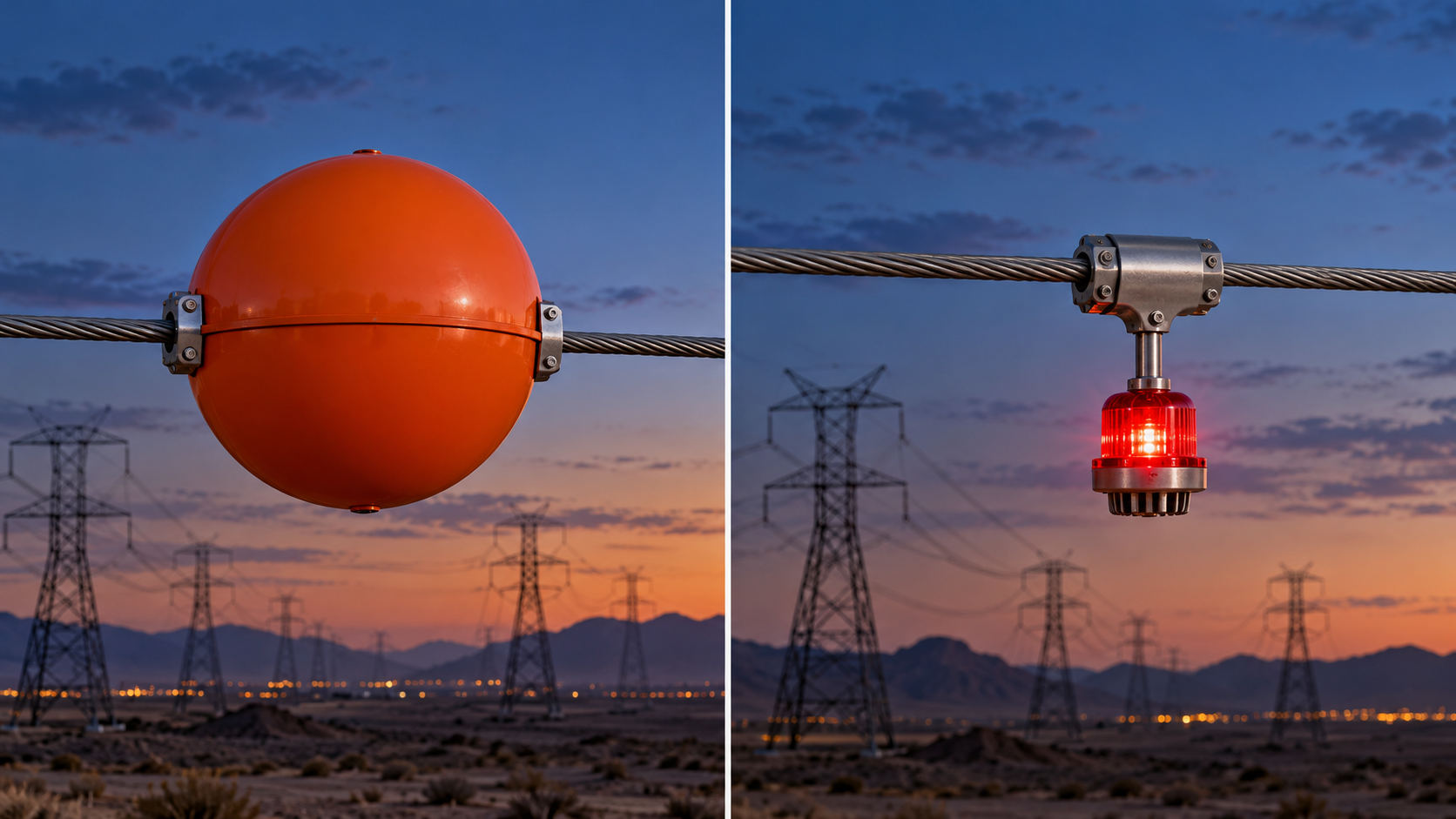
Aerial marker balls are colored spheres that make overhead wires easier to identify visually. Conductor marking lights produce warning illumination directly at the conductor. An unlighted marker ball does not need electrical power, while an induction-powered conductor light depends on the line’s operating conditions.
The products serve related visibility purposes, but they are not interchangeable. Selection depends on the project’s marking and lighting requirements, installation location and compatibility with the overhead wire.
This guide compares unlighted aerial marker balls with induction-powered conductor marking lights, using Alrouf’s GS-AWS and AR-CM-001 as product examples.
| Comparison | Unlighted aerial marker ball | Induction-powered conductor marking light |
|---|---|---|
| Main function | Provides a visible colored marker on an overhead wire | Produces warning illumination at the conductor |
| Example | Alrouf GS-AWS | Alrouf AR-CM-001 |
| Visibility method | Sphere size, color and contrast | Light emitted by the LED assembly |
| Electrical power | Not required for the unlighted sphere | Harvested from current flowing through the conductor |
| Reflective surface | May help reflect incident light; does not generate light | Separate from the light’s active illumination |
| Selection checks | Marker size, color, clamp fit and mechanical loading | Lighting performance, conductor fit and electrical operating conditions |
| Installation arrangement | Determined by the project’s marking design | Determined by the project’s lighting design |
| Automatic substitution | Not a substitute for required obstruction lighting | Not a substitute for required daytime marking |
Aerial marker balls are spherical overhead-wire markers used to improve the visibility of cables against their surroundings.
They are also called aircraft warning spheres, overhead wire markers or obstruction balls.
The Alrouf GS-AWS aerial marker ball is an unlighted marker with a nominal sphere size of 600 mm. Its published color options include red, white and orange.
Its visual effect comes from the marker’s physical size, color and contrast. The suitable color arrangement and marker positions must be established through the project’s approved marking design.
No. A reflective coating returns some incident light; it does not generate illumination.
The GS-AWS should therefore not be treated as an electrically illuminated warning device. Where the project requires obstruction lighting, assess equipment designed for that function.
For background on the use of these spheres, read our guide to aerial marker balls for power lines.
Conductor marking lights place warning illumination directly on an overhead conductor.
The Alrouf AR-CM-001 uses red LEDs and obtains operating energy through electromagnetic induction from the current flowing in the conductor. Its published description includes automatic ambient-light control through a photocell.
These are two different functions:
A photocell does not supply power, and the description “self-powered” should not be interpreted as independence from the conductor’s electrical conditions.
For a fuller explanation, read how conductor marking lights work.
Start by identifying what the project requires the installation to achieve.
A marking requirement may call for colored spheres to make a span more conspicuous. A lighting requirement may call for active illumination with specified operating and performance characteristics.
Some projects may require both functions. Others may specify a different approved arrangement.
Do not select equipment solely because the product name contains “aircraft warning” or because it attaches to the same overhead line.
The project team should confirm:
A supplier’s product catalogue helps assess equipment, but it does not replace the complete marking or lighting design.
An unlighted marker ball does not depend on electrical current to retain its physical marking function.
An induction-powered conductor light needs suitable current conditions to obtain energy. Line voltage alone is insufficient to establish whether it will operate as required.
For a conductor marking light, provide the supplier with the line’s operating-current information, frequency and voltage. Request confirmation of the conditions under which the proposed light achieves its specified performance.
Do not assume that an induction-powered light continues operating after the line is de-energized.
The published AR-CM-001 explanation does not establish a backup power source or guaranteed operation during a line outage.
If continued warning illumination is required under those conditions, include that requirement in the technical enquiry and obtain a documented response.
Both products require a suitable attachment arrangement, but their mounting requirements should be reviewed independently.
For a marker ball, confirm the selected wire and clamp configuration. For a conductor marking light, confirm the conductor dimensions and the mounting assembly specified for that model.
The utility owner’s assessment should also address the proposed equipment’s effect on the line.
| Mechanical consideration | Information to review |
|---|---|
| Wire compatibility | Type, dimensions and construction |
| Attachment | Approved clamp and fastener arrangement |
| Equipment loading | Weight and wind effects |
| Movement | Vibration and other relevant line behavior |
| Clearances | Relationship to surrounding conductors and structures |
| Installation | Approved access, handling and work procedures |
Do not assume that a clamp which physically fits is automatically suitable for the installation.
Environmental suitability and warning performance are different questions.
A product may have appropriate materials or ingress protection while still requiring separate assessment of its marking or lighting function.
Review the site’s temperature, weather exposure, corrosion conditions and maintenance access against the exact product documentation.
Avoid combining specifications from different models or treating a general catalogue statement as evidence for every supplied configuration.
Neither product should be installed using a generic spacing assumption.
The required quantity, position and arrangement depend on the location, span, equipment characteristics and applicable project requirements.
Do not transfer a spacing figure for marker balls to conductor marking lights. Likewise, a light’s stated beam coverage does not independently establish the number of units needed along a span.
Provide the proposed layout to the responsible project team for review before finalizing quantities.
They may be considered together where the approved design requires complementary marking and lighting functions.
For example, a project may need a conspicuous physical marker and a separate source of warning illumination. That does not mean both products must always be installed, or that placing them together automatically meets the specification.
The complete arrangement must account for visibility, electrical compatibility, mechanical loading and installation requirements.
Prepare separate technical checks for each product.
Request confirmation of:
Request confirmation of:
Compare the documentation against the exact model being supplied.
No. An unlighted aerial marker ball provides a colored physical marker, while a conductor marking light produces illumination.
The unlighted GS-AWS does not need electricity for its marking function. Other products described as illuminated spheres should be assessed separately.
No. Reflection and emitted light are different functions. A reflective sphere should not be substituted for required obstruction lighting without an approved technical basis.
The AR-CM-001’s described power source is electromagnetic induction from the current-carrying conductor, rather than a solar panel.
Do not assume so. Confirm the model’s power arrangements and outage behavior against the project’s requirements.
Not automatically. Marker and light positions must follow their respective design requirements.
Begin with the approved marking and lighting requirements. Then assess the equipment against the wire, electrical conditions, environment and required supporting documents.
For a project enquiry, provide the location, span layout, wire details, required marking or lighting function, quantity and applicable specification.
Review the GS-AWS aerial marker ball for unlighted marking, or the AR-CM-001 conductor marking light for conductor-mounted illumination.
For additional selection considerations, read how to choose an aviation obstruction light for overhead power lines.
Contact Alrouf to request current technical information and a project-specific quotation.
