
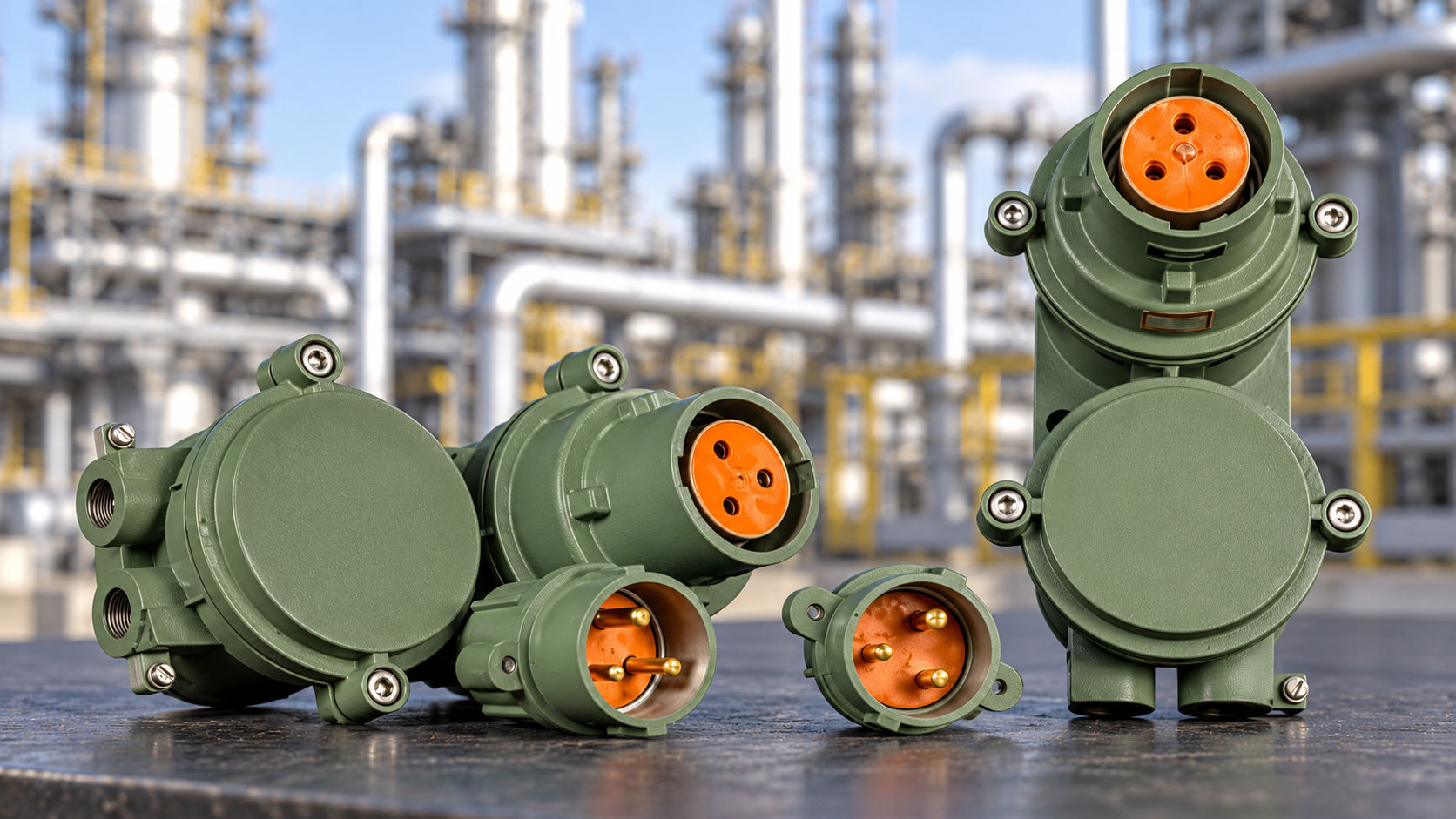
To choose an explosion proof socket, match the exact product to the site’s hazardous-area classification, electrical supply, connected load, environmental conditions and approved plug combination. Verify the model’s marking, certification and installation instructions before ordering.
Selecting a socket by current rating or enclosure material alone is insufficient. Two industrial sockets may have similar electrical ratings while offering different protection concepts, permitted applications and connection arrangements.
For contractors, consultants and procurement teams in Saudi Arabia, the starting point should be the approved project specification and hazardous-area classification.
An explosion proof socket is an electrical connection device designed with a specified protection concept for use in an explosive atmosphere.
“Explosion proof” is often used as a broad commercial description. Technical suitability depends on the actual equipment marking, construction and supporting certification.
For flameproof protection, designated parts of the equipment are designed to contain an internal explosion and prevent its transmission to the surrounding explosive atmosphere under specified conditions.
Do not assume that every explosion-protected socket uses the same protection concept or is suitable for both gas and dust hazards.
Obtain the approved area-classification information before comparing products.
The assessment should identify the relevant:
Gas zones and dust zones describe different hazards. A product suitable for a specified gas atmosphere is not automatically suitable for combustible dust.
Likewise, a reference to Zone 1 or Zone 2 does not establish every other aspect of suitability. The complete equipment marking must be assessed against the site requirements.
Where the project uses a Class/Division classification system, obtain confirmation of the appropriate equipment approval rather than assuming direct equivalence with a Zone-based marking.
Ask the supplier for documentation covering the exact socket, plug and supplied configuration.
Review:
| Document or detail | What to confirm |
|---|---|
| Product code | Matches the quoted and supplied equipment |
| Equipment marking | Matches the site classification and operating conditions |
| Certificate | Covers the relevant model and protection arrangement |
| Certificate schedule | Includes applicable variations and limitations |
| Installation instructions | Describe the permitted installation and use |
| Specific conditions of use | Have been identified and incorporated into the design |
If a certificate reference ends in “X,” review its specific conditions of use.
Do not treat a certificate for a different enclosure, component or product family as automatic approval for the complete socket assembly.
For projects requiring ATEX or IECEx evidence, confirm the applicable documents for the selected model. A general statement in a brochure is not a substitute for checking that evidence.
An explosion proof socket must meet the electrical requirements of the connected equipment as well as the hazardous-area requirements.
Confirm:
For equipment such as motors, assess the actual operating duty and starting characteristics as part of the electrical design.
A socket with a suitable ampere rating may still have the wrong voltage coding, contact arrangement or switching capability.
For example, a three-phase load requiring a neutral conductor needs a different contact arrangement from one that does not.
The complete connection system must match the application.
Select the plug and socket as an approved combination.
A similar appearance, matching current rating or the ability to physically engage does not independently establish compatibility for hazardous-area use.
Ask the supplier to identify:
Do not substitute plugs or use adapters without documented confirmation that the complete arrangement is permitted.
Also remember that an explosion-protected socket does not make the connected tool, motor or portable equipment suitable for an explosive atmosphere. The connected equipment needs its own assessment.
An interlock can control the relationship between plug engagement and electrical switching.
Depending on the design, it may prevent energization before correct engagement or prevent withdrawal while the socket is switched on.
The exact sequence is product-specific. Obtain the manufacturer’s instructions rather than assuming that every hazardous-area socket operates in the same way.
Confirm the permitted connection, disconnection and isolation procedures. Do not bypass an interlock or modify the mechanism to accept an incompatible plug.
Hazardous-area protection and environmental protection are separate considerations.
Review the selected model against the actual site conditions.
| Site condition | Selection consideration |
|---|---|
| High ambient temperature | Permitted operating range and any restrictions |
| Dust or water exposure | Required ingress protection and installation details |
| Coastal or corrosive atmosphere | Housing, finish, seals and external hardware |
| Mechanical exposure | Mounting position and protection from damage |
| Frequent connection cycles | Suitability for the intended operating duty |
| Outdoor installation | Weather exposure and manufacturer instructions |
An IP rating does not independently establish explosion protection, corrosion resistance or suitability for a particular ambient temperature.
Check the protection requirements for the complete installed arrangement, including cable entries, seals, covers and mating components.
Cable glands and entry accessories must suit the equipment’s protection concept, cable construction, entry thread and certification requirements.
Do not assume that any gland with a matching thread is acceptable.
Confirm:
Installation should be carried out by personnel competent in hazardous-area electrical work, following the approved design and manufacturer’s instructions.
Alrouf’s Explosion Proof Flame Proof Socket catalogue describes a range with:
The catalogue identifies petrochemical and gas-industry applications and references installation in Zones 1, 2, 21 and 22.
These are catalogue descriptions, not blanket confirmation that every model or configuration is suitable for all those locations.
Review the Alrouf explosion proof plugs and sockets product page and request the current model-specific datasheet, marking and certification package for your application.
Before comparing prices, ensure that each supplier is quoting equivalent equipment and scope.
| Quotation item | Information required |
|---|---|
| Socket and plug | Exact model codes and approved combination |
| Electrical configuration | Voltage, current, frequency and contacts |
| Hazardous-area suitability | Marking and supporting documentation |
| Environmental suitability | Ratings, temperature limits and materials |
| Accessories | Glands, blanking elements, mounting items and covers |
| Installation information | Instructions and configuration requirements |
| Support | Warranty terms, spare parts and maintenance information |
A lower quotation may exclude the mating plug, approved glands or required documentation.
For broader technical-submittal considerations, read our guide to switchgear standards and compliance in Saudi Arabia.
“Explosion proof socket” is commonly used as a broad product description, while flameproof refers to a particular protection approach. Check the exact marking and certification rather than relying on the product name alone.
Do not select a standard industrial socket solely because its electrical or IP ratings match. The equipment must have the protection and supporting evidence required for the classified location.
No. IP66 describes ingress protection. Suitability for an explosive atmosphere requires separate assessment of the equipment’s protection concept, marking and documentation.
Do not assume so. Equipment approved only for Zone 2 is not automatically suitable for Zone 1. Verify the complete approval and project requirements.
Only where the proposed combination is documented as permitted. Matching dimensions or electrical ratings alone do not establish hazardous-area compatibility.
No. The connected equipment must also be suitable for its intended location and operating conditions. The socket’s protection does not extend automatically to the tool or appliance.
Provide the area classification, gas or dust information, temperature requirements, supply voltage, load current, contact arrangement, cable details, installation conditions and quantity.
A suitable connection system begins with a clearly defined application and verifiable product documentation.
Explore Alrouf’s explosion proof plugs and sockets and prepare your electrical and hazardous-area requirements.
Contact Alrouf to request current technical documents and a quotation for the required configuration.
