
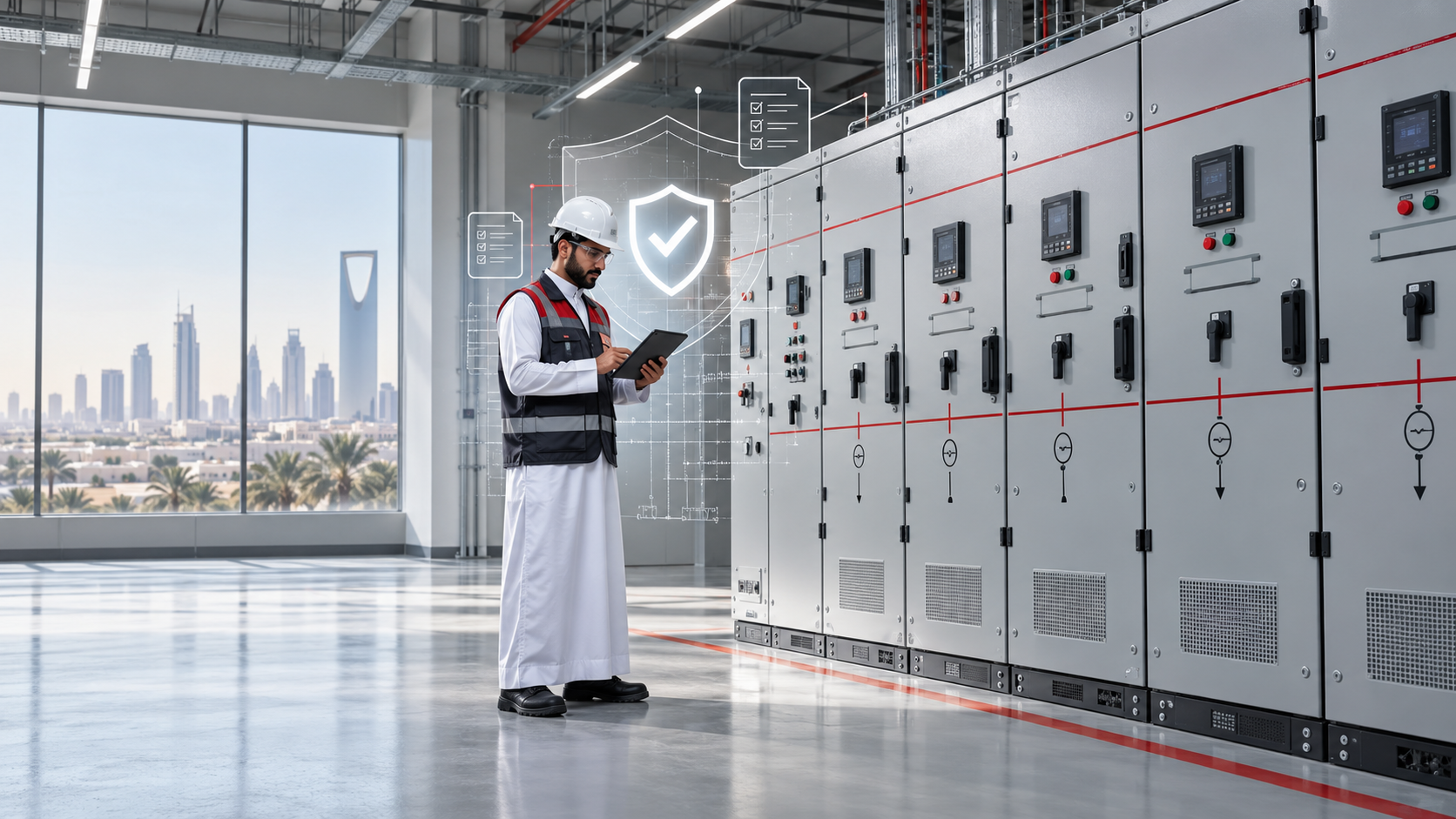
Switchgear installed in Saudi Arabia must meet the applicable SASO technical regulations, Saudi-adopted IEC standards, Saudi Building Code requirements, SABER conformity procedures and project specifications. The exact requirements depend on the equipment’s voltage, product classification, fault rating, installation environment and whether it is imported or manufactured locally.
Compliance must be evaluated for the complete switchgear assembly—not only for its individual circuit breakers and components. Engineers, consultants and procurement teams should verify the design, short-circuit ratings, environmental suitability, test evidence, documentation and conformity route before approving the equipment.
Switchgear compliance helps ensure that electrical equipment can distribute power, interrupt expected fault currents and protect people and connected systems under its intended operating conditions.
Non-compliant or incorrectly documented switchgear can lead to:
Compliance should therefore be defined during the design and specification stages—not after manufacturing or delivery.
If you need a general introduction to the equipment and its purpose, read What Is Switchgear? A Complete Guide.
Switchgear acceptance can involve SASO, the SABER platform, Saudi Building Code requirements, utilities, engineering consultants and individual project owners.
The Saudi Standards, Metrology and Quality Organization, known as SASO, develops and adopts standards and technical regulations for products placed on the Saudi market.
International IEC standards may be adopted as Saudi standards and published as SASO IEC standards. The applicable Saudi edition should be checked when preparing a specification or conformity file because standards and regulatory requirements can be updated.
SASO lists a national standard for low-voltage switchgear and controlgear assemblies, reinforcing the importance of evaluating the complete assembly.
The applicable standard depends on the type of equipment. Requirements for low-voltage assemblies are different from those for medium-voltage metal-enclosed switchgear or equipment installed in explosive atmospheres.
SABER is the Saudi electronic platform used for product registration, conformity certificates and shipment certificates.
The required conformity route can depend on:
The importer or local manufacturer should confirm the route for the exact switchgear product. It should not be assumed that every electrical panel requires the same certificate or process.
The Saudi Electrical Code SBC 401 contains requirements affecting electrical systems installed in Saudi buildings and facilities.
Product conformity and installation compliance are related but separate. A switchgear assembly may have suitable test evidence, while its installation must still satisfy requirements concerning:
Yes. Saudi Electricity Company, government entities, industrial operators, consultants and other project owners may impose additional requirements.
These can include:
Meeting an IEC standard does not automatically replace contractual project requirements.
The IEC 61439 series is the principal international reference for low-voltage switchgear and controlgear assemblies.
IEC 61439-1 provides the general rules for low-voltage switchgear and controlgear assemblies. It addresses matters such as:
IEC 61439-1 is normally used with the part that applies to the particular assembly. It should not generally be treated as a complete standalone product specification.
IEC 61439-2 applies to power switchgear and controlgear assemblies used for power distribution and control.
Depending on the project, these may include:
One of the most important IEC 61439 principles is that compliance applies to the complete assembly—not merely to the separately certified components installed inside it.
For an explanation of those components, see Switchgear Components and Their Functions.
No. Installing compliant circuit breakers, contactors and protective devices does not automatically make the complete switchgear assembly compliant.
The arrangement and integration of components can affect:
For example, a circuit breaker may comply with IEC 60947-2, but the panel must still be verified for its busbar arrangement, rated current, temperature rise, short-circuit withstand and enclosure design.
Manufacturers should provide evidence relating to the offered assembly instead of relying only on individual component certificates.
IEC 61439 distinguishes between design verification and routine verification.
Design verification demonstrates that the assembly design satisfies the applicable requirements.
Depending on what the relevant standard permits, verification may be established through:
It may address enclosure protection, electrical clearances, protective circuits, temperature rise, short-circuit withstand, dielectric performance and mechanical operation.
The manufacturer should clearly identify the verification method used for each characteristic.
Routine verification is performed on every completed assembly to identify manufacturing defects and confirm that the supplied equipment corresponds to its approved design.
It may include:
Routine-verification records should be retained and submitted when required by the project.
Medium-voltage switchgear is generally evaluated under the relevant parts of the IEC 62271 series and their applicable Saudi-adopted editions.
These standards can include:
Only the parts relevant to the offered equipment should be specified.
For a clearer explanation of the voltage categories, read Types of Switchgear: LV, MV and HV Explained.
Matching the nominal system voltage is not enough. A medium-voltage technical submittal may need to confirm:
The project should also define whether the switchgear must be fixed or withdrawable, indoor or outdoor, and air-insulated or gas-insulated.
If the required voltage category has not been determined, see LV vs MV vs HV Switchgear: Which One Do You Need?.
Internal arc classification indicates that metal-enclosed switchgear has been tested under specified conditions to assess its ability to protect people during an internal arc fault.
It is not a guarantee of protection under every possible fault. Its meaning depends on the:
Changes to the enclosure, ventilation, cable compartment or pressure-relief path may affect the relevance of the test evidence.
The submittal should therefore state the complete internal arc classification and any installation limitations—not merely say that the panel is “arc resistant.”
Different standards apply according to the component type and voltage.
Common references include:
Component and assembly standards serve different purposes. Component compliance cannot replace verification of the completed switchgear assembly.
Switchgear must withstand and interrupt the prospective fault conditions at its installation point.
Engineers may need to assess:
These values should be coordinated with the project’s short-circuit and protection-coordination studies.
A circuit breaker with a high breaking capacity does not prove that the complete panel—including its busbars, supports, connections and enclosure—can withstand the same fault level.
To understand what happens after a fault is detected, read How Does Switchgear Work?.
Saudi switchgear installations may be exposed to high temperatures, dust, sand, humidity, solar radiation and corrosive atmospheres.
The equipment manufacturer should evaluate:
If the installation conditions exceed the standard service conditions, the switchgear may require derating, ventilation, special coatings, alternative materials or enclosure modifications.
IEC 60529 defines IP codes for the protection provided by enclosures against access to hazardous parts, solid objects and water.
However, an IP rating does not independently confirm:
The completed assembly—including its doors, joints, glands, seals and cable entries—must maintain the required IP rating. Incorrect field modifications can compromise the enclosure’s protection.
Electrical switchgear installed where explosive gases, vapours or combustible dust may be present requires additional hazardous-area assessment.
Relevant parts of the IEC 60079 series can include:
Equipment must match the classified zone, protection concept, equipment group, gas or dust group, temperature class, equipment protection level and ambient conditions.
A general “explosion-proof” statement is insufficient. The complete product marking and supporting certificate must correspond to the supplied configuration and project classification.
Al Rouf’s ILS/JB/350 catalogue describes an explosion-proof and weatherproof multiple switch-socket assembly designed for hazardous-area power distribution.
The catalogue lists:
These are catalogue-specific specifications. They should not be treated as blanket certification for every Al Rouf switchgear product.
The catalogue states that its specifications and certifications must be verified against the approved drawing before manufacturing. The project submittal should therefore confirm that the supplied configuration, product marking and certification evidence match the approved design.
A complete technical submittal may include:
The models, ratings and configurations appearing in these documents must match the supplied equipment.
Test reports or certificates for different products should not be submitted without documented technical justification confirming their applicability.
A factory acceptance test may be required before delivery. Its scope can include:
After installation, site testing should confirm cable connections, phase sequence, earthing, relay settings, trip functions and integration with the wider electrical system.
Common mistakes include:
Early technical review can prevent approval delays and unsuitable equipment selection.
A structured selection process should include:
Low-voltage power switchgear assemblies are generally assessed under the applicable Saudi-adopted editions of the IEC 61439 series. The current Saudi standard, technical regulation and project requirements should be confirmed before specification.
The applicable procedure depends on the product classification, HS code, technical regulation and whether the equipment is imported or locally manufactured. The precise route must be checked for the specific product.
Not necessarily. IEC-based evidence may support technical compliance, but SASO regulations, SABER procedures, Saudi codes, utility standards and project specifications may impose additional requirements.
No. IP66 concerns protection against solid objects and water. Explosion protection requires separate hazardous-area assessment, appropriate construction, certification and marking.
No. A certified circuit breaker does not certify the complete panel. The assembly must separately satisfy applicable construction, dielectric, temperature-rise and short-circuit requirements.
IEC 62271-200 is a principal standard for AC metal-enclosed switchgear above 1 kV. Other IEC 62271 parts may apply to the circuit breakers, switches and other devices used in the assembly.
Switchgear compliance in Saudi Arabia requires coordinated consideration of SASO regulations, SABER procedures, the Saudi Electrical Code, applicable SASO/IEC standards and project-specific requirements.
Compliance must be demonstrated for the actual assembly and supplied configuration. Component certificates, catalogue descriptions and broad compliance statements cannot replace traceable design verification, routine testing and complete technical documentation.
