
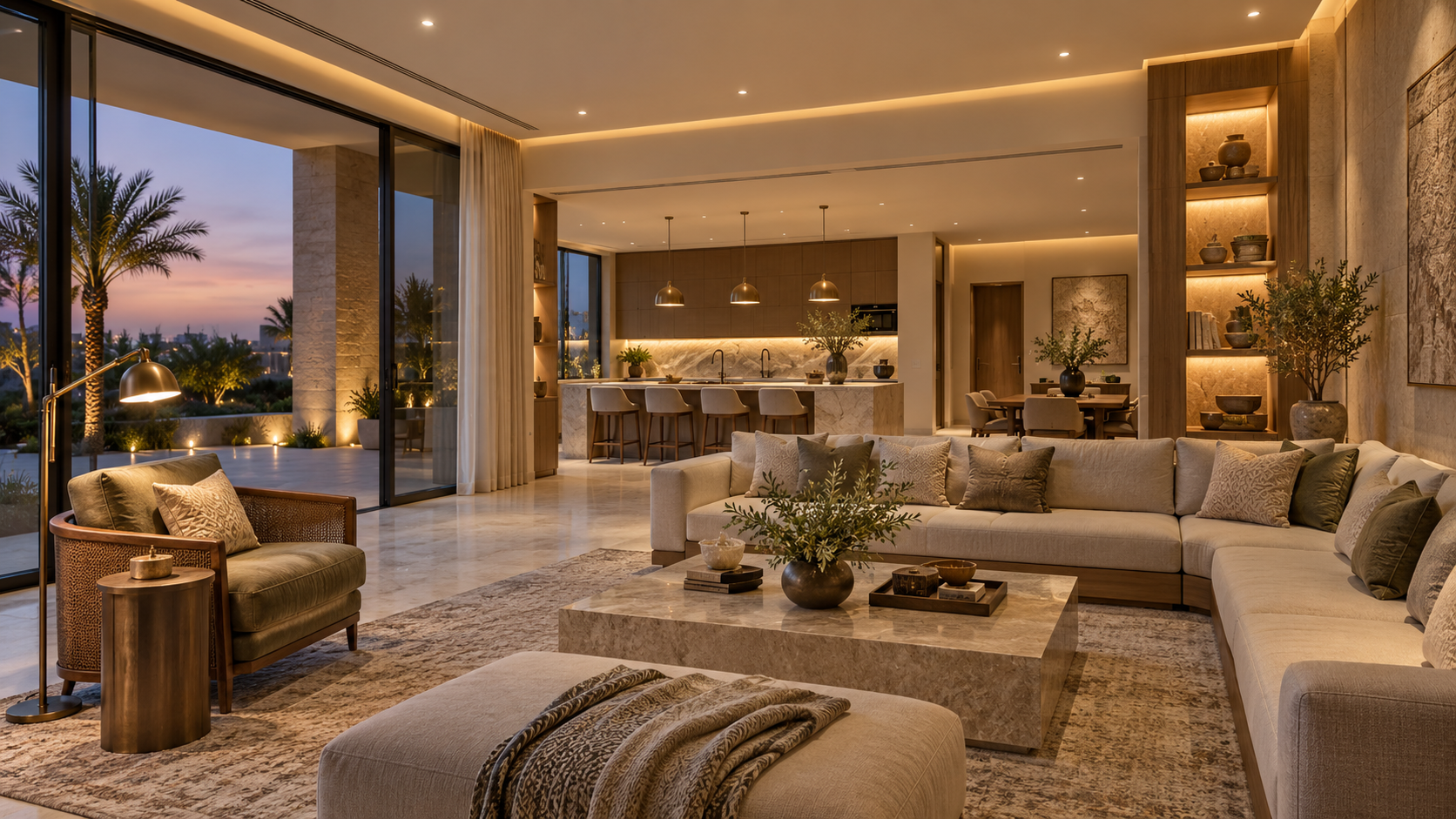
Choosing LED lighting for your home starts with matching the light output, colour temperature, beam distribution, and controls to each room’s activities. A comfortable living room needs a different arrangement from a kitchen worktop or a bathroom mirror.
For villas and apartments in Saudi Arabia, a useful lighting plan combines everyday visibility with flexibility. Rather than choosing fixtures by appearance or wattage alone, consider where light is needed, how it reaches the surface, and how the room will be used.
This guide explains the main selection factors and where Alrouf’s lighting control solutions can support your home.
General lighting provides the room’s overall illumination. Depending on the space, this might come from ceiling-mounted fixtures, downlights, or indirect lighting.
The layout should account for room dimensions, ceiling height, furniture, and surface colours. A single bright fixture does not necessarily provide comfortable illumination throughout the room.
Task lighting supports activities such as preparing food, reading, studying, or grooming.
Place it where the activity happens. Under-cabinet lighting can illuminate a kitchen worktop, while a reading light can provide local illumination without making the entire room brighter.
Accent lighting draws attention to artwork, shelving, architectural details, or textured surfaces.
Use it selectively. Too many competing highlights can make a room visually busy and reduce the effect of the features you want to emphasize.
Living rooms and majlis spaces often accommodate conversation, television viewing, reading, and gatherings.
Combine general lighting with local reading lights and selected accents. Separate circuits or compatible dimming allow the arrangement to change with the activity.
Position fixtures to limit reflections on television screens and avoid directing bright light into seated occupants’ eyes. Warm light may suit a relaxed atmosphere, but compare samples with the room’s finishes before making a final choice.
Kitchen lighting should make preparation surfaces easy to see.
Ceiling lighting alone can leave worktops in shadow when someone stands between the fixture and the counter. Under-cabinet or other dedicated task lighting can help address this.
Consider colour rendering when assessing finishes and food appearance. Select fixtures suitable for their location, and plan maintenance access around cabinets and appliances.
Bedroom lighting should support both relaxation and practical activities.
Combine general illumination with bedside reading lights and lighting around wardrobes or dressing areas. Controls accessible from the bed can make the arrangement more convenient.
If dimming is required, confirm compatibility between the luminaire, driver, and control device. A product described as LED is not automatically dimmable.
Bathrooms need lighting for circulation and mirror-based tasks.
A ceiling fixture positioned behind the user may create shadows on the face. Carefully positioned mirror lighting can improve visibility for grooming.
Fixture selection must account for its location relative to wet areas. Ask a qualified designer or installer to confirm the required protection and installation arrangement.
Plan lighting around the desk, screen, and reading materials.
A local task light can supplement general illumination without adding glare to the display. Check the position of fixtures and windows, and assess flicker performance where relevant.
The goal is suitable illumination for the task—not simply the brightest available lamp.
Outdoor lighting should help people identify steps, pathways, entrances, and changes in level.
Check the fixture’s suitability for the expected temperature, dust, moisture, and exposure. Indoor fixtures should not be installed outside unless their specifications permit it.
Aim lighting toward the intended area and limit spill into neighbouring properties or directly into people’s eyes.
Lumens describe light output. Watts describe electrical power consumption. Use both when comparing products.
A lower-wattage fixture may reduce energy demand, but it still needs to provide the required illumination. Beam angle, mounting height, and room surfaces affect how much useful light reaches the working area.
Compare the proposed layout with the existing installation rather than assuming that every LED replacement delivers the same result.
Colour temperature, measured in kelvin, describes the appearance of white light.
| Colour temperature | Typical appearance | Possible use |
|---|---|---|
| Around 2700–3000K | Warm white | Bedrooms, living areas and relaxed settings |
| Around 3500–4000K | Neutral white | Kitchens, bathrooms and multipurpose rooms |
| Around 5000K and above | Cooler white | Selected task areas where this appearance is preferred |
These are starting points, not fixed rules. Review the lighting alongside paint, flooring, furniture, and daylight.
Colour rendering describes how colours appear under the light. Check the product’s published CRI and compare samples where accurate colour appearance matters.
Before buying dimmable LEDs, confirm that the fixture, driver, and dimmer work together.
Compatibility affects the usable dimming range and operating behaviour. For a larger installation, testing a sample combination can help identify issues before the full order is placed.
Where you want coordinated brightness levels or lighting scenes, explore Alrouf Smart Lighting Solutions. Confirm the control method and functions included in the proposed configuration.
Homeowners may want lighting to operate alongside curtains, air conditioning, or other systems.
That is a broader requirement than choosing a dimmable lamp. It involves reviewing equipment compatibility, wiring, user controls, and the desired operating scenes.
Alrouf Smart Home Solutions can be considered when planning this integration. Define the functions you need before selecting the system.
Energy savings depend on the total power of the installation and how long it operates.
Compare the old and proposed fixtures at suitable illumination levels. Then consider operating hours, dimming, and controls that reduce unnecessary use.
Avoid relying on a universal savings percentage. A project-specific comparison gives a more useful estimate.
It depends on the room and personal preference. Warm white is often selected for relaxed spaces, while neutral white may suit practical areas. Compare samples before committing to a full installation.
No. The luminaire or lamp must support dimming, and its driver must be compatible with the control device.
Not necessarily. Start with the rooms and activities where scenes, scheduling, or coordinated controls would be useful.
Only if its specifications support both locations. Check environmental protection, temperature limits, and installation requirements.
Prepare a room plan showing furniture positions, ceiling heights, activities, and preferred controls.
Share it with Alrouf Lighting Technology to discuss suitable lighting options and control configurations for your home. Request model-specific specifications and confirm the proposed arrangement before installation.
