
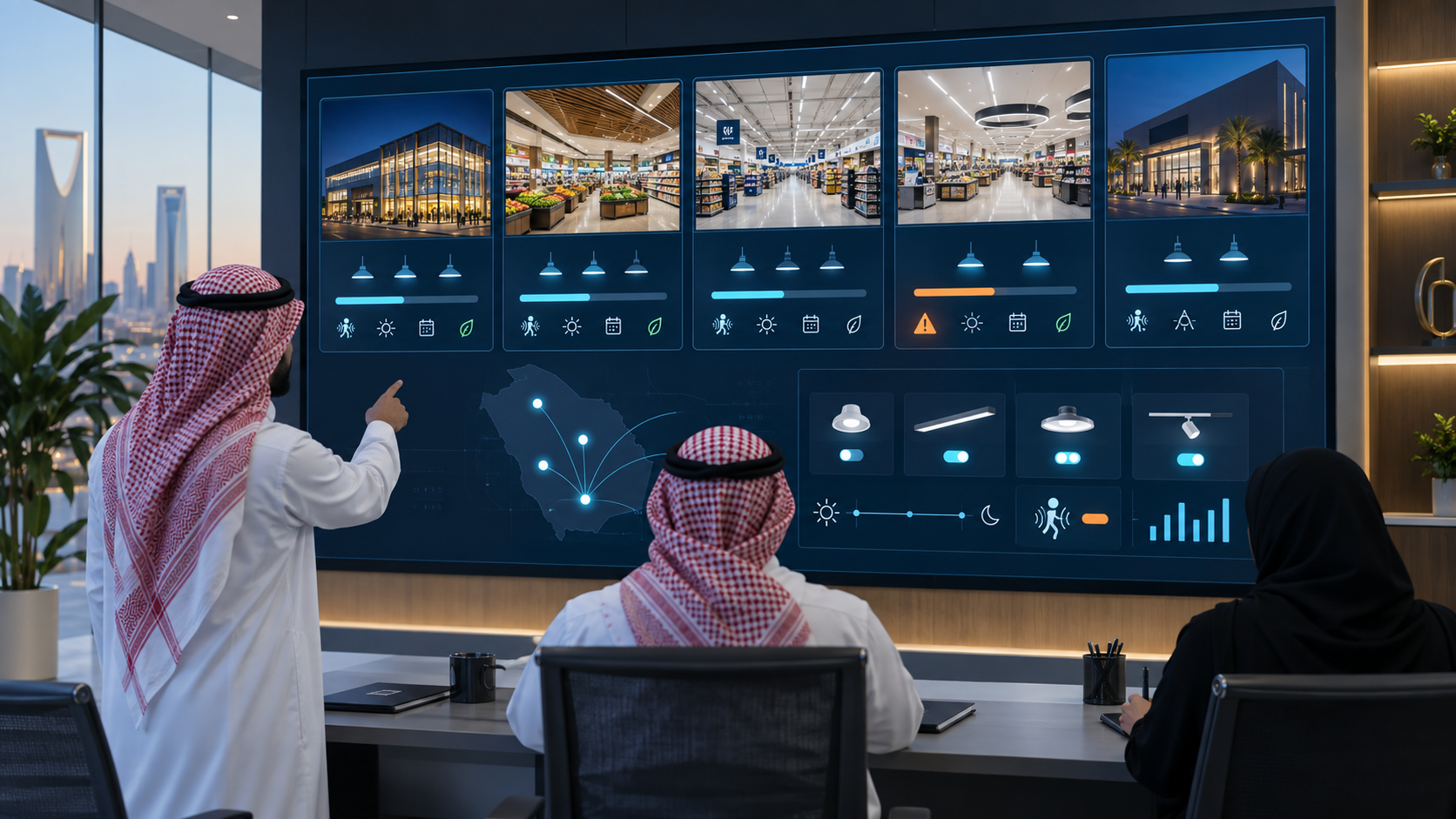
Multi-branch retail lighting management allows authorized teams to monitor and control lighting across several stores from one central platform. Retailers can coordinate schedules, scenes, permissions and performance standards while allowing each branch to retain the local flexibility it needs. This improves consistency, simplifies maintenance and provides clearer visibility across the retail portfolio.
For supermarket chains, hypermarkets, convenience stores and other multi-location retailers, the challenge is not limited to installing efficient luminaires. Every branch must operate its lighting correctly every day.
Multi-branch retail lighting management connects lighting controls in different stores to a central management platform. Each location retains its local luminaires, sensors, controllers and gateways, while approved users can supervise connected branches through one interface.
Depending on the selected platform, central management may cover:
One dashboard does not mean every store must use identical settings. A hypermarket, convenience store and shopping-mall branch may have different opening hours, layouts and daylight conditions. The central platform creates common standards while preserving necessary branch-level settings.
Individual store management can create inconsistent lighting performance and limited operational visibility.
One branch may follow its approved schedule while another leaves lights operating after closing. Local employees may activate temporary overrides that remain in place, and maintenance teams may not discover failures until employees report them.
Common challenges include:
Centralized retail lighting control helps head-office teams identify these differences and manage them more consistently.
A useful dashboard should help operations and facility teams quickly understand which branches require attention.
Depending on the platform and connected equipment, it may display:
The dashboard should prioritize actionable information rather than display technical data without context. Facility teams should be able to identify a branch operating outside its schedule, an offline gateway or a location consuming more energy than comparable stores.
Central management allows retailers to create approved lighting templates for different store formats.
Separate templates may be developed for:
Each template can define:
These templates create a consistent starting point and reduce configuration errors when new stores are commissioned.
Standardization should not ignore differences in store size, architecture, customer traffic or available daylight. It provides common governance without forcing every location to operate identically.
Effective multi-site lighting management combines central oversight with controlled local access.
Branch managers may occasionally need to:
The platform should define who can make these changes, which zones they can control and how long an override remains active.
Temporary overrides should expire automatically where possible. Otherwise, a short-term change could disable an approved schedule for several days.
A permission structure may include:
Central scheduling allows head office to distribute approved operating times to individual branches or selected store groups.
Schedules may cover:
Retail hours in Saudi Arabia can change during Ramadan, Eid and seasonal shopping periods. Central control can help update the relevant branches without relying on employees to reprogram every location individually.
Mall-based stores, standalone hypermarkets and regional branches may still require different schedules, so every update should be reviewed before deployment.
Central management becomes more valuable when branch data is converted into meaningful performance indicators.
Useful metrics include:
Stores should not be compared using total electricity consumption alone. A large hypermarket will naturally consume more than a small convenience store.
Fair comparisons should account for floor area, store format, operating hours, daylight and installed equipment. Similar branches can then be grouped together to identify locations that require investigation.
For more detail about scheduling, sensors, dimming and daylight harvesting, read How Smart Lighting Reduces Energy Costs in Supermarkets and Hypermarkets.
Remote monitoring can help maintenance teams identify abnormal operation before it becomes a larger problem.
Depending on the selected platform, notifications may identify:
An alert may not reveal the exact physical cause of every problem. It gives the maintenance team a starting point and helps determine which store should be inspected first.
This can reduce unnecessary travel and allow technicians to arrive with better information about the affected system.
Each branch should be divided into functional lighting zones before it is connected to central management.
Typical zones include:
The dashboard may supervise these zones, but each department still needs an appropriate lighting design. Checkout counters, food displays and glazed entrances should not use identical light levels or control behaviour.
Explore Zone-Based Lighting for Retail: Fresh Food, Checkout, and Entrance Design for detailed zone-planning guidance.
A multi-branch system typically combines local lighting controls with a communication and management layer.
Its components may include:
The Alrouf Smart Lighting Control Product Catalog 2026 includes technologies for commercial and smart-building projects, such as:
These technologies can support different parts of a smart lighting project. However, dashboard features, analytics, remote access and multi-branch hierarchies vary by platform. The complete functionality must be confirmed during project design.
The correct protocol depends on the existing infrastructure and operational requirements.
DALI can support addressable luminaires, groups, scenes and sensor-based control within a store. KNX may be suitable when lighting must integrate with a wider building-automation system.
Casambi and Zigbee can support wireless control networks and may offer flexibility for retrofit projects. RF systems may support straightforward wireless switching and dimming. Gateways connect these local systems with wider management platforms where compatibility permits.
The decision should consider:
The protocol should not be selected solely according to initial price or mobile-app availability.
A system that can affect several branches requires clear access and cybersecurity controls.
Important requirements include:
A branch should maintain essential local lighting if its external connection becomes unavailable. Offline behaviour and recovery procedures should therefore be tested during commissioning.
A phased approach reduces technical and operational risk:
The pilot should confirm compatibility, operational reliability and management processes before the system is expanded across the portfolio.
Yes, when the selected platform supports multi-site management and each branch has compatible controllers, gateways and connectivity.
Yes. Standard templates can be used while allowing approved variations based on store format, location and operating hours.
A properly designed system should preserve essential operation through local controllers and stored schedules. Exact offline behaviour depends on the platform.
They can receive limited permission to activate approved scenes or temporary changes. Overrides should be logged and configured to expire where possible.
Potentially. Existing luminaires, drivers, controls, wiring and network infrastructure must first be assessed for compatibility.
It may be possible when compatible emergency equipment and management platforms are used. Alrouf’s catalogue includes emergency-lighting auto-test systems, but project-specific integration must be confirmed.
Multi-branch retail lighting management gives retail chains a consistent way to supervise lighting across every connected store. Central schedules, controlled permissions, performance comparisons and maintenance alerts improve operational visibility while preserving necessary local flexibility.
The strongest approach combines local store control with suitable gateways, secure communication and clear management rules. Retailers should begin with an audit and pilot, verify the selected platform’s multi-site capabilities and expand the system according to store format.
Alrouf Lighting Technology offers commercial lighting-control technologies including sensors, controllers, gateways, wireless controls, DALI, KNX, Casambi and Zigbee solutions. The final architecture and dashboard features should be selected according to the retailer’s infrastructure and operational requirements.
