
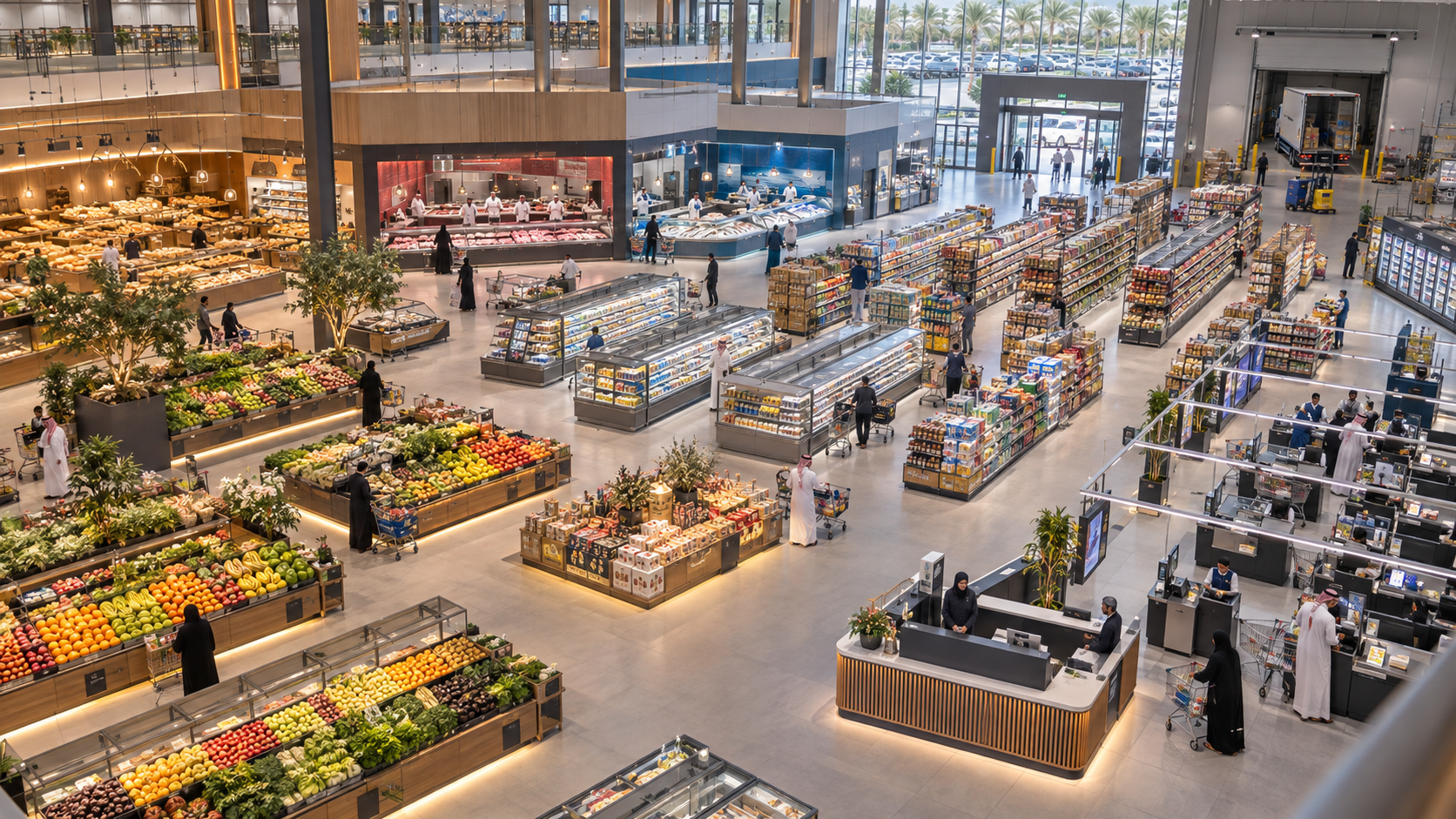
Zone-based lighting for retail divides a store into functional areas and gives each one its own lighting levels, colour characteristics and control strategy. Fresh-food departments need accurate, appealing product presentation, checkout counters require comfortable task visibility, and entrances need balanced brightness that welcomes customers and supports visual adaptation. This approach improves the shopping experience while avoiding unnecessary illumination.
A supermarket or retail store should not use one lighting solution across every department. Different zones contain different products, tasks, customer behaviours and daylight conditions. Effective retail lighting design responds to these differences while maintaining a consistent identity throughout the store.
Zone-based lighting for retail is a design method that groups luminaires according to the function and operating requirements of each store area. Every zone can then have its own light distribution, colour temperature, colour-rendering performance, dimming level and operating schedule.
Typical retail lighting zones include:
Dividing these areas into individual lighting zones allows the design team to support product presentation, customer movement and employee tasks without overlighting the entire store.
Each retail zone performs a different role. Applying the same lighting level and colour characteristics everywhere can reduce visual interest, waste energy and make certain tasks more difficult.
A successful retail lighting design should answer four questions:
Fresh-food displays need colours and textures to look natural and attractive. Checkout counters require clear task visibility with limited glare. Entrances must attract attention while allowing customers’ eyes to adjust between outdoor and indoor brightness.
Zone-based design addresses each requirement independently while maintaining a coordinated store environment.
Fresh-food lighting should reveal the natural appearance of products without causing misleading colour shifts, glare or unnecessary heat.
The objective is not simply to make food look brighter. It is to create appropriate contrast, render colours accurately and make products easy to inspect.
Fruit and vegetable displays contain a wide range of greens, reds, yellows and natural textures. Produce section lighting should make these colours appear fresh and realistic.
The design should provide:
Excessively coloured light can make produce look artificial. The lighting should enhance natural appearance rather than change it.
Bakery areas often benefit from a warmer visual atmosphere that supports the appearance of bread, pastries and other baked products.
The lighting design may combine:
Light sources must be positioned carefully to avoid strong reflections on glass display cases.
Fresh-meat lighting requires controlled colour rendering that helps customers inspect products accurately. Poorly selected light can distort red tones or make food appear unnatural.
The design should avoid:
The goal is accurate and appealing presentation, not artificial colour manipulation.
Seafood counters often contain ice, stainless steel, glass and wet reflective surfaces. These materials can create glare if luminaires are poorly positioned.
Effective seafood display lighting should support:
LED lighting is particularly suitable for refrigerated cases because it is efficient, controllable and produces less heat than older lighting technologies.
The lighting should be integrated with the display rather than simply added above it. Poor positioning can create shadows, highlight packaging instead of products or reflect directly into customers’ eyes.
Lighting schedules can also coordinate refrigerated-case illumination with store opening hours and after-hours operation.
Checkout lighting should provide clear, comfortable visibility for payment, product handling and customer interaction.
Employees need to read screens, receipts, product labels and cash accurately. Customers must be able to see payment terminals, counters and bagging areas without discomfort.
An effective checkout lighting design should provide:
Bright downlights positioned directly over reflective screens may create distracting glare. Luminaires should be arranged according to the counter layout and employee viewing direction.
Not necessarily. Active and inactive checkout lanes can operate as separate lighting zones.
When a lane is closed, its lighting can be reduced while:
The change should be gradual and coordinated so the checkout area does not appear partially closed or visually inconsistent.
Lighting can help customers recognize entrances to queues, available payment areas and exit directions. Slightly higher visual emphasis at active counters can guide movement without relying entirely on signs.
However, extreme brightness contrasts should be avoided because they can create discomfort and reduce uniformity.
Retail entrance lighting creates the customer’s first impression and supports the transition between outdoor and indoor light conditions.
During bright Saudi daytime conditions, the entrance must appear sufficiently visible from outside. At night, excessive entrance brightness can create glare and make the surrounding environment appear unnecessarily dark.
A well-designed entrance should:
The human eye takes time to adjust when moving between different brightness levels. A customer entering from intense daylight may initially perceive the interior as darker than it is.
Entrance lighting should create a smooth transition rather than an abrupt difference. This can be achieved through:
This is particularly important for glazed entrances and retail buildings exposed to strong sunlight.
A daylight sensor measures available natural light and adjusts the output of nearby luminaires.
During bright daytime periods, artificial lighting near the entrance can be reduced when sufficient daylight is available. As daylight decreases, the system can gradually increase the lighting output.
This maintains a consistent visual environment and prevents entrance luminaires from operating at full power throughout the day.
Effective commercial retail lighting normally combines three layers.
Ambient lighting provides general visibility and supports safe navigation. It creates the background light level across aisles, circulation areas and open retail spaces.
Task lighting supports specific activities such as payment processing, food preparation, shelf restocking and customer service. It should provide sufficient visibility without creating glare or hard shadows.
Accent lighting creates contrast and draws attention to products, promotional displays or architectural elements. Track lights and adjustable spotlights are often used because their direction can be changed when merchandise layouts are updated.
A good design balances these layers. Using only uniform ambient lighting may make the store visually flat, while excessive accent lighting can create glare and confusing contrast.
Colour Rendering Index, or CRI, describes how naturally colours appear under a light source compared with a reference source. Strong colour rendering is particularly important for fresh food, clothing, cosmetics and other colour-sensitive products.
CRI should not be considered alone. Spectral performance, product colours and the surrounding environment also influence appearance.
Correlated Colour Temperature, or CCT, describes whether white light appears warmer or cooler.
Different colour temperatures may support different retail environments, but one value should not be selected only because it makes a product look more intense. The overall design should maintain natural appearance and a consistent visual identity.
Glare can reduce comfort and visibility even when the measured light level is high. It may come from exposed light sources, reflective floors, glass display cases, checkout screens or polished surfaces.
Glare can be controlled through appropriate:
Uniformity helps customers navigate safely, while contrast draws attention to displays. Retail design requires a balance between the two.
Too little contrast can make products difficult to distinguish. Excessive contrast can create dark areas and visual fatigue.
Retail lighting calculations should not focus only on light reaching the floor. Products are displayed on vertical shelves, signs and walls. Adequate vertical illumination helps customers view merchandise and navigate the store.
Smart lighting control systems allow each retail zone to respond to its operating conditions.
Useful functions include:
For example, a supermarket may use:
These scenes support both visual design and operational efficiency.
The Alrouf Smart Lighting Control Product Catalog 2026 includes solutions that can support commercial retail lighting and zone-based control.
The documented range includes:
Alrouf also provides retail lighting options such as linear and track lighting, which can support general aisle illumination and adjustable accent lighting.
Wireless kinetic switches can be especially useful when a store layout changes because they allow flexible switch placement without batteries or conventional power wiring at the switch location. The selected products and communication protocol should always be based on project-specific technical requirements.
Common mistakes include:
Avoiding these mistakes requires coordination between the retailer, lighting designer, MEP consultant and control-system specialist.
The best retail lighting combines ambient, task and accent lighting with accurate colour rendering, controlled glare and appropriate contrast. The system should be divided into zones based on products, customer activity and employee tasks.
Fresh-food lighting should provide accurate colour rendering, controlled beam distribution and limited heat. The exact colour characteristics should be selected according to the product category and verified using physical samples.
There is no single level for every store or department. Required illumination depends on the task, product, shelf height, layout, surface reflectance and applicable project requirements. Professional calculations and on-site measurements are necessary.
Yes, but the transitions must be carefully coordinated. Different colour temperatures can support specific departments, while excessive variation may make the store appear visually inconsistent.
Yes, depending on the compatibility of the existing luminaires, drivers and electrical circuits. Wired or wireless controls may be used, but the site must be assessed before selecting a retrofit solution.
Zone-based lighting for retail allows fresh-food displays, checkout counters and entrances to receive lighting designed around their specific functions. Fresh-food zones require accurate and attractive product presentation, checkout areas need comfortable task visibility, and entrances must create a welcoming transition between outdoor and indoor conditions.
Combining suitable LED luminaires with dimming, daylight sensing, scheduling and individual zone control creates a more adaptable retail environment. The result is improved product presentation, customer comfort and operational control without applying unnecessary lighting across the entire store
