
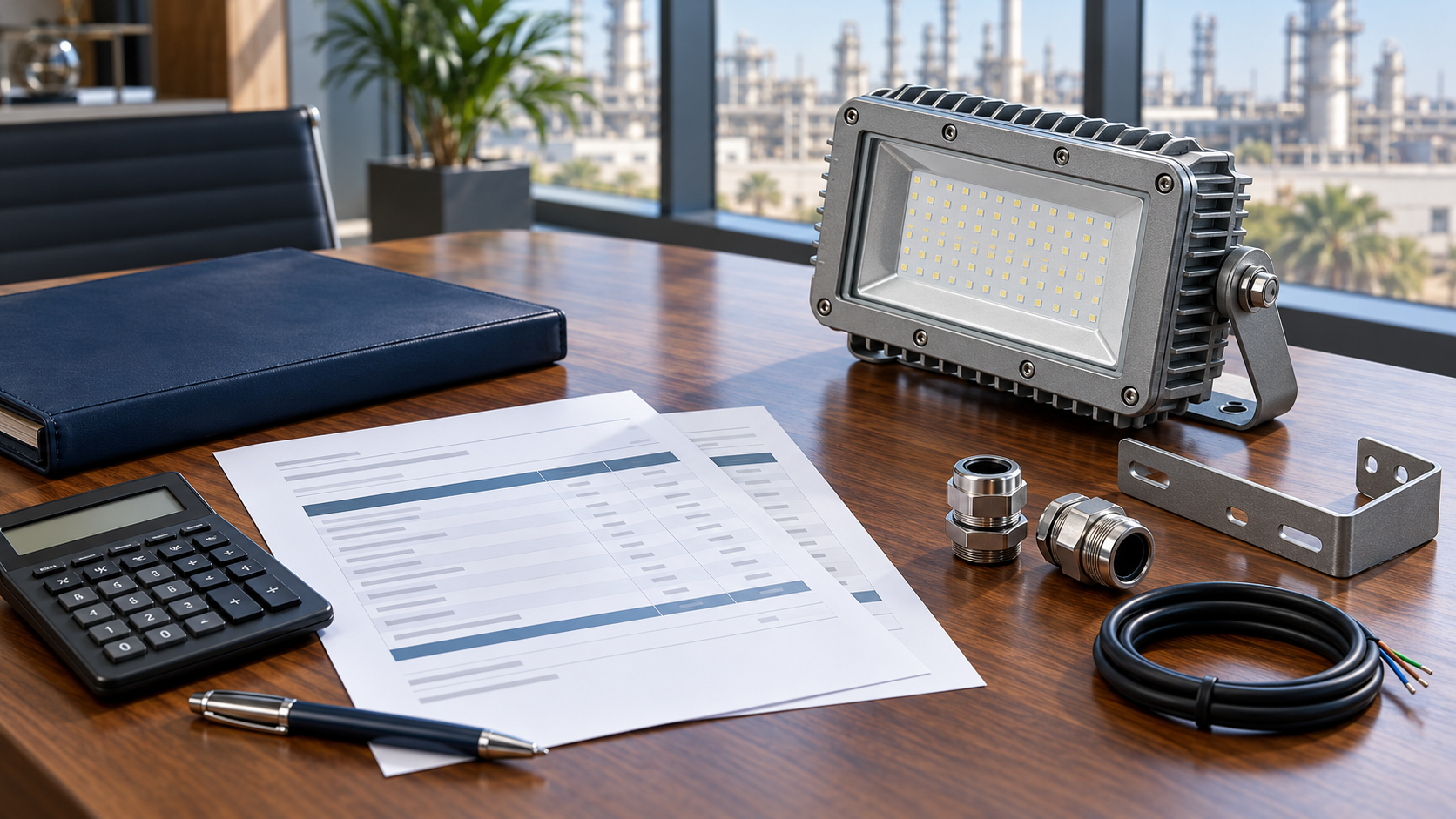
An explosion-proof lighting price is meaningful only when the quotation identifies the exact equipment and supply scope. Fixture type, electrical configuration, protection requirements, accessories, quantities and delivery terms can all affect the offer.
For contractors and procurement teams in Saudi Arabia, the useful comparison is between products that meet the same project requirements. A lower unit price may represent a different configuration or exclude items needed for installation.
This guide explains what to specify, how to compare offers and what to send when requesting a quotation.
“Explosion-proof lighting” covers different products and configurations.
A fixed high bay, a floodlight and a portable hand lamp perform different lighting tasks. Even within one product family, power rating, voltage, mounting arrangement and optional equipment can change the supplied configuration.
Before comparing prices, define what the project needs. Our Explosion-Proof Lighting Guide explains the main fixture types and selection considerations.
| Quotation factor | What buyers should define |
|---|---|
| Fixture format | Floodlight, high bay, linear light or hand lamp |
| Lighting performance | Required output, distribution and mounting height |
| Hazardous-area requirements | Classification, protection level and relevant gas or dust group |
| Electrical configuration | Input voltage, driver and control requirements |
| Environmental conditions | Temperature, moisture and corrosion exposure |
| Mounting and connections | Brackets, supports, cable entries and connection components |
| Optional equipment | Dimming or emergency operation, where available |
| Quantity and schedule | Number of units, delivery location and required date |
| Documentation and testing | Required submissions, inspections and project-specific deliverables |
Ask suppliers to identify the configuration behind each price rather than supplying only a product-family name.
Compare equipment intended for the same lighting task.
For example, Alrouf lists:
These formats should not be treated as interchangeable because they have similar wattages.
For fixed lighting, compare the proposed layout and photometric performance. For hand lamps, include handling, suspension, supply voltage and cable length in the assessment.
If your requirement is portable inspection lighting, read our hand lamp selection guide.
No. Wattage identifies electrical power consumption; it does not establish whether the installation delivers the required lighting performance.
Ask suppliers to identify the proposed model’s light output and distribution. Where a lighting calculation is required, compare the resulting coverage, uniformity and fixture quantity.
A lower-priced unit may require a different quantity or layout to meet the same design requirement. Evaluate the proposed installation alongside the unit price.
State the required conformity documents and hazardous-area characteristics in the enquiry.
Ask each supplier to confirm which documents cover the exact model offered, including relevant options and operating limits. Identify missing evidence before comparing the commercial offers.
Do not assume that two products described as “ATEX lighting” or “IECEx lighting” have identical scope or installation conditions.
Read our ATEX vs IECEx lighting certification guide for a document-review checklist.
Request a written accessory schedule.
Depending on the selected product and installation, clarify whether the offer includes:
Review Alrouf’s hazardous-area lighting accessories when preparing the enquiry, then confirm compatibility and included quantities.
An accessory shown in a catalogue photograph should not automatically be treated as part of the quoted package.
Ask suppliers to identify optional equipment separately.
For emergency configurations, request the available emergency output, duration, temperature limits and supporting documentation.
For dimmable configurations, specify the required control method and confirm compatibility.
This makes it easier to distinguish the base luminaire price from the cost and scope of the requested options.
Use one comparison sheet with the same requirements for every supplier.
| Comparison item | What to record |
|---|---|
| Product identity | Manufacturer, model and complete ordering code |
| Technical response | Compliance, alternatives and deviations |
| Documentation | Documents provided and outstanding |
| Quantity | Number of fixtures and accessories |
| Unit price | Price for the stated configuration |
| Included scope | Accessories, testing and other agreed deliverables |
| Exclusions | Required items outside the quotation |
| Delivery | Location, lead time and starting milestone |
| Commercial terms | Currency, payment terms, validity and tax treatment |
| Warranty | Coverage, duration and exclusions |
Resolve mandatory technical gaps before selecting an offer on price.
Unit price covers the quoted item. Total project cost may also include required accessories, transport, installation, access equipment and other project activities.
For a useful comparison:
For replacement work, also identify shutdown, access and disposal requirements where relevant.
Provide:
A defined enquiry reduces assumptions and helps suppliers prepare comparable offers.
Request a quotation for the required model and supply scope. A generic price without configuration details is not a reliable basis for project budgeting.
Evaluate technical suitability, included scope, delivery and support alongside price. Resolve required exclusions and missing documents before selecting a supplier.
Yes. Send the project requirements and ask the supplier to propose a configuration, with assumptions and deviations clearly identified.
No. Confirm the accessory schedule and quantities in writing.
Yes. Separating optional items helps buyers understand the base scope and compare equivalent configurations.
Explore Alrouf’s hazardous-area lighting range and prepare your specification, quantities and delivery requirements.
Contact Alrouf to confirm the available configuration, supporting documents and commercial scope for your project.
