
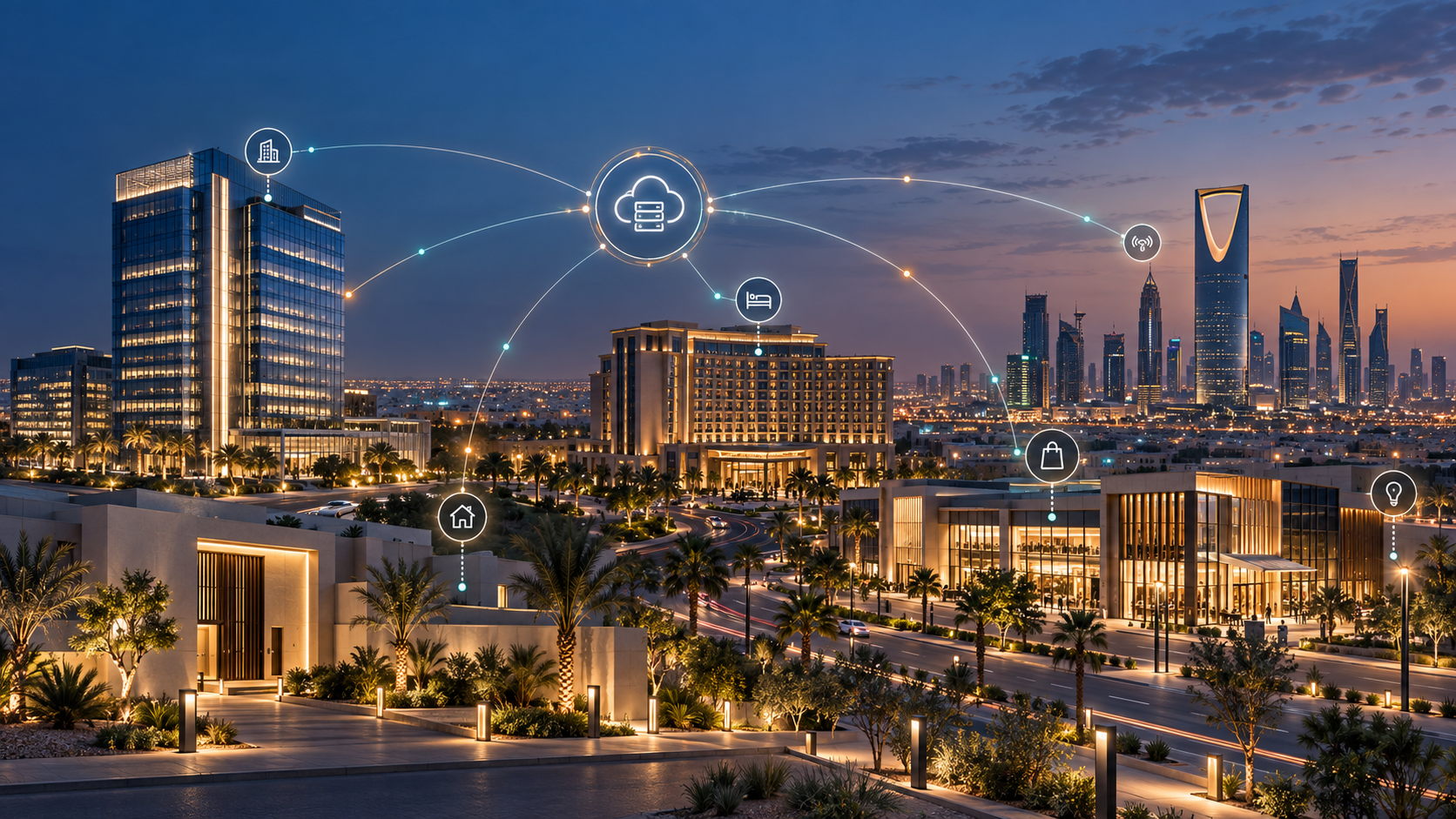
The Saudi Arabia smart lighting market is developing around a broader shift from manually operated lighting toward connected systems that can be automated, monitored and managed according to how buildings are used. Demand is emerging across commercial buildings, hotels, retail stores, homes, public facilities and smart-building projects.
Rather than simply replacing conventional luminaires with connected lamps, smart lighting projects combine LED fixtures, controllers, sensors, switches, communication protocols and management software. The result can be a more flexible lighting environment that responds to occupancy, daylight, schedules and operational requirements.
Saudi Arabia’s wider focus on digital transformation, sustainability and efficient resource management provides an important context for this development. However, the market should not be measured by unverified forecasts alone. For project owners, the more useful questions are which technologies are available, where they create value and how to select a system that can operate reliably over time.
The Saudi smart lighting market includes the products, platforms and services used to automate and manage lighting in residential, commercial and public environments.
It covers more than smart bulbs. A complete market ecosystem may include:
The market also includes design, installation, programming, commissioning, maintenance and system-integration services.
This distinction matters because a connected lamp designed for a small home does not address the same requirements as a hotel, shopping centre or multi-storey office building. Each project needs an appropriate control architecture based on its size, operating model and existing infrastructure.
Several practical factors are encouraging interest in lighting automation and intelligent control.
Saudi organisations are paying greater attention to how energy is measured, managed and improved. The Saudi Energy Efficiency Center’s Energy Management Program promotes structured energy management across different sectors, including continuous monitoring and the integration of energy management into organisational systems.
Smart lighting can contribute to this objective by reducing unnecessary operating hours through occupancy sensing, daylight response, dimming and scheduling. Actual savings depend on the building, operating hours, system design and user behaviour, so each project should be assessed individually.
Modern developments increasingly require lighting to operate as part of a wider building system rather than as an isolated electrical service.
Lighting controls may exchange information with HVAC, room-management, security or Building Management Systems. This allows building operators to coordinate services according to occupancy, schedules and operational conditions.
This direction is consistent with the broader digital-transformation and sustainability objectives presented through Saudi Vision 2030.
Not all demand comes from new construction. Hotels, offices, shops and villas may need to modernise their lighting without carrying out extensive control-cable installation.
Wireless and hybrid systems can offer practical retrofit options, subject to the building layout, communication range and existing electrical infrastructure.
Traditional lighting gives facility teams limited information about when different areas operate. Connected systems can provide central monitoring, device status and energy information where supported.
This visibility can help teams identify unnecessary usage, adjust schedules and manage multiple zones or properties more consistently.
Hotel guests, office users, retailers and homeowners increasingly expect personalised and convenient environments. Lighting scenes, mobile control, automatic adjustment and integration with other services can support that experience when they are designed around a real operational need.
Offices can use occupancy and daylight sensors to manage workstations, meeting rooms, reception areas, corridors and shared spaces.
A commercial system may divide the building into zones, apply different schedules and provide central control across several floors. Lighting scenes can support meetings, presentations, focused work, cleaning and after-hours operation.
Explore Al Rouf’s smart office solutions for workplace applications.
Hotels require lighting strategies that balance guest comfort with operational control. Guest rooms may include welcome, reading, relaxation, sleeping and housekeeping scenes.
Common areas such as corridors, reception spaces and restaurants may be managed through schedules, occupancy data and central control. Compatible systems may also integrate with hotel or building-management platforms.
Learn more about smart hotel technology.
Retail lighting influences visibility, navigation, atmosphere and operating costs. A smart system can apply different settings to entrances, fresh-food displays, aisles, checkout zones, storage rooms and staff areas.
Multi-branch operators may also use central scheduling and monitoring to maintain more consistent lighting operation across locations.
See Al Rouf’s smart supermarket lighting system.
Residential systems may support entrance scenes, bedroom and living-room settings, kitchen task lighting, landscape lighting and away modes.
The appropriate platform depends on the number of zones, required automation, preferred interface and whether the project needs integration with other home systems.
Explore smart home lighting solutions.
Hospitals, educational facilities, government buildings and mixed-use developments may require multiple control zones, central monitoring and integration with broader building services.
These projects generally need more structured system design than small standalone installations.
Connected outdoor-lighting applications may combine controllers, gateways, monitoring platforms and adaptive dimming. The required communication architecture differs from indoor building control and must be selected according to coverage, infrastructure and operational requirements.
The market includes several technologies because no single protocol is suitable for every project.
Wireless kinetic switches generate the energy required to transmit a command when the switch is pressed. This removes the need for a battery inside the switch and can reduce maintenance associated with battery replacement.
They can be useful where flexible switch placement or reduced control wiring is important, subject to product compatibility and site conditions.
Radio-frequency controls can connect switches, receivers, dimmers and controllers without dedicated control cabling. The correct frequency and system configuration must be selected for the project and applicable local requirements.
Zigbee can connect compatible switches, sensors, lights and gateways through a wireless network. It is commonly associated with connected-device ecosystems and can support scalable control when products are selected and configured correctly.
Bluetooth-based and mesh-network platforms can allow devices to communicate across a distributed lighting network. Their suitability depends on network design, project scale, device support and management requirements.
These platforms may support connected residential and selected commercial applications, including app-based control and integration with compatible devices.
They should be specified according to the project’s security, reliability, local-control and integration requirements rather than chosen only for mobile-app convenience.
DALI is a dedicated digital lighting-control protocol that supports addressing, grouping, configuration and two-way communication with compatible devices. According to the DALI Alliance, DALI is standardised through IEC 62386 and is designed for flexible, scalable lighting networks.
It is frequently considered for commercial projects that need structured luminaire-level or group control.
KNX is an open standard for smart homes and buildings that can connect lighting with HVAC, shading, energy management, security and other functions. The KNX Association positions the technology as a scalable, multi-manufacturer building-automation ecosystem.
Some outdoor or large-scale applications may use technologies such as LoRaWAN, NB-IoT, Wi-SUN or power-line communication. These are not interchangeable with indoor lighting protocols, and their use depends on coverage, data requirements, infrastructure and system architecture.
Choosing between wired, wireless and hybrid control is one of the most important project decisions.
| Approach | Typical strengths | Suitable context |
|---|---|---|
| Wired | Structured communication and planned integration | New commercial buildings and major renovations |
| Wireless | Flexible installation and reduced control cabling | Existing buildings and selected retrofit projects |
| Hybrid | Combines structured infrastructure with flexible devices | Complex projects with mixed requirements |
A wireless system is not automatically better because it is easier to install, and a wired system is not automatically better because it uses cables. The correct choice depends on reliability requirements, building layout, communication range, integration needs, maintenance capacity and future expansion.
Project teams should evaluate the following areas before selecting products:
A villa, hotel, office and supermarket have different users, schedules and control priorities. The system must reflect how the building actually operates.
Poor zoning can limit the value of automation. Rooms, departments, floors and operating areas should be divided according to their independent lighting needs.
Retrofit projects require a careful review of electrical circuits, available control wiring, panel capacity, network coverage and installation constraints.
The design should identify whether the lighting must integrate with a BMS, HVAC, hotel-management system, security platform or energy-management system.
The system should support future devices, zones or buildings without requiring a complete replacement.
Projects should consider commissioning, documentation, maintenance, spare parts, technical support and training—not only the initial hardware cost.
Designers and contractors should confirm the applicable requirements of the Saudi Building Code, project specifications and relevant electrical and lighting standards.
Smart lighting projects can underperform when technology is selected before requirements are defined.
Common challenges include:
A strong project should define the expected behaviours before products are selected: what activates the lights, what dims them, who can override the system, what happens during a network failure and how the system will be maintained.
One of the clearest opportunities is the modernisation of existing buildings. Hotels, offices, retailers and residential properties may want greater control without extensive disruption.
Wireless kinetic switches, RF controls, wireless sensors and hybrid architectures may help address that need. However, retrofit suitability should be confirmed through a project assessment.
Another opportunity is multi-site management. Retailers, hospitality groups and organisations with several facilities may benefit from consistent schedules, central visibility and standardised control strategies.
Energy-performance monitoring also creates an opportunity to move lighting decisions from assumption to evidence. When a compatible system records operating data, facility teams can review performance and refine schedules over time.
Al Rouf provides smart lighting solutions in Saudi Arabia for residential, hospitality, office, retail, commercial and smart-building applications.
Its lighting-control portfolio includes:
The appropriate system is selected according to the project type, floor plans, number of luminaires and zones, required sensors, existing infrastructure and integration requirements.
For a general explanation of how the technology operates, read the smart lighting system guide.
Demand is being influenced by smart-building development, energy-management priorities, building modernisation, digital operations and the need for more flexible control across commercial, hospitality, retail, residential and public projects.
Applications include offices, hotels, retail stores, supermarkets, villas, apartment buildings, hospitals, educational facilities, government buildings, mixed-use developments and selected outdoor infrastructure.
It can be suitable when additional control cabling would be difficult or disruptive. Site layout, communication range, device compatibility and reliability requirements must be assessed before specifying a wireless system.
DALI is dedicated primarily to digital lighting control. KNX is a wider home and building-automation standard that can connect lighting with HVAC, shading, security and other services. Some projects use both as part of an integrated architecture.
No. Smart lighting may use RF, Zigbee, Bluetooth-based mesh networks, DALI, KNX or other communication methods. Internet access may be required for certain remote or cloud functions, but many control functions can operate locally.
Start with the building type, operational requirements, control zones and integration needs. Then evaluate wired, wireless or hybrid options, confirm compatibility and plan commissioning, documentation, maintenance and future expansion.
Occupancy sensing, daylight response, scheduling and dimming can reduce unnecessary lighting operation. The actual result depends on the building, hours of use, system design, programming and user behaviour.
The Saudi Arabia smart lighting market is best understood as a shift toward connected, measurable and adaptable lighting rather than simply a market for smart lamps.
Opportunities exist across new developments and existing buildings, but successful implementation depends on selecting the right architecture, defining operational requirements and coordinating lighting with wider building systems.
By combining appropriate luminaires, sensors, controllers, communication technologies and commissioning, project teams can create lighting environments that are easier to manage, more responsive to users and better aligned with long-term energy-management goals.
To discuss a residential, hospitality, retail or commercial project, explore Al Rouf’s smart lighting solutions in Saudi Arabia and share your project requirements with the Al Rouf team.