
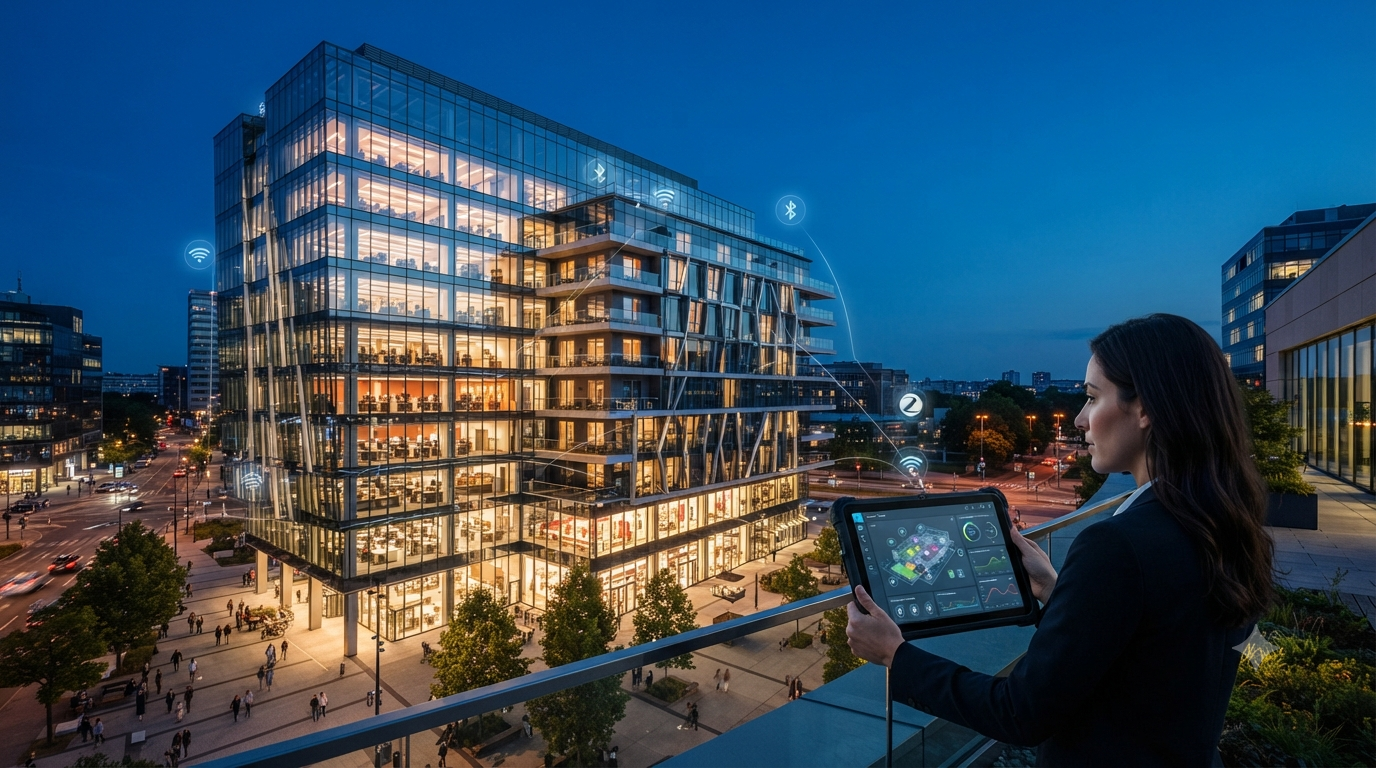
A smart lighting system is a connected solution that allows users to automate, monitor and control lighting through sensors, controllers, smart switches, mobile applications or a central management platform. Unlike conventional lighting, it can adjust brightness, operating schedules and lighting scenes according to occupancy, daylight levels and user requirements.
Smart lighting systems are used in homes, offices, hotels, retail stores and commercial buildings to improve comfort, simplify lighting management and reduce unnecessary energy consumption. Al Rouf provides flexible and scalable smart lighting solutions for residential and commercial projects across Saudi Arabia.
A smart lighting system connects LED luminaires with intelligent controllers, sensors and communication technologies. These components exchange information and adjust the lighting according to programmed rules, sensor readings or user commands.
For example, the system can:
A typical smart lighting system may include:
Advanced systems may also integrate with HVAC, security and Building Management Systems to support wider building automation.
Smart lights can be controlled using smart wall switches, mobile applications, motion sensors, schedules, lighting scenes, centralized control panels, or compatible voice-control platforms. The available methods depend on the lighting system, communication technology, and compatibility between the fixtures, controllers, sensors, and applications.
Common ways to control smart lights include:
A reliable smart lighting system should retain convenient wall-switch control so that users can operate their lights without depending entirely on a mobile phone or internet connection.
Before choosing a control method, confirm that the lighting fixtures, LED drivers, dimmers, sensors, gateways, switches, and applications are compatible.
Explore Al Rouf’s Smart Lighting Solutions for residential and commercial lighting control applications.
Traditional lighting generally depends on manual wall switches and fixed electrical circuits. Users must switch lights on, turn them off or adjust them manually.
A smart lighting system introduces automation and centralised control. It can respond to occupancy, available daylight, operating schedules and building requirements without depending entirely on manual intervention.
| Traditional lighting | Smart lighting system |
|---|---|
| Mainly controlled manually | Supports manual, automated and remote control |
| Uses fixed operating patterns | Supports programmable schedules and scenes |
| Provides limited visibility into usage | May provide central monitoring and reporting |
| Lights may remain on unnecessarily | Sensors can reduce unnecessary operation |
| Changes may require rewiring | Some wireless systems allow more flexible upgrades |
| Usually operates independently | Can integrate with other building systems |
The right option depends on the building, project objectives, existing infrastructure and required level of control.
Occupancy sensing, daylight harvesting, dimming and scheduling can reduce lighting operation when full output is unnecessary.
Actual savings depend on the building type, operating hours, system design and user behaviour. A project assessment should therefore be completed before estimating potential energy savings.
Users can adjust brightness, colour temperature and lighting scenes according to the activity or time of day. This can improve comfort in homes, hotel rooms, workplaces and hospitality spaces.
A single interface can control multiple rooms, floors or buildings. This is particularly valuable for commercial properties, hotels and multi-branch retail operations.
Preset scenes can support meetings, presentations, cleaning, trading hours, guest arrival and evening operation. They can be activated automatically or with a single command.
Daylight sensors can reduce artificial lighting output when natural light is sufficient, helping maintain the required illumination level without unnecessary consumption.
Depending on the selected technology, additional devices, sensors or control zones can be introduced as the building’s requirements change.
Commercial systems can integrate with Building Management Systems and other building services to coordinate lighting with occupancy, HVAC, security and operating schedules.
Smart lighting can support residential, hospitality, retail, office and commercial projects. However, each type of space requires a different control strategy.
Smart home lighting solutions allow residents to create personalised scenes, schedule lighting, control outdoor areas and manage lights remotely.
Common applications include:
Smart office solutions can use occupancy and daylight data to control meeting rooms, workstations, corridors and shared spaces.
The objective is to provide suitable lighting while reducing unnecessary operation in vacant or naturally illuminated areas.
Smart hotel technology can provide welcome, reading, relaxation, sleeping and housekeeping scenes within guest rooms.
Lighting controls may also work with room occupancy status and hotel-management systems to improve the guest experience and simplify operations.
A smart supermarket lighting system can apply different schedules and control strategies across entrances, fresh-food displays, aisles, checkout areas and back-of-house spaces.
Multi-branch retailers can also manage lighting schedules and settings more consistently through centralised control.
Commercial smart lighting systems can manage large numbers of luminaires across offices, hospitals, educational facilities, government buildings and mixed-use developments.
These projects may require:
No. A smart lighting system does not necessarily require Wi-Fi.
Depending on the application, lighting controls may use technologies and protocols such as:
Wi-Fi may be suitable for certain residential or small-scale applications. Larger commercial projects often require protocols that provide structured control, suitable reliability and greater scalability.
The appropriate technology depends on:
A wired lighting-control system uses dedicated cables to connect luminaires, sensors and controllers. It can provide stable communication and is often considered during the design of new commercial buildings.
A wireless system allows devices to communicate without dedicated control cabling. This may make it suitable for existing buildings where extensive rewiring would be expensive or disruptive.
Some projects use a hybrid design that combines wired infrastructure with wireless devices. The selection should be based on the site conditions and technical requirements rather than assuming that one method is always better.
Choosing a smart lighting system should begin with the building’s operational requirements—not with a particular device or mobile application.
A villa, hotel, office and supermarket each require different control strategies. Identify how each space is used, how many people occupy it and when lighting is required.
New buildings may accommodate dedicated control wiring during construction. Existing properties may benefit from wireless or hybrid solutions that reduce installation disruption.
Determine which rooms, floors or departments must operate independently. Proper zoning improves control and prevents entire areas from being illuminated unnecessarily.
Decide whether the project needs:
Commercial projects may need lighting to integrate with a BMS, HVAC, security platform or other building services. Compatibility should be confirmed before the system design is approved.
The selected system should support future luminaires, sensors, zones or buildings without requiring complete replacement.
Professional design, installation, programming, testing, commissioning and user training are essential for reliable long-term performance.
Saudi projects have diverse lighting requirements across villas, hotels, offices, retail stores, industrial facilities and public buildings.
In existing properties, wireless lighting control can support modernisation while limiting major changes to the electrical infrastructure. In new developments, wired or hybrid systems can be coordinated with the wider building-automation strategy from the design stage.
The system should be selected according to the project’s operational requirements, space distribution, integration needs and long-term maintenance and expansion plans.
Al Rouf provides smart lighting and intelligent control solutions for residential, hospitality, retail, office and commercial applications across Saudi Arabia.
The available portfolio includes:
Al Rouf can support projects from system selection and design through installation, programming, commissioning and after-sales assistance.
Explore Al Rouf’s smart lighting solutions in Saudi Arabia to identify a system suited to your project’s technical and operational requirements.
A smart lighting system connects luminaires with sensors, controllers and management software. It allows lighting to be automated, scheduled, dimmed and controlled remotely or through a central platform.
The system receives information from sensors, schedules or user commands and sends instructions to connected lighting devices. It can then switch, dim or adjust the lights according to programmed settings.
Lighting control is the broader method of managing luminaires through switches, dimmers, sensors and controllers. Smart lighting adds connectivity, automation, monitoring and integration capabilities.
Yes. Many systems can continue operating through local controllers, sensors, switches or dedicated networks without a permanent internet connection. Internet access may only be required for remote access or certain cloud-based features.
Yes. Compatible commercial smart lighting systems can integrate with a Building Management System. The exact integration depends on the lighting protocol, BMS platform and project design.
Yes. Wired, wireless or hybrid solutions can be used depending on the existing infrastructure. Wireless controls may reduce the need for additional control cabling in retrofit projects.
There is no single protocol that is best for every project. The selection depends on the building size, required functions, existing infrastructure, integration requirements and future expansion plans.
A smart lighting system combines LED luminaires, sensors, controllers and communication technologies to provide automated and centralised lighting management. It can improve occupant comfort, reduce unnecessary energy use and simplify operations across homes, offices, hotels, retail stores and commercial buildings.
Successful implementation depends on selecting the appropriate control method, communication protocol and integration strategy for the building. Al Rouf provides scalable smart lighting solutions in Saudi Arabia designed around each project’s technical and operational requirements.