
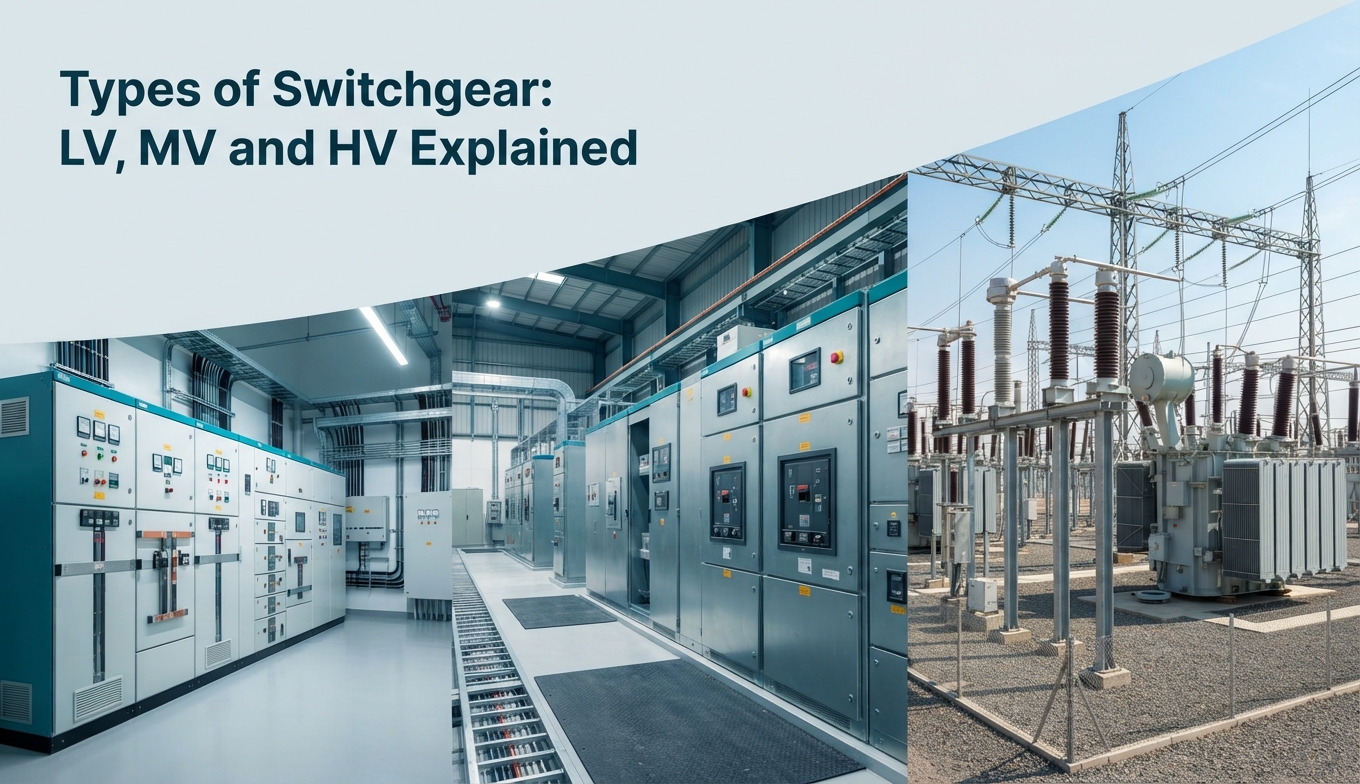
Switchgear is classified into low-voltage, medium-voltage and high-voltage types according to the voltage level at which it operates. LV switchgear is mainly used for final power distribution, MV switchgear supports industrial and primary distribution systems, and HV switchgear controls electricity within transmission networks and major substations.
Understanding these differences helps electrical engineers, consultants and project managers select equipment that provides the required protection, reliability and operational safety.
Switchgear is a combination of electrical switching, protection, control and isolation devices. It controls the flow of electricity and disconnects faulty circuits before electrical failures can damage equipment or place people at risk.
A switchgear assembly can contain:
Switchgear performs three essential functions: controlling electrical circuits, protecting equipment against faults and isolating sections of the power system for safe maintenance.
The three main types of switchgear are:
They perform similar protection and control functions, but their construction, insulation, switching technology, safety requirements and applications differ significantly.
Voltage classifications are not completely universal. They may vary according to the country, utility, manufacturer and applicable standard. In common industry usage, however, the following ranges provide a practical distinction:
IEC 61439-2 covers low-voltage power switchgear and controlgear assemblies with rated voltages not exceeding 1,000 V AC or 1,500 V DC. IEC 62271-1 applies to AC switchgear and controlgear rated above 1,000 V.
Low-voltage switchgear controls and distributes electricity in systems operating at no more than 1,000 V AC. It is commonly installed downstream from a distribution transformer and supplies power to lighting, HVAC systems, motors, machinery and other electrical loads.
LV switchgear is normally found near the final stages of electrical power distribution.
Common LV switchgear components include:
Air circuit breakers are frequently used as incomers or main breakers, while moulded-case and miniature circuit breakers protect outgoing circuits according to their rated current and fault level.
LV switchgear is widely used in:
LV switchgear may be configured as a main distribution board, sub-main distribution board, distribution board or motor control centre.
Correctly designed LV switchgear provides:
The equipment must be selected according to both its normal operating current and the prospective short-circuit current at the installation point.
Medium-voltage switchgear controls and protects power systems operating above 1 kV and commonly up to approximately 36 kV. Some industry classifications extend the MV category to 52 kV.
MV switchgear forms an important link between utility distribution networks, transformers and large electrical loads. It is commonly used when the power requirements of a facility are too high for direct low-voltage distribution.
A typical MV switchgear assembly may contain:
Vacuum circuit breakers are widely used in MV applications because they can interrupt electrical arcs efficiently and generally require less maintenance than some older interruption technologies.
Medium-voltage switchgear is commonly installed in:
In these applications, MV switchgear can protect transformers, motors, generators, capacitor banks, cables and other important equipment.
MV switchgear can be classified according to its insulation and construction.
Air-insulated switchgear, or AIS, uses air as its primary insulation medium. It generally requires more installation space but offers relatively straightforward access for inspection and maintenance.
Gas-insulated switchgear, or GIS, places energised components inside sealed, gas-insulated compartments. It provides a compact footprint and is useful where installation space is restricted or environmental conditions are challenging.
Solid-insulated switchgear uses solid dielectric materials around energised components. Its enclosed design can provide a compact alternative for certain distribution applications.
A ring main unit is a compact form of MV switchgear used in ring distribution networks. RMUs are often installed in commercial developments, industrial facilities and utility distribution systems.
High-voltage switchgear controls, protects and isolates electrical equipment within transmission networks and major substations. In common industry usage, HV switchgear generally refers to equipment operating above approximately 36 kV, although the exact boundary depends on the standard and market.
Electrical energy transmitted at high voltage produces greater insulation and fault-interruption requirements. HV switchgear therefore requires specialised construction, extensive electrical clearances and advanced protection systems.
HV switchgear installations may include:
Protection schemes must detect abnormal conditions and operate the correct circuit breaker quickly enough to limit equipment damage and maintain network stability.
HV switchgear is mainly used in:
Its primary role is to control major power flows and isolate faults within the transmission or high-voltage distribution network.
HV installations commonly use:
The appropriate configuration depends on the system voltage, installation space, environmental conditions, maintenance strategy, network design and applicable utility requirements.
The principal difference is operating voltage, but voltage affects almost every part of the equipment’s design.
LV switchgear is mainly responsible for distributing power to final loads. MV switchgear connects distribution networks with transformers and large industrial equipment. HV switchgear controls electricity at transmission and major substation levels.
As the operating voltage increases:
The right switchgear must therefore match both the voltage level and the operational requirements of the electrical system.
A circuit breaker is one component within a switchgear system. Its primary function is to interrupt current during normal switching or fault conditions.
Switchgear is the complete assembly. It can include circuit breakers, busbars, protection relays, isolators, metering devices, earthing switches and control equipment.
In simple terms, a circuit breaker performs the interruption, while switchgear provides the complete environment required to control, protect and isolate the electrical system.
Switchgear and switchboards both distribute and control electricity, but switchgear generally offers higher levels of fault protection, compartmentalisation and control.
Switchboards are commonly used in low-voltage power distribution. Switchgear may be used in LV, MV and HV systems where enhanced fault interruption, protection coordination and operational reliability are required.
The exact distinction can vary depending on local terminology and the equipment standard being applied.
Selecting switchgear requires a detailed assessment of the electrical network and its operating environment.
Important selection factors include:
A qualified electrical engineer should calculate the expected load and fault levels before the switchgear configuration is finalised.
Regular maintenance helps switchgear operate safely and interrupt faults when required. Poor maintenance can result in overheating, insulation deterioration, loose connections, mechanical failure or incorrect protection operation.
A switchgear maintenance programme may include:
Maintenance frequency should follow the manufacturer’s instructions, operating conditions, equipment history and applicable safety requirements.
LV, MV and HV switchgear serve different stages of the power system. LV switchgear distributes power to final loads, MV switchgear manages primary distribution and large facilities, and HV switchgear controls power within transmission networks and major substations.
Selecting the correct type requires more than identifying the voltage. Engineers must also evaluate fault levels, environmental conditions, protection coordination, safety, maintainability and future expansion.
A properly specified switchgear system improves electrical safety, protects valuable equipment and supports reliable power distribution throughout the life of the facility.
The three main types are low-voltage, medium-voltage and high-voltage switchgear. They are classified according to their operating voltage and position within the power distribution or transmission system.
LV switchgear is generally rated up to 1,000 V AC. IEC 61439-2 covers power switchgear and controlgear assemblies with rated voltages not exceeding 1,000 V AC or 1,500 V DC.
Medium voltage commonly refers to systems operating above 1 kV and up to approximately 36 kV. However, some manufacturers and applications extend this category to 52 kV.
Vacuum circuit breakers are widely used in MV switchgear because they provide effective arc interruption, operational reliability and relatively low maintenance requirements.
AIS uses air as its primary insulation medium and generally requires more space. GIS contains energised components inside sealed gas-insulated compartments, allowing a more compact installation.
No. Each switchgear assembly is designed for specific voltage, current, insulation and fault levels. Using equipment outside its rated conditions can create a serious safety and reliability risk.
IEC 61439 is an important standards series for low-voltage switchgear and controlgear assemblies. The IEC 62271 series covers AC switchgear and controlgear operating above 1,000 V. Additional product-specific, national and utility standards may also apply.
