
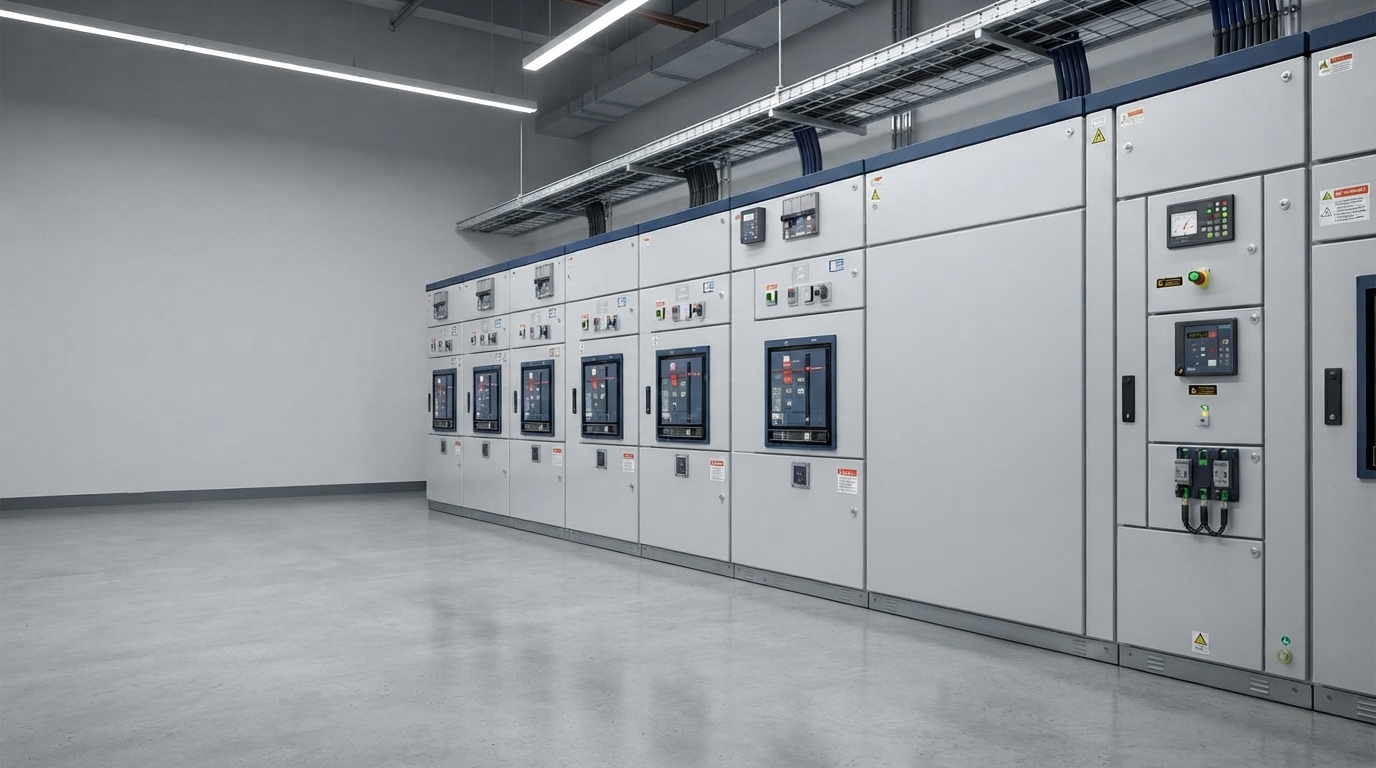
Saudi Arabia's electrical infrastructure continues to expand across industrial facilities, commercial buildings, substations, infrastructure projects, and major developments. As electrical systems become larger and more complex, reliable equipment for controlling and protecting electrical power becomes increasingly important.
One of the most important parts of an electrical power system is switchgear.
If you've ever wondered what is switchgear, how it works, what its main components are, or which type is suitable for your project, this guide explains everything you need to know.
Switchgear is a combination of electrical switching, protection, and isolation equipment used to control and protect electrical circuits and equipment.
It can include components such as circuit breakers, disconnect switches, fuses, protection relays, busbars, and earthing switches.
In simple terms, switchgear acts as the control and safety layer of an electrical power system.
Under normal operating conditions, switchgear allows electricity to flow through the system. When an abnormal condition such as a short circuit, overload, or earth fault occurs, the protection system detects the problem and interrupts the electrical circuit.
Switchgear also makes it possible to safely isolate part of an electrical network for inspection, maintenance, or repair.
The main switchgear function can be divided into three key areas: protection, control, and isolation.
Switchgear protects electrical systems from abnormal conditions such as:
When a fault occurs, the protection system can automatically interrupt the circuit before the fault causes significant damage to electrical equipment.
Switchgear allows operators to safely switch electrical circuits on and off.
This can be necessary during:
Switchgear allows a specific section of an electrical system to be physically isolated.
This is particularly important during maintenance because technicians need to ensure that the equipment they are working on is safely disconnected from energized parts of the network.
So, how does switchgear work?
Switchgear monitors the electrical conditions within a circuit.
During normal operation, current flows through the system. If a fault occurs, equipment such as current transformers (CTs), voltage transformers (VTs), and protection relays can detect abnormal electrical conditions.
The protection relay then sends a trip signal to the circuit breaker.
The circuit breaker opens the circuit and interrupts the flow of fault current.
The basic process can be summarized as:
Fault occurs → Fault detected → Protection relay operates → Trip signal sent → Circuit breaker opens → Fault isolated
This rapid response helps protect transformers, generators, motors, cables, and other electrical equipment from damage.
Modern switchgear systems can also incorporate digital protection relays and SCADA integration, allowing operators to monitor and control electrical equipment remotely.
A typical switchgear assembly can contain several important components.
Circuit breakers are one of the primary protective devices in switchgear.
Their main purpose is to interrupt electrical current when a fault is detected. They can also be operated to control circuits during normal system operation.
Busbars are conductive metal bars that distribute electrical power within the switchgear assembly.
They connect incoming electrical power to multiple outgoing circuits.
Isolators, also called disconnect switches, provide physical electrical isolation.
They are particularly important when equipment needs to be safely disconnected for maintenance.
Earthing or grounding switches help safely discharge residual electrical energy and connect an isolated section of the electrical system to earth before maintenance.
Protection relays are responsible for detecting abnormal electrical conditions.
They monitor electrical parameters and can initiate a trip command when a fault meets predefined protection settings.
Current transformers and voltage transformers allow high electrical currents and voltages to be measured safely by protection systems, meters, and monitoring equipment.
The enclosure protects the internal electrical components and provides the required level of insulation and environmental protection.
The type of enclosure and insulation depends on the switchgear design and application.
There are several ways to classify the types of switchgear.
The most common classifications are based on:
Understanding these classifications helps engineers and project teams select equipment according to the electrical system and installation requirements.
Low-voltage switchgear (LV switchgear) generally operates at voltages up to 1kV.
It is commonly used in:
LV switchgear is typically used closer to the end-use electrical loads than medium- or high-voltage switchgear.
Medium-voltage switchgear (MV switchgear) typically operates between approximately 1kV and 36kV.
It is widely used in:
In Saudi Arabia, commonly specified medium-voltage classes include 11kV, 13.8kV, and 33kV. The Saudi SEO research also identifies MV switchgear and these voltage levels as relevant search topics for the local market.
High-voltage switchgear operates above approximately 36kV.
It is generally used in:
High-voltage applications require equipment capable of safely handling high operating voltages and fault currents.
Air-insulated switchgear (AIS) uses air as the primary insulation medium.
AIS can be a practical solution where sufficient installation space is available.
Its characteristics include:
Gas-insulated switchgear (GIS) uses an insulating gas as the insulation medium.
One of the main advantages of GIS is its compact design.
This makes it particularly useful for installations where space is limited, including:
Gas insulated switchgear is also an important Saudi-market search term, with the SEO research showing 210 monthly searches in Saudi Arabia.
Metal-clad switchgear separates major electrical components into individual grounded metal compartments.
These compartments can contain:
This construction provides a high level of separation and operator protection and is commonly used in medium-voltage utility and industrial applications.
Metal-enclosed switchgear uses a common metal enclosure around the electrical equipment but does not necessarily provide the same internal compartmentalization as metal-clad switchgear.
It can be used for applications where the requirements do not require the same level of internal separation.
Arc-resistant switchgear is designed to provide additional protection for personnel in the event of an internal arc fault.
The construction incorporates reinforced enclosures and pressure-relief features intended to direct arc-fault energy away from operators.
This type of design can be particularly important in industrial environments where personnel safety is a major consideration.
The terms switchgear and switchboard are sometimes used interchangeably, but they generally describe different equipment and applications.
Switchgear is commonly associated with switching, protection, and isolation in medium- and high-voltage electrical systems.
A switchboard is more commonly associated with low-voltage power distribution within buildings.
In simple terms, switchgear focuses heavily on protection, switching, and isolation, while a switchboard is commonly used to distribute low-voltage electrical power to downstream circuits.
The exact terminology can vary depending on the applicable standards, manufacturer, and project specifications.
Saudi Arabia's electrical infrastructure includes a range of voltage levels for utility distribution, industrial facilities, substations, and other applications.
Some important voltage classes include:
11kV switchgear is a medium-voltage solution widely used in utility and industrial distribution applications.
It is one of the important MV switchgear voltage classes specified in the Saudi market.
13.8kV switchgear is commonly used in industrial applications and electrical distribution systems.
It is particularly relevant to industrial facilities in regions with significant processing and petrochemical activity.
33kV switchgear is used for larger distribution and sub-transmission applications, including industrial and utility substations.
Selecting the correct voltage class is an important part of the electrical design process. The equipment rating should match the project's electrical requirements and applicable standards.
Switchgear is used throughout electrical power systems and can be found in many types of facilities.
Common applications include:
In large industrial and infrastructure projects, switchgear helps maintain electrical system safety, reliability, and operational control.
Some industrial environments may contain flammable gases, vapors, or combustible dust. In these locations, electrical equipment may need specialized protection suitable for hazardous areas.
For example, Al Rouf Lighting Technology's ILS/JB/350 is an explosion-proof and weatherproof multiple switch-socket assembly designed for hazardous-area power distribution and interlocked switch-socket service. The catalog specifies Ex-d Gas Group IIC protection, IP66 protection, T6 temperature classification, and Zone 1 & 2 / Zone 21 & 22 applications.
The product includes a 63A / 4-pole MCCB incoming device, outgoing MCBs, interlocked plugs, DIN-rail terminals, earthing points, stainless-steel hardware, and wall or structure mounting.
This type of specialized equipment demonstrates why electrical switching and protection equipment must be selected according to both the electrical requirements and the installation environment.
For hazardous areas, engineers need to consider factors such as explosion protection, ingress protection, temperature classification, area classification, cable entries, and applicable standards.
Proper switchgear maintenance is essential because switchgear is a critical part of electrical protection and distribution systems.
A maintenance program may include several types of inspection and testing.
Visual inspections can identify:
Thermographic inspection can help identify abnormal heating at electrical connections before it develops into a more serious problem.
Insulation resistance testing helps determine whether insulation has deteriorated due to factors such as heat, moisture, contamination, or age.
Circuit breakers can be tested for operating time, contact resistance, and correct mechanical operation.
Protection relays should be tested to verify that they detect faults correctly and initiate the appropriate protection response.
For gas-insulated switchgear, gas pressure and quality should be monitored according to the manufacturer's requirements and applicable maintenance procedures.
The appropriate switchgear testing and maintenance schedule depends on the equipment, manufacturer recommendations, operating conditions, applicable standards, and site requirements. Saudi Arabia's high temperatures and, in some areas, humidity and airborne contaminants can make regular inspection particularly important.
Selecting switchgear should begin during the early stages of electrical system design.
Several factors should be considered.
Determine whether the project requires low-voltage, medium-voltage, or high-voltage switchgear.
The equipment must be appropriately rated for the prospective fault current at the installation point.
Consider whether air-insulated or gas-insulated switchgear is more appropriate based on space, application, and project requirements.
Consider whether metal-clad, metal-enclosed, or arc-resistant construction is required.
For projects in Saudi Arabia, environmental factors may include:
The selected switchgear should meet the applicable project specifications, electrical standards, and utility requirements.
Technical support, spare-parts availability, maintenance capabilities, and after-sales service can also influence the long-term reliability of an installation.
The Saudi SEO research specifically recommends considering voltage class, insulation type, construction, environmental factors, and manufacturer credentials when specifying switchgear for Saudi projects.
A properly designed switchgear system can provide several important benefits:
For industrial facilities and large infrastructure projects, these functions are essential for maintaining safe and reliable electrical operations.
Switchgear is used to control, protect, and isolate electrical circuits and equipment. It can switch circuits during normal operation and interrupt fault currents when abnormal conditions occur.
Switchgear monitors electrical conditions using equipment such as protection relays, current transformers, and voltage transformers. When a fault is detected, the protection system can send a trip signal to the circuit breaker, which opens the circuit and isolates the fault.
Switchgear can be classified by voltage level, insulation medium, and construction. Common types include low-voltage, medium-voltage, high-voltage, air-insulated, gas-insulated, metal-clad, metal-enclosed, and arc-resistant switchgear.
Switchgear is generally associated with switching, protection, and isolation, particularly in medium- and high-voltage systems. Switchboards are commonly used for low-voltage electrical power distribution within buildings.
Gas-insulated switchgear uses an insulating gas as the insulation medium. Its compact design makes GIS suitable for applications where installation space is limited.
Low-voltage switchgear operates at voltages up to approximately 1kV and is commonly used in commercial, residential, and light industrial electrical distribution.
Medium-voltage switchgear generally operates between approximately 1kV and 36kV. Common Saudi applications include 11kV, 13.8kV, and 33kV systems.
11kV switchgear is medium-voltage switching and protection equipment rated for an 11,000-volt electrical system. It is widely used in utility and industrial distribution applications.
Metal-clad switchgear separates major electrical components into grounded metal compartments, providing a high level of separation and operator protection.
The required maintenance frequency depends on the equipment, manufacturer recommendations, operating conditions, applicable standards, and site requirements. A maintenance program may include thermal inspection, insulation resistance testing, circuit-breaker testing, and protection-relay testing.
Switchgear is a critical part of modern electrical infrastructure.
From low-voltage switchgear used in buildings to medium-voltage switchgear used in industrial and utility distribution networks, different switchgear technologies serve different electrical and operational requirements.
Understanding the types of switchgear, components, voltage classes, insulation methods, applications, testing requirements, and environmental considerations is essential when selecting electrical equipment.
For projects in Saudi Arabia, engineers and project teams should consider the required voltage level, environmental conditions, applicable standards, certification requirements, and available technical support before selecting switchgear.
The right equipment can help create an electrical system that is safe, reliable, controllable, and easier to maintain.
Our technical team is available to assist with product selection
